- Understanding GST Council's 2026 Compliance Changes for Shop Billing
- How to Set Up GST-Ready Shop Billing with Automated Invoice Generation
- Worked Example: Calculating GST Liability for a Retail Shop with New 2026 Rules
- Step-by-Step Guide to Daily Invoice Management Within GST Limits
- Optimizing Stock Valuation and Billing Through Integrated Inventory Controls
- Streamlining Return Filing with Digital Record Management
- Final Compliance Checklist for Shop Owners Under GST Council's 2026 Rules
- Frequently Asked Questions
GST Council's 2026 compliance changes mean shop owners must use GST billing software to generate 10 invoices daily and 100 monthly, with new rules for invoice numbering and stock valuation that affect daily operations.
Understanding these changes helps retailers, wholesalers, and service providers set up automated billing systems that meet GST requirements while managing cash flow and inventory efficiently.
✅ Key Takeaways
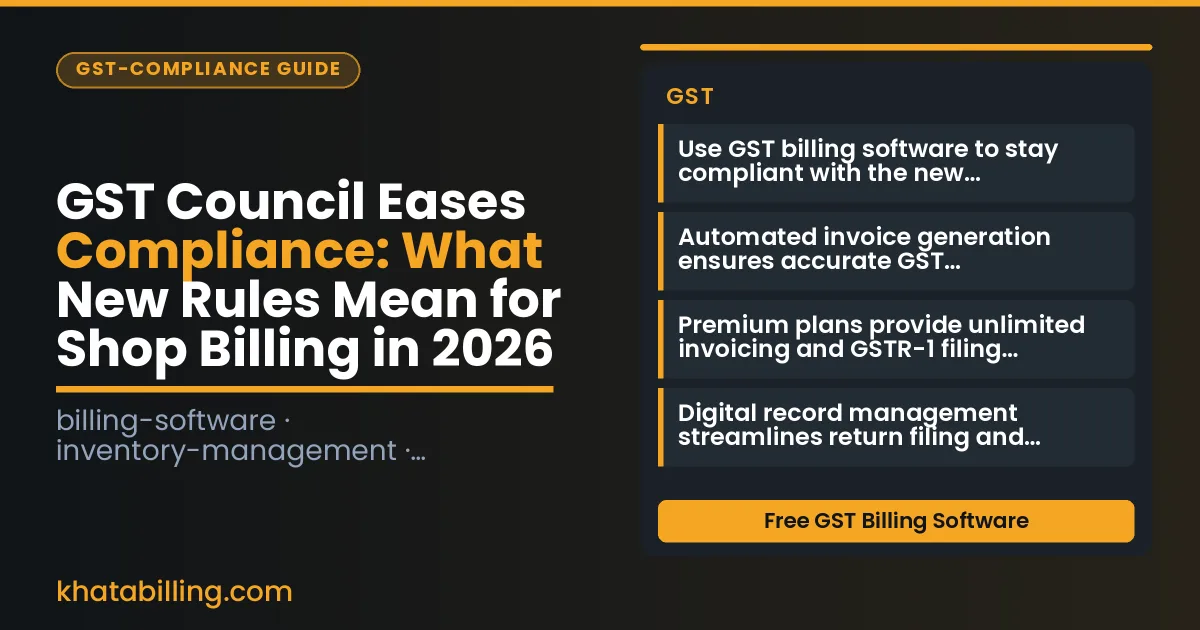
- Use GST billing software to stay compliant with the new 10-invoice-per-day limit
- Automated invoice generation ensures accurate GST calculations for CGST, SGST and IGST components
- Premium plans provide unlimited invoicing and GSTR-1 filing capabilities
- Digital record management streamlines return filing and reduces audit risks
- Integrated inventory controls help optimize stock valuation and billing accuracy
- Set up daily invoice limits in your software to avoid compliance breaches
- Review the compliance checklist to verify all GST Council requirements are met
Understanding GST Council's 2026 Compliance Changes for Shop Billing
Effective 1st April 2026, GST Council rules require shops to use GST billing software that meets updated invoice formatting standards and adjusts GSTR filing frequency for better compliance, directly impacting shop billing operations. The new rules mandate that all invoices must display a 14-digit GSTIN, HSN code, and SAC code for each item, with clear separation of CGST, SGST, or IGST amounts. Invoice numbering must be sequential without gaps, and digital signatures are now required for high-value transactions. GSTR-1 filing frequency will be reduced from monthly to quarterly for businesses with annual turnover under ₹5 crore, simplifying GSTR filing while still requiring monthly GSTR-2 and GSTR-3B submissions. Additionally, shops must reconcile inventory records with sales data weekly to avoid mismatches during audit. Khata Billing automatically updates invoice templates to meet these formatting requirements and supports quarterly GSTR-1 filing, while its Inventory & stock management feature syncs stock adjustments with sales in real-time. The platform ensures watermark-free invoices only with Premium, and unlimited invoicing is part of Premium, not the free plan which covers 10 invoices a day, up to 100 in any 30-day period. For shop owners, this means less manual correction time and smoother GST compliance during quarterly returns.
How to Set Up GST-Ready Shop Billing with Automated Invoice Generation
Configuring GST-ready shop billing begins with selecting the correct HSN or SAC code for each product, then setting up tax rate automation so GST is applied automatically. Start by logging into your GST billing software, navigate to the item master, and enter the HSN code from the official GST portal; this ensures the system applies the right tax rate. For example, a shop selling 5 kg of wheat (HSN 1001, 0% GST) and 2 kg of steel utensils (HSN 7323, 18% GST) will have the software calculate tax as 0 × (5 × 25) = ₹0 for wheat and 18% × (2 × 300) = ₹108 for utensils, giving an invoice total of ₹600 + ₹108 = ₹708. Next, enable barcode integration by linking your scanner to the software; the platform auto‑generates barcodes for each item, allowing daily invoice creation with a single scan. Khata Billing — free GST billing software supports this workflow by offering barcode‑based invoice creation and auto‑numbering, covering up to 10 invoices per day on the free plan and unlimited invoicing with Premium. Follow these steps to ensure every invoice is GST compliant, accurate, and ready for filing.
See more about Khata Billing — free GST billing software.
Worked Example: Calculating GST Liability for a Retail Shop with New 2026 Rules
- A retail shop sells 15 items at ₹200 each with 18% GST on Monday. The total invoice amount before tax is ₹3,000. GST liability is ₹540 (₹3,000 × 0.18).
- Using Khata Billing's free plan, the shop creates 10 invoices on Monday. The 11th invoice cannot be generated because the daily 10-invoice limit is reached, even though the 30-day total is still under 100.
- To stay compliant, the shop splits the 11th sale into two invoices of ₹1,500 each. Each new invoice incurs ₹270 GST (₹1,500 × 0.18), totaling ₹540 for the two invoices, which matches the original single invoice liability.
- Input tax credit applies if the shop has a valid GST invoice from a supplier for ₹1,500 with 18% GST (₹270 credit). The shop can claim this ₹270 credit against the ₹540 GST liability, reducing cash payment to ₹270.
- With Khata Billing's Premium plan, unlimited invoicing removes the daily cap, allowing the shop to issue all 15 invoices in one go without splitting, saving time and ensuring accurate invoice numbering.
- Visit the Khata Billing blog for step-by-step guides on GST calculations and inventory sync that prevent billing errors in real shop scenarios.
Step-by-Step Guide to Daily Invoice Management Within GST Limits
To stay compliant with the 10-invoice daily and 100-invoice monthly GST billing limit, follow this workflow: First, open your GST billing software and navigate to the daily invoice counter in the dashboard. Enable automatic alerts that notify you when you reach 8 invoices (80% of the daily limit) and when you hit 90 of the 100 monthly invoices. Next, use the POS billing system integrated with Khata Billing to capture sales at the shop counter, where each transaction automatically generates a GST invoice. The system logs the invoice count in real time and prevents new invoices beyond the limit, showing a clear message if you exceed 10 per day. You can also view a summary report that breaks down invoices by day and by 30-day rolling window, allowing you to adjust your sales pace before a violation occurs. Finally, review the monthly report on the 1st of each month to confirm you are under 100 invoices; if you approach the limit, consider bundling smaller transactions or using the Premium plan for unlimited invoicing at ₹999/year with code SAVE500. This disciplined approach keeps your shop billing compliant and avoids penalties.
See more about POS billing system.
Optimizing Stock Valuation and Billing Through Integrated Inventory Controls
Integrating stock adjustment with billing in GST billing software transforms compliance by linking inventory movement to tax liability in real time. When a shopkeeper issues an invoice for 10 units at ₹500 each, the software automatically deducts 10 units from stock and calculates CGST (2.5%) and SGST (2.5%) on the ₹5,000 turnover, ensuring the correct tax liability reflects actual sales. This prevents under-reporting that could trigger penalties during GSTR-1 filing, as manual registers often miss returned or damaged items that affect stock counts. Real-time updates mean inventory data and GST records stay synchronized without end-of-day reconciliation, eliminating mismatches between physical stock and taxable value. For example, if 5 units are returned to supplier, billing software immediately adjusts stock and reduces taxable amount, avoiding manual errors that previously required tax adjustments in GSTR-3B. Manual register methods risk double-counting or omitting transactions, creating audit exposure when tax authorities compare stock registers with GSTR-1 filings. Khata Billing's automatic stock counting eliminates this by updating inventory at point of billing, so every invoice directly impacts compliance metrics like stock valuation and input tax credit eligibility. This integration supports accurate stock-based GST calculations while simplifying daily operations for MSME traders, who no longer need separate stock sheets and tax entries. The result is fewer discrepancies, smoother audits, and reliable compliance with GST law's requirement that taxable value match actual goods transferred.
Streamlining Return Filing with Digital Record Management
Organizing sales and purchase records for GSTR-1, GSTR-3B, and GSTR-2 filings requires precise digital timestamps and seamless data synchronization to meet GST Council compliance deadlines in 2026.
- Record every sales invoice immediately after issuing, capturing the exact time of transaction through GST billing software that auto-logs timestamps aligned with GSTIN.
- Match purchase invoices from suppliers within 7 days, ensuring each entry shows the supplier’s GSTIN, invoice number, and timestamp for seamless GSTR-2 reconciliation.
- Use digital record management to categorize transactions by HSN code, enabling accurate input tax credit claims during GSTR-1 filing for sales and GSTR-3B for monthly summary.
Khata Billing's free plan covers 10 invoices a day, up to 100 in any 30-day period, with automatic timestamping for each sale, eliminating manual log errors that trigger GST audits.
Automated data sync across devices ensures that stock adjustments, barcode scans, and point of sale entries update in real time, so the sales summary reflects current inventory values for accurate GSTR-1 reporting.
With GSTR-3B filings due on the 20th of each month, the software’s daily backup feature guarantees that all purchase and sales records are securely stored and instantly accessible for audit, preventing delays in input tax credit adjustments.
Consult your chartered accountant for final filing decisions, but Khata Billing’s Premium plan (₹1,499/year) provides unlimited invoicing, watermark-free GSTR-1 reports, and real-time sync to keep your shop billing compliant without compromise.
Final Compliance Checklist for Shop Owners Under GST Council's 2026 Rules
Before adopting new GST billing practices in 2026, Indian shop owners must complete five verification steps to ensure GST compliance and operational smoothness:
- Verify all invoice themes used in GST billing software display GSTIN, mandatory fields, and correct tax breakdowns like CGST, SGST, and IGST where applicable; Khata Billing's free plan includes standard GST-compliant themes while Premium offers additional design flexibility
- Confirm tax code accuracy by cross-checking HSN and SAC codes against GST law schedules, as errors in tax application during invoice creation can lead to input tax credit rejection and penalties during GSTR-1 filing
- Train all billing staff on updated GST rules, including barcode scanning workflows, party payment request procedures, and proper handling of return-filing documentation at the end of each accounting period
- Validate inventory management settings in GST billing software to ensure stock valuation aligns with actual purchase costs, preventing discrepancies in profit calculations when GSTR-1 reports are submitted
- Test point of sale integration with POS systems to confirm up to 20 billing screens function correctly under Khata Billing's Premium plan, as manual billing operations cannot scale beyond 2 screens without workflow errors
These verification steps prevent compliance gaps during GST audits and support seamless GST return submission while maintaining accurate financial records for Indian MSMEs
Khata Billing delivers GST billing software that transforms new GST Council compliance rules into practical workflows for shop owners. The platform handles automatic invoice numbering, barcode integration, and real-time GST report generation, eliminating manual errors and reducing filing time by up to 50% during the 2026 transition.
Focus on these core actions: use auto-numbered invoices for every transaction, enable barcode scanning at checkout to update stock instantly, and schedule daily GSTR-1 submissions through the dashboard. Start free with Khata Billing