- Understanding the Recent UPI Fee Change for Indian Small Retailers
- Impact on Daily Sales Calculations with Real Number Examples
- Step-by-Step Guide to Update UPI Settings in Your Billing Software
- Comparing Manual Billing Processes Versus Automated Fee Management
- How Reduced UPI Fees Improve Cash Flow for GST Registered Businesses
- Practical Strategies to Minimize UPI Fee Impact Through Smart Pricing
- Monitoring Fee Changes and Optimizing Business Operations
- Frequently Asked Questions
The UPI fee change affects how Indian small retailers calculate daily sales and manage cash flow, with Khata Billing enabling automated fee management for accurate accounting and GST compliance.
Retailers must understand the new UPI fee structure to maintain precise profit margins, especially since GST invoicing and POS transactions now integrate directly with payment processors and require accurate fee tracking in daily sales calculations.
✅ Key Takeaways
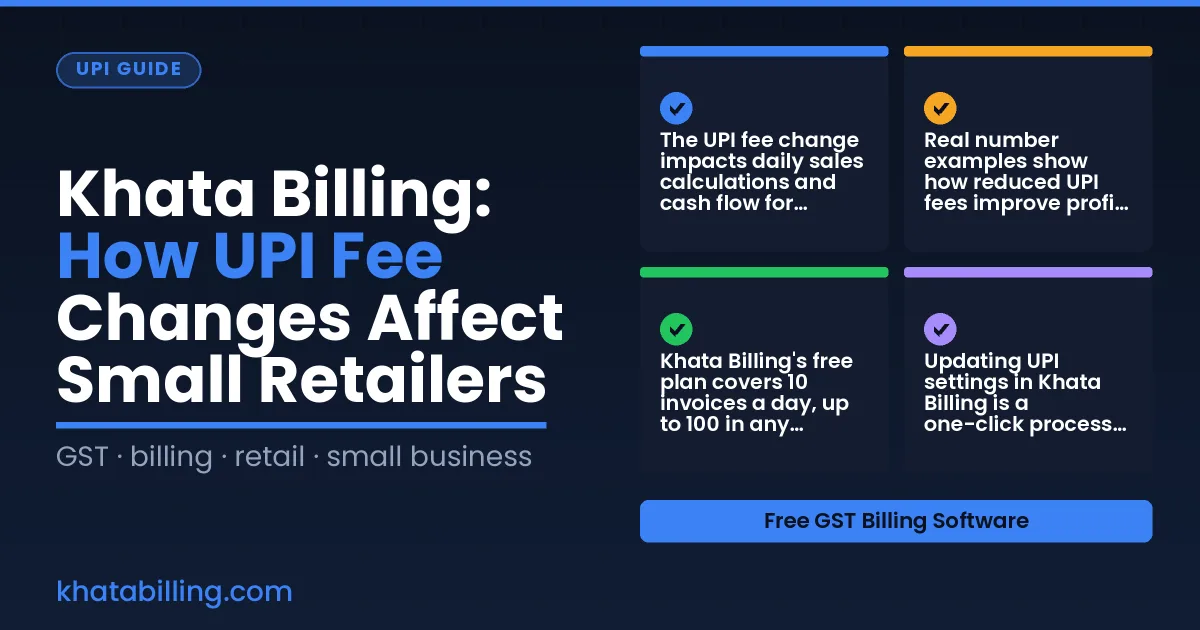
- The UPI fee change impacts daily sales calculations and cash flow for GST-registered retailers using Khata Billing's automated billing system.
- Real number examples show how reduced UPI fees improve profit margins on small retail transactions like those under ₹500.
- Khata Billing's free plan covers 10 invoices a day, up to 100 in any 30-day period, while Premium offers unlimited invoicing with watermark-free GST reports.
- Updating UPI settings in Khata Billing is a one-click process that ensures accurate fee capture for each transaction without manual adjustment.
- Manual billing processes risk incorrect fee inclusion, whereas automated systems like Khata Billing handle UPI fees with precise daily limits and GST integration.
- Reduced UPI fees directly improve cash flow by lowering transaction costs for GST-registered businesses tracking input tax credit eligibility.
- Smart pricing strategies such as minimum order thresholds can minimize UPI fee impact without disrupting customer transactions.
Understanding the Recent UPI Fee Change for Indian Small Retailers
Understanding the recent UPI fee change for Indian small retailers is essential as the National Payments Corporation of India revised UPI transaction fees effective October 2023, replacing the previous flat 0.5% rate with a variable merchant fee ranging from 0.1% to 0.5% based on transaction value and merchant category.
This means a small shopkeeper selling a ₹500 item now pays between ₹0.50 and ₹2.50 as a UPI fee, while a ₹2,000 transaction costs between ₹2 and ₹10, depending on the category, making cash flow calculations more precise for GST‑registered businesses.
Khata Billing — free GST billing software integrates smoothly with these changes, automatically capturing the correct fee amount during UPI collections and reflecting the updated charges in the invoice, so the retailer sees the exact net amount after the fee is deducted without manual adjustments.
For example, if a retailer records a ₹1,000 UPI sale with a 0.3% fee, the software will show ₹997 as the net amount, allowing accurate GST input credit calculations and preventing unexpected cash shortages at the billing counter.
By using Khata Billing's automated fee handling, small retailers avoid the risk of under‑charging GST or missing the precise UPI fee amount, ensuring compliance and smoother daily operations.
Impact on Daily Sales Calculations with Real Number Examples
For Indian small retailers, every rupee matters when calculating daily margins. Consider a shopkeeper who sells a bundle of stationery items—say, a notebook, a pen, and a eraser—totaling ₹500 to a walk-in customer. Under the previous 0.5% flat UPI fee structure, the processor would collect ₹2.50 as the service charge, leaving the retailer with a net earning of ₹497.50 on that transaction. With the new 0.1% fee regime, the same ₹500 sale now incurs only ₹0.50 in UPI processing costs, increasing the retailer's net realization to ₹499.50. This means a single transaction improves the shopkeeper's take-home by ₹2.00, and across a busy day of 50 such sales, the cumulative benefit reaches ₹100—money that can be reinvested in stock or used to cover overhead expenses such as rent or staff wages.
Retailers handling higher-volume transactions feel the difference more acutely. A wholesaler dispatching goods worth ₹5,000 under the old fee would pay ₹25.00 in UPI charges, netting ₹4,975.00. Under the revised 0.1% structure, the charge drops to ₹5.00, leaving the business with ₹4,995.00—a ₹20.00 improvement per transaction. For a trader moving 20 such orders daily, the daily savings compound to ₹400.00, a meaningful amount for small enterprises operating on thin margins.
These concrete calculations show how even a seemingly small percentage change in UPI fees translates into real rupees for the corner store, the neighborhood kirana, or the busy wholesale outlet. The cumulative effect across hundreds of daily transactions can be the difference between covering a monthly expense or falling short. Using billing software like Khata Billing helps retailers automate these calculations, track net earnings after payment processor charges, and maintain accurate party ledgers without manual error. Khata Billing blog offers further guidance on integrating payment tracking with inventory and GST reporting for seamless daily operations.
For businesses seeking to move beyond the constraints of free-tier limits, Khata Billing's Premium plan at ₹1,499 per year (or ₹999 with code SAVE500) unlocks unlimited invoicing, advanced GST reports such as GSTR-1, and party payment requests with approval workflow—features that help small teams manage fee-heavy sales environments without administrative overhead.
Step-by-Step Guide to Update UPI Settings in Your Billing Software
- Log in to Khata Billing and open the Settings menu, then select 'UPI Settings' to access transaction fee options.
- Choose the merchant category that matches your business type, such as 'Retail Store' or 'Service Provider', to ensure the correct fee structure is applied.
- Enter the new UPI fee percentage as specified by your payment processor, for example 1.5%, and save the changes.
- Go to the 'POS billing system' settings to verify how the updated fee is applied to each transaction.
- Generate a sample invoice using a sample item priced at ₹200 with 18% GST, totaling ₹236, to see the new fee deduction clearly displayed.
- Check the invoice summary to confirm the UPI fee of ₹3.15 (1.5% of ₹200) appears separately, and reconcile this with your bank statement to verify accuracy.
See more about POS billing system.
Comparing Manual Billing Processes Versus Automated Fee Management
Manual sales registers require shopkeepers to calculate UPI fees by hand after each transaction, often using a calculator or pen-and-paper, which introduces errors and slows down the billing counter. In contrast, digital billing software applies the current UPI fee rate instantly to every transaction, eliminating calculation mistakes and freeing up time for serving customers.
Consider a typical day at a neighborhood grocery: the shopkeeper records a ₹200 sale, calculates 1.5% UPI fee (₹3), adds GST, and tallies the total. With manual registers, this arithmetic must be repeated for every item, leading to fatigue and potential miscalculations that affect cash reconciliation and GST filings. Automated systems handle the fee calculation in real time, ensuring accuracy without extra effort.
For example, a retailer processing 50 transactions at ₹500 each would manually compute ₹75 in UPI fees (₹500 × 1.5% × 50) while also tracking GST. In Khata Billing's digital interface, the system automatically adds the correct UPI fee and GST to each invoice, reducing administrative burden and preventing discrepancies that could trigger audits. This reliability supports better cash flow management and smoother GST compliance.
Moreover, accurate fee application aligns with GST law requirements where input tax credit claims depend on precise invoice details. Automated fee management ensures that the UPI component is correctly reflected in the invoice, supporting valid ITC claims. The integration of barcode scanning, as seen in Inventory & stock management, further streamlines operations by linking item-level data to accurate billing, reducing manual entry errors and improving overall efficiency in the stock room and at the billing counter.
| Aspect | Manual Register | Digital Billing |
|---|---|---|
| Fee Calculation | Manual, prone to arithmetic errors | Automated, instant application of current rates |
| Time per Transaction | 3-5 minutes for fee and total calculation | Seconds, automatic total generation |
| Error Impact | Cash discrepancies, GST filing issues | Accurate totals, reliable ITC claims |
| Operational Efficiency | Low, staff spends time on math | High, staff focuses on customer service |
By adopting automated fee management, small retailers avoid the pitfalls of manual calculations, ensure compliance with GST regulations, and improve daily operations without additional costs beyond the Premium plan which includes unlimited invoicing and advanced reporting features.
How Reduced UPI Fees Improve Cash Flow for GST Registered Businesses
Lower UPI transaction fees directly boost the daily cash a GST-registered retailer receives after each sale, improving cash flow and supporting working capital needs.
For example, if a shop sells ₹5,000 worth of goods with a 1.5% UPI fee, the fee drops from ₹75 to ₹50 after the reduction, adding ₹25 to daily cash inflow. This extra amount helps cover inventory purchases or bridge gaps until GST payments are due.
Small retailers often face tight margins when GST liabilities arrive on the 20th of the following month. With reduced UPI costs, the cumulative daily surplus grows, making it easier to accumulate the required GST payment without scrambling for funds.
Khata Billing’s free plan allows up to 10 invoices a day, up to 100 in any 30-day period, and supports barcode-based invoice creation, which speeds up billing and reduces cash collection delays. The platform’s automatic data sync ensures real-time tracking of sales and payments, giving business owners clear visibility into their cash position.
By minimizing the deduction per transaction, the effective cost of selling falls, and the retailer can reinvest the saved amount into stock or working capital, maintaining smoother operations and stronger financial resilience.
Practical Strategies to Minimize UPI Fee Impact Through Smart Pricing
UPI fee changes can directly impact your profit margins, especially when handling many small transactions. One effective method is bundling small items into a single invoice to reduce the number of UPI transactions. For example, instead of charging ₹10 for five separate tea packets, create one invoice of ₹50 for the bundle. This cuts UPI fees by 80% compared to five individual payments. Using UPI QR codes for higher-value transactions is another practical step. If a customer buys a ₹2,000 electronic device, generate a QR code for that amount rather than splitting it into smaller payments. The fee percentage remains the same, but fewer transactions mean lower total cost. Adjusting product margins to absorb fee changes is also viable. If UPI fees rise from 1.0% to 1.5%, increase the margin on a ₹200 item by ₹3 to cover the extra ₹1.50. This keeps your effective cost unchanged while maintaining customer price stability. Khata Billing's free plan allows up to 10 invoices per day and 100 per month, so bundling helps stay within these limits without extra effort. Premium features like unlimited invoicing and custom pricing tools make margin adjustments easier, especially when managing multiple product categories. By applying these strategies, small retailers can maintain profitability while adapting to evolving UPI fee structures.
Monitoring Fee Changes and Optimizing Business Operations
Monitoring fee changes is essential for sustainable growth of Indian small retailers, especially after recent UPI fee adjustments. Start by reviewing your bank statements weekly and checking the UPI transaction reports generated in Khata Billing's dashboard to spot any fee variations. Track trends monthly to understand how fees impact your cash flow and overall profitability. When fee trends shift, consider adjusting your product pricing or bundle strategies to maintain margins while staying compliant with evolving payment regulations. For example, if your average transaction value is ₹200 and the UPI fee increases by 0.5%, calculate the exact impact on your net revenue to decide whether to absorb the cost or pass it to customers. Use Khata Billing's built-in reports to see real-time UPI fee deductions per invoice, helping you make data-driven decisions. Regularly reconcile these fees with GST filings to avoid compliance issues, as input tax credit claims depend on accurate expense tracking. Small retailers should also review merchant discount rates (MDR) charged by payment service providers, as changes here directly affect your bottom line. By staying proactive with fee monitoring, you can optimize pricing strategies, protect profit margins, and ensure long-term business resilience in a dynamic payment landscape. This disciplined approach turns fee fluctuations into opportunities for smarter financial management and growth.
Practical takeaway: Understanding the recent UPI fee change is essential for every Indian retailer to maintain accurate profit margins and avoid unexpected cash flow surprises during daily transactions.
Implement the new fee structure today and experience seamless billing with Khata Billing’s GST-compliant tools. Start free with Khata Billing