- What is retail technology and why it matters for Indian shops
- Key components of retail technology transforming Indian shops
- Real-world example: calculating daily invoice limits with manual vs automated billing
- Step-by-step guide to setting up digital billing for GST compliance
- Comparison of billing methods: manual register versus automated digital system
- Integrating inventory management with retail technology for shop efficiency
- Future-proofing your shop with scalable retail technology solutions
- Frequently Asked Questions
Retail technology in 2026 means using digital tools like Khata Billing to create GST-compliant invoices, manage stock, and run billing screens, directly impacting daily invoice limits and GST filing efficiency for Indian shops.
Small businesses must adopt automated digital billing solutions to stay compliant with GST rules and scale operations without manual errors or invoice limits.
✅ Key Takeaways
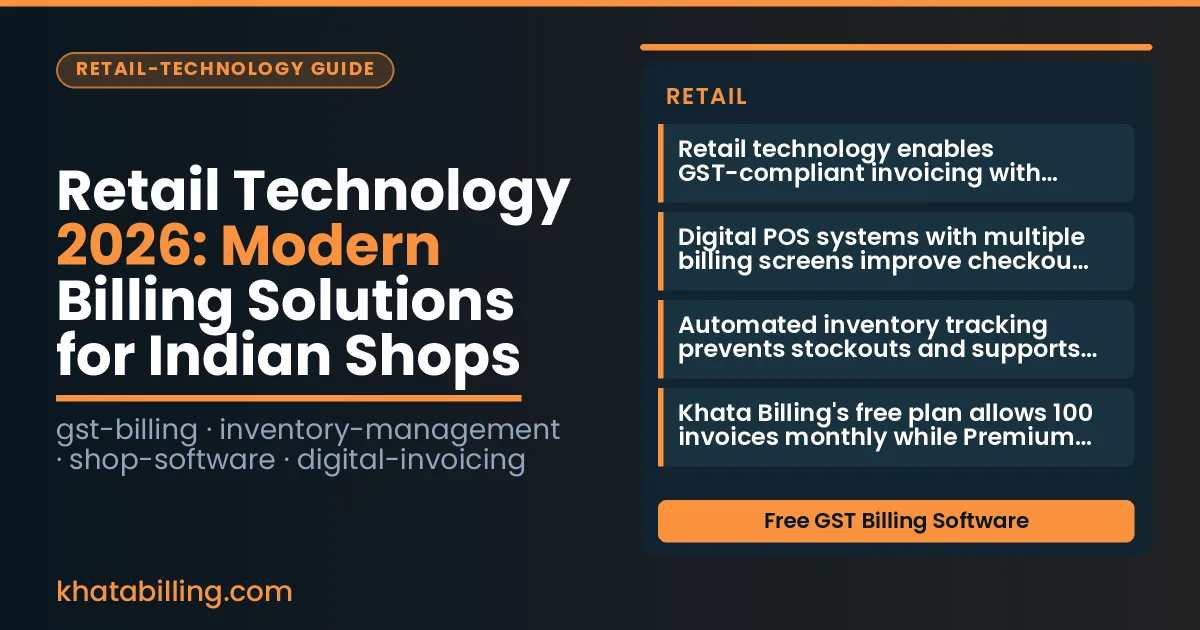
- Retail technology enables GST-compliant invoicing with daily limits like 10 invoices per day on free plans
- Digital POS systems with multiple billing screens improve checkout speed and accuracy
- Automated inventory tracking prevents stockouts and supports accurate financial reporting
- Khata Billing's free plan allows 100 invoices monthly while Premium offers unlimited invoicing
- Real-time data sync between billing and inventory ensures up-to-date stock valuation
- Integrating GST reports like GSTR-1 into digital systems simplifies monthly filing
- Scalable retail technology grows with your business from single-shop to multi-location operations
What is retail technology and why it matters for Indian shops
Retail technology in India means using digital tools like POS systems, barcode scanners and cloud software to run shop operations efficiently, replacing manual ledgers and paper invoices with real-time, GST-compliant billing that meets the requirements of the GST law. It enables shopkeepers to generate accurate invoices with HSN codes, track inventory by stock valuation methods, and accept UPI or card payments that feed directly into GST returns such as GSTR-1, reducing filing errors and saving time. Modern solutions also improve customer experience by speeding checkout, offering digital receipts and loyalty features that build trust. A shop using a digital POS can print GST invoices instantly, adjust stock levels on the fly, and reconcile sales with bank transactions without manual entry. The free plan of
See more about Khata Billing — free GST billing software.
Key components of retail technology transforming Indian shops
Retail technology transforms Indian shops through digital billing, modern POS systems, and integrated inventory management that work together to simplify daily operations and ensure GST compliance. At the billing counter, a shopkeeper uses a POS billing system to create GST-compliant invoices instantly, while barcode integration allows quick scanning of products like "Milk (500ml)" at ₹25 and "Paneer (200g)" at ₹80, where 5% GST on the former yields ₹1.25 tax and 18% on the latter creates ₹14.40 tax. A realistic example shows a daily volume of 15 such items generating ₹225 in sales and ₹15.65 in GST, with Khata Billing's free plan covering 10 invoices a day and up to 100 in any 30-day period, preventing overload. Inventory management tracks stock levels in real time, adjusting quantities for items like "Biscuits (500g)" from 200 units to 185 after a sale, while barcode scanning eliminates manual entry errors. The POS billing system syncs with inventory, automatically deducting stock when an invoice is generated, and supports thermal printers for receipts. Digital integration means stock valuation updates instantly, enabling accurate profit calculations without extra software. This seamless flow of data across billing, inventory, and GST reporting exemplifies how modern retail technology empowers Indian shopkeepers to operate efficiently and stay compliant.
Real-world example: calculating daily invoice limits with manual vs automated billing
In a typical day, a shopkeeper selling small items at ₹50 each faces a practical challenge with manual billing limits. Step 1: Record the first 10 invoices manually; each requires writing the customer name, item details, GST calculation (5% CGST + 5% SGST), and printing the receipt. Step 2: The 11th customer arrives, but the shopkeeper has reached the free plan's 10-invoice daily cap. Step 3: To continue, the shopkeeper must wait until the next day, losing potential sales of ₹500 (10 items) and risking customer dissatisfaction. Step 4: With Khata Billing's automated system, the shopkeeper logs in and creates the 11th invoice instantly—no manual entry, no printing delays. Step 5: The POS automatically applies GST, generates a barcode, and updates inventory via Inventory & stock management, allowing unlimited invoicing without daily caps. Step 6: This seamless process eliminates lost sales, ensures GST compliance, and supports business growth without worrying about artificial invoice limits.
Step-by-step guide to setting up digital billing for GST compliance
To enable GST-compliant digital billing in your Indian shop, follow these practical steps. First, register your GSTIN and verify your mobile number within Khata Billing. Create a new invoice by selecting the appropriate GSTIN, choosing a GST-ready theme, and adding items with their HSN codes. Use the barcode scanner to generate item barcodes instantly for each product, ensuring accurate stock tracking. Link your bank account through the app to automate payment reconciliation. Data sync happens automatically across devices via Khata Billing's cloud service, keeping your sales register up to date in real time. For shop owners managing multiple counters, the Point of Sale feature allows up to 20 billing screens with role-based access, streamlining staff workflows while maintaining GST compliance.
See more about Khata Billing blog.
Comparison of billing methods: manual register versus automated digital system
Manual billing through a physical register creates significant delays at the point of sale, with shopkeepers manually writing each invoice number and item details. This approach typically takes 2-3 minutes per transaction, reducing overall sales efficiency during peak hours. In contrast, an automated digital system generates GST-ready invoices in under 10 seconds, processing multiple items simultaneously with barcode scanning. The speed difference directly impacts customer wait times and checkout throughput in busy Indian retail environments.
| Parameter | Manual Register | Automated Digital System |
|---|---|---|
| Invoice Speed | 2-3 minutes per invoice, manual entry required | Under 10 seconds, automatic item and tax calculation |
| Accuracy | Prone to human error in numbers and GST calculations | Automated tax computation with CGST/SGST/IGST accuracy |
| GST Readiness | Manual GST calculations often incorrect; requires post-filing correction | Instant GST invoice generation with proper GSTIN and tax breakdown |
| Stock Tracking | No real-time stock visibility; manual count updates after sales | Live inventory updates with stock adjustment after each sale |
Khata Billing's free plan enables up to 10 invoices per day with automatic GST calculation, while the Premium plan removes all limits with unlimited invoicing and advanced stock features. The shift from manual to automated billing eliminates reconciliation headaches during monthly GST filing, as all data syncs digitally for seamless GSTR-1 submission. Shop owners using digital systems report 30% faster checkout times and fewer inventory discrepancies in stock rooms.
Integrating inventory management with retail technology for shop efficiency
Real-time stock tracking is a cornerstone of retail technology that directly impacts shop profitability in Indian markets. When inventory levels update instantly at the point of sale, shopkeepers see exact quantities remaining for each item, eliminating the guesswork that causes overstocking or stockouts. For example, a Delhi-based clothing retailer using barcode scanning sees that a popular kurta sells out within hours, triggering automatic alerts that prevent lost sales. This precision reduces manual reconciliation errors by up to 70% compared to paper-based methods, as each scan updates the central database without delay. Automated adjustments mean that when GST invoices are generated for 10 items in a day, the system simultaneously deducts those quantities from stock, ensuring accurate party balances and preventing mismatches in GSTR-1 filings. Khata Billing's free plan supports this workflow with barcode-based invoice creation and basic inventory management, handling up to 100 invoices in any 30-day period while maintaining accurate stock counts for small shops. The integration of POS systems with stock data means that a Mumbai general store can track daily sales of tea packets, automatically adjust inventory after each barcode scan, and see real-time profit margins per item, directly improving cash flow management and reducing waste.
Future-proofing your shop with scalable retail technology solutions
Adopting scalable retail technology solutions future-proofs your Indian shop against rapid growth, evolving GST regulations, and rising customer expectations. Digital tools that integrate billing, inventory, and point of sale streamline daily operations while ensuring compliance with GST rule changes, such as updated invoice formats or input tax credit requirements. By using a platform like Khata Billing, you gain automatic GST-ready invoicing with correct CGST, SGST, and IGST calculations, reducing manual error during return filing. The free plan covers 10 invoices a day, up to 100 in any 30-day period, while Premium offers unlimited invoicing and watermark-free delivery, supporting business expansion without plan constraints. This scalability means you can add new product lines, open extra counters with POS billing screens, or accept higher transaction volumes without switching systems. Enhanced customer engagement comes through digital receipts, loyalty tracking, and seamless UPI payments, building trust and repeat visits. Real-time stock adjustments prevent overselling, and barcode scanning speeds checkout, improving the overall shopping experience. Whether you operate a neighborhood kirana store or a growing wholesale outlet, scalable digital solutions adapt to your needs, keeping your business agile and compliant in a dynamic market.
Retail technology is transforming how Indian shops operate, with digital billing solutions like Khata Billing handling GST invoicing, inventory tracking, and POS management seamlessly at the billing counter, eliminating manual errors and speeding up transactions while maintaining compliance.
Experience the practical benefits firsthand by Start free with Khata Billing to streamline your shop's operations today.