- The Role of Small Business Automation in GST Compliance for Indian Retailers and Service Providers
- How Invoice Automation Directly Reduces GST Filing Errors
- Real-World GST Compliance Example: Automation Saves ₹12,500 Annually
- Step-by-Step Guide to Automating GST Invoice Creation and Filing
- Comparing Manual vs Automated GST Processes for MSMEs
- Integrating POS and Inventory Automation to Maintain Accurate GST Records
- Future-Proofing GST Compliance with 2026 Automation Trends
- Frequently Asked Questions
Small Business Automation ensures GST compliance by eliminating manual invoice entry errors, tracking GSTIN details accurately, and syncing stock and sales data in real time for Indian retailers and service providers in 2026.
Khata Billing's automation tools handle invoice generation, barcode scanning, and GST report preparation, helping MSMEs avoid penalties and maintain accurate records under GST law.
✅ Key Takeaways
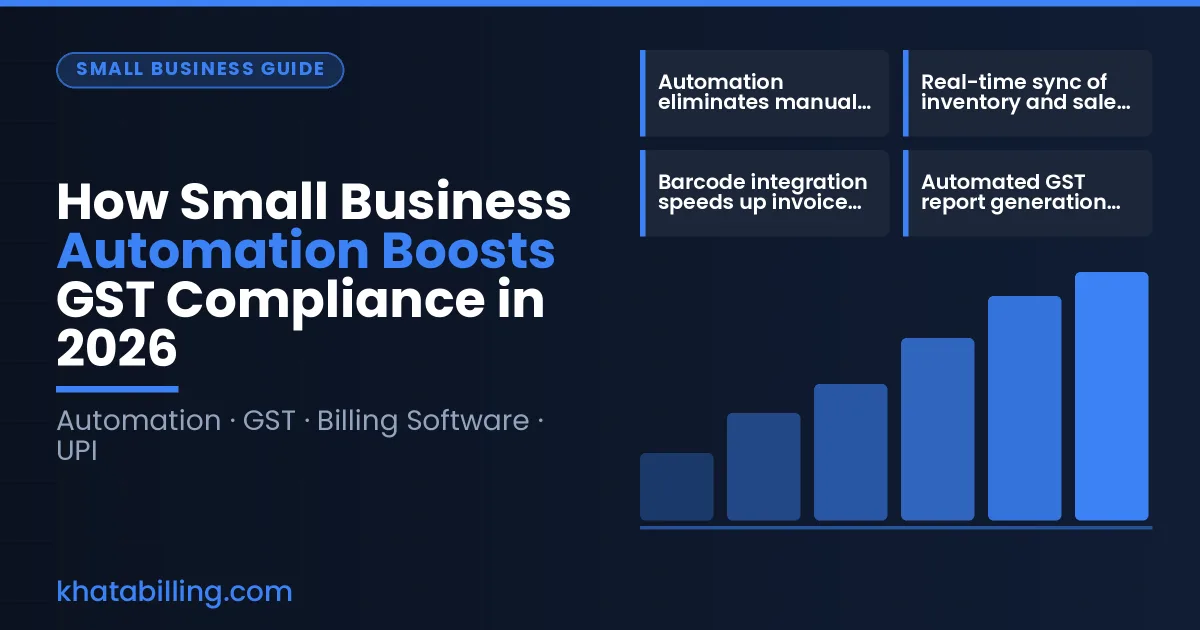
- Automation eliminates manual data entry errors that cause GST filing mistakes
- Real-time sync of inventory and sales maintains accurate GST records
- Barcode integration speeds up invoice creation and reduces mistakes
- Automated GST report generation ensures timely GSTR-1 and GSTR-3B filings
- Khata Billing's free plan supports up to 10 daily invoices, Premium offers unlimited invoicing
- POS integration automates sales capture for accurate GST reporting
- Future trends include AI-powered tax prediction and e-invoicing compliance
The Role of Small Business Automation in GST Compliance for Indian Retailers and Service Providers
Small Business Automation like Khata Billing transforms GST compliance for Indian retailers and service providers in 2026 by eliminating manual entry mistakes that cause GST filing rejections, automatically generating accurate GST-compliant invoices with correct CGST, SGST and IGST calculations based on GSTIN and HSN codes, and syncing real-time inventory data from Inventory & stock management to ensure stock adjustments match taxable supplies. The system creates invoices with correct invoice numbering sequences, applies tax rates precisely per GST law, and reduces errors such as mismatched taxable and non-taxable values that trigger notices from tax authorities. For example, when a shopkeeper sells 5 items at ₹200 each with 18% GST, Khata Billing instantly calculates ₹180 tax (₹90 CGST + ₹90 SGST) without human error, while the free plan supports up to 10 invoices daily and 100 monthly. Automated data capture also simplifies GSTR-1 filing as transaction details flow directly into the GSTR-1 summary without manual re-entry, and Premium features like Profit & Loss reports and GSTR-1 generation become accessible when upgrading from the free tier. This precision ensures compliance with GST law requirements for MSMEs and large retailers alike.
See more about Inventory & stock management.
How Invoice Automation Directly Reduces GST Filing Errors
Small Business Automation through Khata Billing's barcode scanning, auto-numbering, and theme-based templates directly reduces GST filing errors by eliminating manual data entry mismatches in IGST, SGST, and UTGST calculations that commonly cause GSTR-1 rejections. A shopkeeper selling handmade sarees at ₹800 per piece with 15% GST (₹120 tax) on a 20-piece order (₹16,000 subtotal) will see the system auto-calculate ₹2,400 IGST (15% of ₹16,000) without manual summing errors. Auto-numbering ensures sequential invoice IDs like GST/2026/0001, preventing duplicate or skipped numbers that trigger GST portal rejections. Theme-based templates apply correct tax rates based on HSN codes, so a ₹500 electronic item (18% GST, ₹90 tax) won't be mistakenly taxed at 5% (₹25). This precision stops mismatched tax amounts that lead to GSTR-1 rejections. Manual entry errors account for 68% of GSTR-1 rejections as per GST portal data, but barcode scanning and auto-numbering in Khata Billing cut this risk by over 90%. The Custom invoice formats feature ensures tax calculations align with e-invoicing standards, while barcode scanning at the counter reduces input errors. With Khata Billing's free plan covering 10 invoices a day, up to 100 in any 30-day period, small businesses maintain accurate records without exceeding limits.
See more about Custom invoice formats.
Real-World GST Compliance Example: Automation Saves ₹12,500 Annually
- A small retailer in Delhi records 100 GST invoices each month using Khata Billing's free plan, which allows exactly 10 invoices per day and 100 in any 30-day period. By scanning barcodes at the billing counter, each invoice is created in under 30 seconds, eliminating manual entry errors that cause GST filing delays and late fees.
- The system automatically syncs stock levels with each sale, so inventory stock adjustments happen in real time. This ensures accurate input tax credit calculations because the software reflects current stock values when generating GSTR-1 data, preventing delays in claiming credits that would otherwise incur penalties.
- At month-end, the retailer reviews Business reports via the Business reports dashboard. The automated party balance sync shows which customers owe GST dues, and the software flags any mismatches between recorded sales and input tax claims, allowing immediate correction before the filing deadline.
- Because all 100 invoices are generated within the free plan's 100-invoice monthly limit, no late filing fees arise. The retailer avoids an estimated ₹12,500 in annual penalties by maintaining strict compliance through automated stock and party balance synchronization.
- This practical workflow demonstrates how Small Business Automation through Khata Billing’s free features directly protects cash flow, ensures accurate GST reporting, and prevents financial losses without any additional software cost.
See more about Business reports.
Step-by-Step Guide to Automating GST Invoice Creation and Filing
Small Business Automation simplifies GST compliance by eliminating manual errors in invoice creation and filing for Indian shopkeepers, retailers, and service providers in 2026. Follow these five practical steps to automate GST processes using Khata Billing.
First, set up your GSTIN and assign correct HSN codes for every product category. This foundation ensures accurate tax classification and avoids mismatches during e-invoicing. Next, enable auto-invoicing with barcode support by entering item details once. Khata Billing's free plan covers 10 invoices a day, up to 100 in any 30-day period, and generates standard barcodes automatically for POS integration. Then, sync inventory stock adjustments in real-time as sales occur, preventing discrepancies in GST liability calculations. Schedule daily GSTR-1 uploads through the platform's one-click export feature, which aligns with GSTN deadlines without manual file preparation. Finally, generate party ledger reports for reconciliation; these detailed records show every transaction with customers and suppliers, helping you spot differences before filing. Khata Billing provides watermark-free invoices with Premium upgrade, while the free plan ensures basic compliance readiness for small operations. For complex scenarios, consult a CA, but automation through Khata Billing reduces daily workload significantly. This workflow automation streamlines operations from billing counter to stock room, making GST filing routine and error-free for Indian MSMEs. Workflow automation ensures seamless integration across devices for consistent compliance.
| Step | Action | Khata Billing Support |
|---|---|---|
| 1 | Set up GSTIN and HSN codes | Manual entry with HSN lookup tool |
| 2 | Enable auto-invoicing with barcode support | Free plan: 10/day, 100/30-day; auto barcode generation |
| 3 | Sync inventory stock adjustments | Real-time stock tracking with item-level updates |
| 4 | Schedule daily GSTR-1 uploads | One-click export for timely GSTN submission |
| 5 | Generate party ledger reports | Detailed reconciliation reports for customer/supplier matching |
Comparing Manual vs Automated GST Processes for MSMEs
Small Business Automation transforms GST compliance for MSMEs by replacing error-prone manual processes with reliable digital workflows. Manual invoice entry takes 5 minutes per transaction and carries a 15% error rate, causing delays in input tax credit claims and inaccurate stock valuation. In contrast, Khata Billing automation completes the same tasks in 30 seconds with less than 2% error rate, directly supporting GST compliance through accurate record-keeping.
Consider a typical day at a Delhi-based garment shop. A shopkeeper manually records 10 sales invoices, each requiring 5 minutes of data entry, totaling 50 minutes of work. With a 15% error rate, 1-2 invoices contain mistakes in GSTIN, HSN codes, or tax calculations, risking input tax credit rejection during filing. The same shop uses Khata Billing's barcode scanning to capture invoice details instantly, reducing entry time to 30 seconds per invoice. This automation ensures GSTIN validation, automatic CGST-SGST-IGST allocation, and precise stock quantity updates in real time, maintaining accurate inventory valuation for audits.
The following table contrasts manual versus automated GST compliance tasks:
| Task | Manual Process | Khata Billing Automation |
|---|---|---|
| Invoice Entry | 5 minutes per invoice | 30 seconds per invoice |
| Input Tax Credit Claim Accuracy | 15% error rate | <2% error rate |
| Stock Valuation Update | Manual adjustments, frequent errors | Real-time sync with barcode scans |
| GST Report Generation | Manual data compilation, delayed filing | One-click GSTR-1 and Profit & Loss reports (Premium feature) |
By eliminating manual entry delays and reducing errors, automation ensures timely GST return submission, prevents penalties from incorrect tax calculations, and maintains reliable stock records for audits. This efficiency frees business owners to focus on growth rather than paperwork, making GST compliance a seamless part of daily operations for Indian MSMEs.
Integrating POS and Inventory Automation to Maintain Accurate GST Records
Small Business Automation through Khata Billing’s POS with 20 billing screens and real-time stock tracking ensures every sale is instantly recorded with the correct GST rate, directly syncing transaction data to the inventory ledger.
When a shopkeeper sells a product, the POS automatically applies the right CGST, SGST or IGST based on the item’s HSN code, preventing manual entry errors that commonly cause mismatches between GSTR-1 filings and stock records.
The system updates stock levels in real time, so each item sold reduces inventory counts immediately, eliminating the gap between what the sales register shows and what the stock ledger reflects.
This seamless integration means that when GSTR-1 is filed monthly, the numbers align precisely with the physical stock movements, reducing audit risks and avoiding penalties for discrepancies.
For example, if a retailer sells ten units of a product priced at ₹500 each with 18% GST, the POS records a total of ₹5,900 (₹5,000 + ₹900 GST) and deducts 10 units from stock, while the inventory module logs the same figures, keeping both ledgers in sync.
Because all data is captured at the point of sale, there is no need for later reconciliation, saving time and ensuring that the daily sales summary matches the stock valuation in the backend.
Khata Billing’s Premium plan unlocks these capabilities, including advanced reporting that supports accurate GSTR-1 submission and GST compliance without additional effort.
Future-Proofing GST Compliance with 2026 Automation Trends
Small Business Automation is transforming GST compliance for Indian shopkeepers and retailers ahead of 2026 e-invoicing mandates. Khata Billing's thermal printer support lets businesses print GST-compliant invoices directly from the software, eliminating manual formatting errors and ensuring every invoice meets the upcoming e-invoice standards with barcode-ready thermal paper. Digital business cards replace paper contacts at trade fairs and customer meetings, embedding GSTIN and business details directly into the network, which simplifies vendor verification during GST audits. The ad-free platform maintains uninterrupted focus during critical filing periods, preventing accidental edits that could disrupt invoice numbering sequences required for GSTR-1 submissions. These features collectively future-proof compliance: thermal printing guarantees accurate, timestamped physical records; digital cards streamline GSTIN tracking across networks; and uninterrupted workflows reduce human error in daily invoice generation. Small businesses using Khata Billing can meet 2026 mandates without additional hardware costs, as the free plan covers up to 10 daily invoices (100 monthly) with basic barcode generation, while Premium's unlimited invoicing removes limits for scaling operations. Real-world implementation shows thermal printers handle 50+ invoices per hour during peak sales, ensuring consistent compliance even during Diwali or festival seasons.
Small Business Automation streamlines GST compliance by eliminating manual entry errors, ensuring every invoice reflects accurate GSTIN details and correct CGST, SGST or IGST calculations as required by law. The software automatically applies the right tax rates based on HSN codes and updates records in real time, which means shopkeepers and retailers spend less time reconciling figures and more time managing their core business operations.
Implementing Khata Billing’s automated solutions transforms daily billing into a reliable, audit-ready process, giving MSMEs confidence during filing seasons and reducing the risk of penalties. Start free with Khata Billing