"My stock counts don't match my sales." This is one of the most common complaints from small business owners in India — and it almost always comes down to one root cause: treating inventory and billing as separate problems instead of one connected system.
Understanding the difference between inventory management and billing — and how they work together — is the first step to running a tighter, more profitable business.
✅ Key Takeaways
- Billing = recording what you sold and to whom
- Inventory = tracking what you have in stock
- Both are necessary for product-based businesses
- Poor inventory leads to stockouts and overstocking
- Poor billing leads to GST non-compliance and revenue leakage
- Best practice: use a tool that connects both automatically
What is Billing?
Billing (or invoicing) is the process of recording a sale and issuing a document — an invoice or bill — to the customer. For GST-registered businesses in India, every sale must be backed by a GST-compliant invoice that shows:
- What was sold (product/service with HSN/SAC code)
- The quantity and price
- Applicable taxes (CGST/SGST or IGST)
- Total amount payable
Billing is primarily a financial and compliance function. It tells your accountant, the GST department, and your customer what the transaction was.
What is Inventory Management?
Inventory management is the process of tracking the goods you hold — how many units you have, where they are, their purchase cost, and when you need to reorder.
For a retailer selling 200 different products, inventory management answers questions like:
- How many units of Product X do I have right now?
- Which items are about to go out of stock?
- What is the total value of goods in my warehouse?
- Which products have been sitting unsold for over 60 days?
Inventory is primarily an operational function. It helps you plan purchasing, avoid stockouts, and reduce wastage.
Key Differences: Billing vs Inventory
Here's a clear side-by-side comparison:
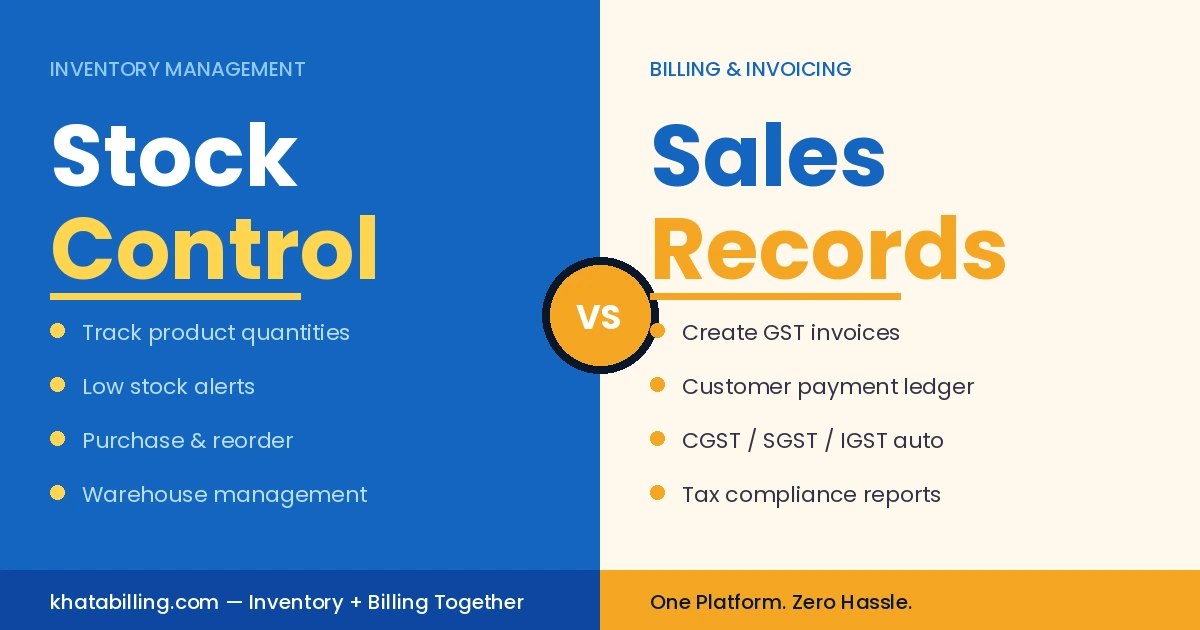
- Purpose: Billing → record sales and collect payment. Inventory → track stock levels and value.
- Who uses it: Billing → sales team, accountant, customer. Inventory → warehouse, procurement, operations.
- When it happens: Billing → at the point of sale. Inventory → continuously, updated with every purchase and sale.
- Output: Billing → GST invoice, payment record. Inventory → stock report, reorder alert, valuation report.
- Compliance link: Billing → GST Act compliance. Inventory → no direct legal requirement, but essential for accurate billing.
Why They Must Work Together
Here's what goes wrong when billing and inventory are disconnected:
- Overselling: You invoice a customer for 10 units but only have 6 in stock. Fulfillment delays, customer complaints, returns.
- Wrong pricing: Prices updated in billing software but not in inventory records (or vice versa) — leads to under-billing and revenue loss.
- Inaccurate stock count: Manual reconciliation at month-end takes hours and is still often wrong.
- GST mismatch: If inventory records show different quantities than what was billed, your GST returns won't match — triggering notices.
When billing automatically updates inventory — every invoice reduces the stock count in real time — these problems disappear entirely.
How Khata Billing Connects Both
Khata Billing is built with this connection as a core feature, not an afterthought:
- Add products once with HSN code, GST rate, unit price, and opening stock quantity
- Create an invoice for a customer selecting items from your product list
- Stock is automatically reduced — no manual entry needed
- Low stock alerts tell you when to reorder before you run out
- Stock reports show current inventory value and item-wise movement
For small businesses, this eliminates an entire category of errors without adding any extra work.
Which Businesses Need Inventory Management?
Not every business needs deep inventory management:
- Definitely need it: Retailers, wholesalers, traders, manufacturers, distributors, pharmacies, FMCG businesses
- May need basic tracking: Restaurants (ingredient inventory), e-commerce sellers
- Usually don't need it: Pure service businesses (consultants, agencies, freelancers) — unless they sell physical products alongside services
Billing and inventory are two sides of the same coin. Billing without inventory tracking means you'll frequently oversell, lose track of stock, and waste hours in manual reconciliation. Inventory without billing means you're not recording sales properly — a compliance risk and a financial blind spot.
The simplest solution: use a tool that does both automatically. Khata Billing connects invoicing and inventory in one place — free to get started, and takes under 5 minutes to set up.