Ten years ago, if you told a kirana shop owner in Surat or a textile trader in Ludhiana that their billing system would live in the cloud — accessible from a ₹8,000 Android phone, automatically backed up, always GST-compliant, and free — they wouldn't have believed you.
In 2026, that is the everyday reality for millions of Indian small businesses using cloud billing software. This is not a trend that will reverse. Cloud billing is the permanent future of how Indian businesses handle invoicing, stock, and compliance — and this article explains exactly why.
✅ Key Takeaways
- Access billing from any device — phone, tablet, laptop
- Automatic data backup — data never lost
- GST rules always current — no manual updates
- Multi-location real-time sync
- Zero installation and maintenance overhead
- Scales with your business — upgrade features as you grow
- Integration-ready — connects with banks, payment gateways, GST portal
- Free at entry level — removes cost barrier for small businesses
The Shift That's Already Happening
The data tells the story clearly:
- Over 70% of new billing software sign-ups in India in 2025 were for cloud-based tools
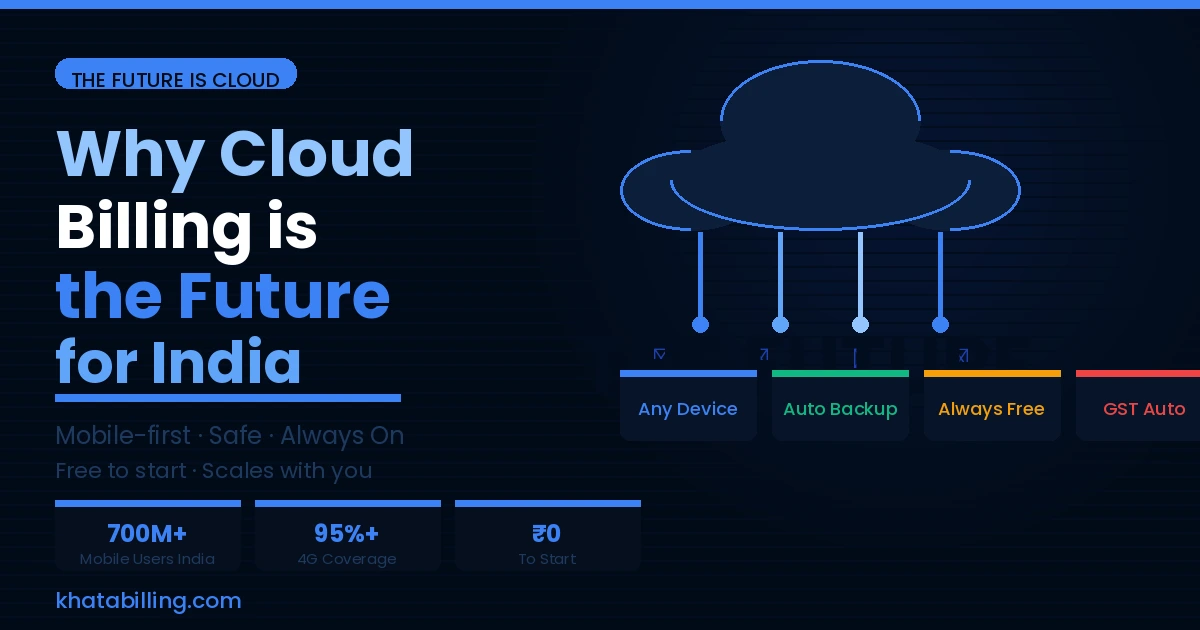
- Mobile internet penetration in India exceeded 700 million users — billing on phone is now the default for many businesses
- The GST portal itself is cloud-based — meaning the compliance system your billing connects to is already in the cloud
- E-invoicing mandates are expanding — requiring direct cloud integration between billing systems and the GST portal
The infrastructure is already cloud. Businesses that stay on desktop billing software are increasingly the exception, not the rule.
5 Reasons Cloud Billing Is the Future for Indian Small Business
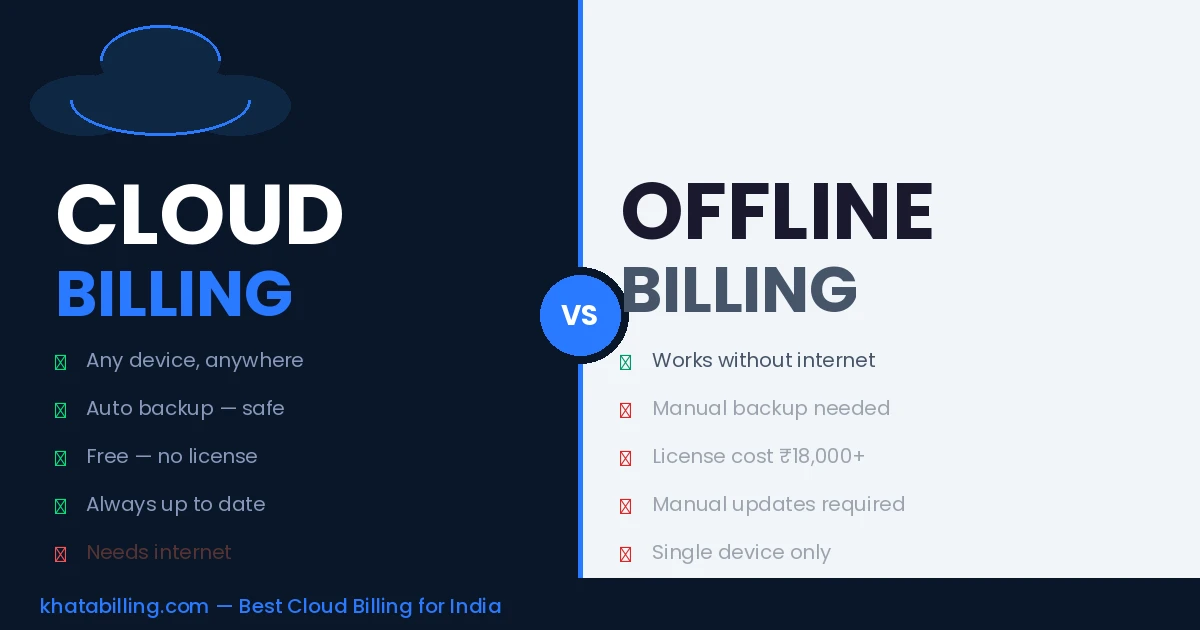
1. Mobile-first India demands mobile billing: India is a mobile-first country. 500+ million Indians access the internet primarily via smartphone. Cloud billing runs on those phones — desktop billing does not. The future of Indian business is mobile, and cloud billing goes where your business goes.
2. GST compliance is becoming automated: E-invoicing, automatic GSTR reconciliation, and AI-based return filing are all happening through cloud integrations. Businesses on cloud billing platforms connect to these automatically. Businesses on desktop software must manually export and upload data — an increasingly cumbersome process as automation deepens.
3. Data safety is non-negotiable: As businesses accumulate years of billing data — customer histories, pricing records, GST documentation — the risk of losing it to a hardware failure becomes unacceptable. Cloud backup eliminates this risk. The cost of lost billing data (in compliance reconstruction, customer disputes, audit preparation) far exceeds any subscription fee.
4. Multi-person, multi-location business is the growth path: Growing businesses add staff, open branches, and need mobile sales teams. Cloud billing enables all of this — everyone accesses the same real-time data regardless of location. Desktop software locks you to one machine.
5. The cost of not upgrading compounds: Every day a business spends manually entering stock updates, compiling GSTR data, and chasing paper receipts is a day of avoidable cost. Cloud billing eliminates these costs. As time goes on, the gap between cloud-enabled and manual businesses only widens.
Khata Billing — Built for India's Cloud Billing Future
Khata Billing is designed with India's specific business reality in mind:
- Works on Indian connectivity: Optimised for 4G speeds — loads fast even on slower connections common in tier-2 and tier-3 cities
- WhatsApp-native: India communicates via WhatsApp. Khata Billing treats WhatsApp as a primary delivery channel for invoices — not an afterthought
- GST-first design: Built around India's GST framework from day one — not adapted from an international tool. CGST/SGST/IGST, HSN codes, GSTR reports — all native features
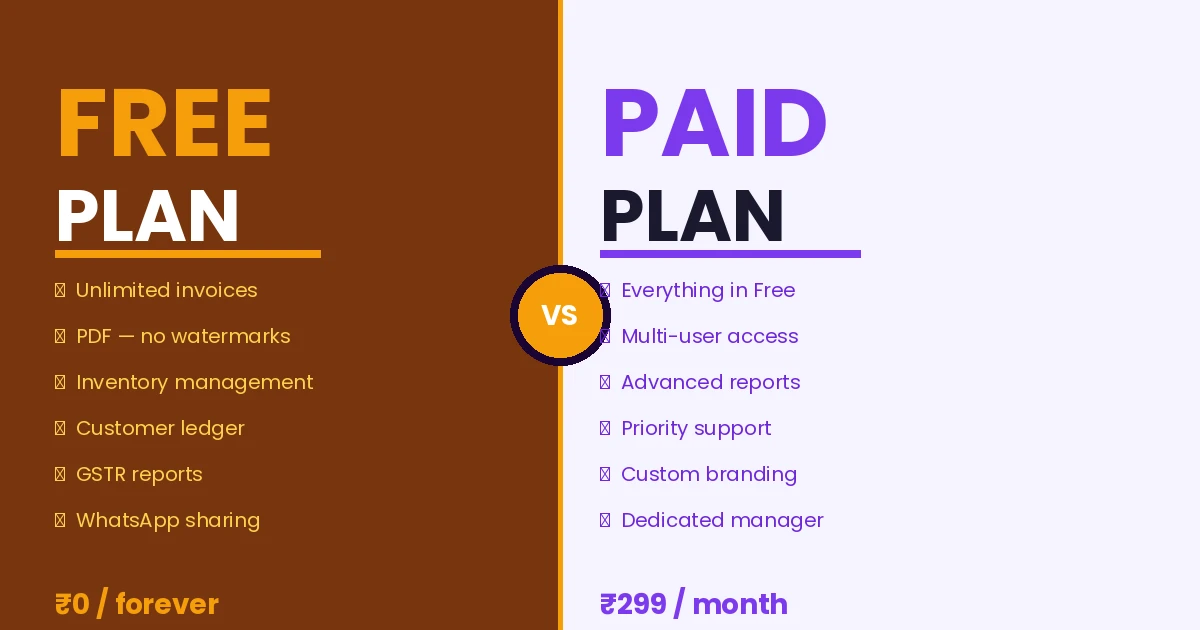
- Zero-cost entry: The free plan removes the cost barrier entirely. Every Indian small business can access professional billing tools regardless of budget
- Scales with growth: Start free as a solo proprietor. Upgrade to multi-user paid plans as you hire staff and open branches — your data and setup carry forward seamlessly
What the Next 3 Years Look Like for Cloud Billing in India
The trajectory is clear:
- E-invoicing will expand to businesses below ₹5 crore turnover — requiring cloud integration with the GST portal
- AI-assisted invoice creation will suggest products, prices, and customers based on past patterns
- Automatic bank reconciliation will link billing collections to bank statements in real time
- GST return pre-filling from billing data will become the standard, not the exception
Businesses already on cloud billing platforms like Khata Billing are positioned to adopt all of these advances seamlessly. Businesses on desktop software face an eventual and increasingly painful migration.
Cloud billing is not a future possibility for Indian small businesses — it is the present reality and the accelerating direction. The question is not whether to move to cloud billing, but how soon.
The answer is: now, and it's free. Start with Khata Billing at khatabilling.com — join the millions of Indian small businesses already operating with the billing infrastructure of the future.