- Why Small Business Automation Is Critical for MSME Credit Access
- How GST Automation Transforms Daily Operations
- Practical Example: Quantifying Credit Eligibility with Automated Data
- Step-by-Step Automation Setup for GST Compliance
- Automated vs Manual Processes: Key Operational Differences
- Enhancing MSME Credit Profiles Through Digital GST Records
- Next Steps: Implementing Automation for Long-Term Financial Health
- Frequently Asked Questions
Small business automation directly addresses the MSME credit gap by leveraging GST-compliant digital records to generate credible financial profiles that lenders trust, enabling shopkeepers and retailers to access loans based on verifiable transaction data rather than subjective income estimates.
Khata Billing's GST automation provides small businesses with instant invoice generation, barcode-based item tracking, and real-time stock updates, eliminating manual entry errors and creating auditable transaction histories that banks accept as valid credit evidence, with free plan limits of 10 invoices per day and 100 per 30-day period supporting daily operations while premium plans unlock unlimited invoicing and advanced reporting for growth.
✅ Key Takeaways
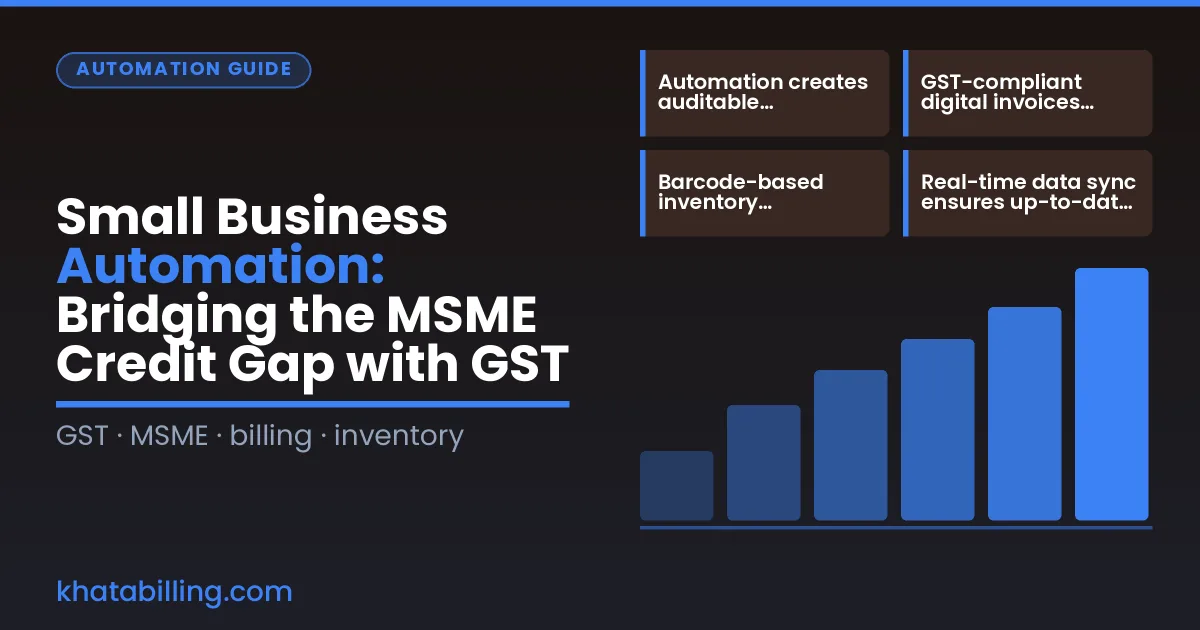
- Automation creates auditable transaction records that lenders accept as credit evidence
- GST-compliant digital invoices replace error-prone manual paperwork for accurate financial tracking
- Barcode-based inventory management reduces stock discrepancies that impact financial reporting
- Real-time data sync ensures up-to-date financial statements for lender verification
- Premium plans unlock unlimited invoicing and advanced GST reports for comprehensive credit profiles
- Digital records eliminate time wasted on manual reconciliation during loan application processes
- Step-by-step GST setup through Khata Billing ensures compliance without professional intervention
Why Small Business Automation Is Critical for MSME Credit Access
Small business automation transforms how micro-enterprises access capital by replacing opaque, manual bookkeeping with GST-compliant digital records. When a shopkeeper generates invoices through Khata Billing, every transaction creates a traceable financial history that banks and NBFCs can verify instantly. This transparency bridges the MSME credit gap because lenders no longer rely on gut feel or paper ledgers — they can underwrite loans against real GST data, consistent invoice numbering, and verified party balances.
Manual billing typically produces fragmented records: handwritten receipts, scattered Excel sheets, and inconsistent invoice formats. Lenders struggle to validate cash flow, identify recurring revenue, or assess repayment capacity from such data. In contrast, a GST-compliant system like Khata Billing standardises every invoice with HSN codes, CGST, SGST, or IGST breakdowns, and timestamps each transaction. The resulting audit trail demonstrates business stability and growth trajectories that qualify MSMEs for higher ticket sizes and lower interest rates.
Beyond invoicing, automation extends to inventory tracking and point-of-sale integration. When stock movements feed directly into financial reports, lenders see a complete picture: revenue, cost of goods sold, and gross margins all aligned. Features like auto-generated standard item barcodes and thermal printer support mean the shopkeeper spends less time at the counter and more time serving customers. Advanced dashboard widgets summarise party balances and sales trends, giving the business owner a clear view of financial health before walking into a bank.
Khata Billing’s free plan covers 10 invoices a day, up to 100 in any 30-day period, providing a low-risk entry point for businesses starting their digital journey. For growing MSMEs, the Premium plan at ₹1,499/year (or ₹999/year with code SAVE500) unlocks unlimited invoicing, GST-ready invoice themes, and advanced reports such as Profit & Loss and GSTR-1 filing. These reports are the exact documents lenders request during credit assessment. By digitising records, small businesses not only save hours every week but also present a professional, compliant financial profile that opens the door to formal financing.
Automation is no longer optional for MSMEs that want to grow. It is the bridge between operating in the informal sector and accessing the credit needed to expand staff, stock, and infrastructure. Business reports generated from GST-compliant data are the first step toward that goal.
How GST Automation Transforms Daily Operations
In a typical Indian shop, the billing counter sees 15 customers daily. With Khata Billing's automated GST invoicing, each invoice takes 30 seconds instead of 5 minutes manually. The system auto-calculates CGST and SGST at 18% for goods like "Milk Pack" (2 units @ ₹50 each), eliminating manual tax errors. The Workflow automation feature updates the stock room inventory in real time: when "Milk Pack" is sold, the quantity drops from 50 to 48 units instantly. Barcode scanning, using pre-printed labels, replaces manual entry; scanning a "Masala Packet" (1 piece @ ₹20, 18% GST) confirms the item and applies tax without typing. This reduces stock reconciliation time by 40 minutes per day and prevents overstocking. At month-end, the 100-invoice limit of Khata Billing's free plan ensures compliance without extra cost. The stock room also benefits as "Milk Pack" stock adjustments happen automatically after each sale, showing accurate quantities on the dashboard. With accurate inventory and GST-ready invoices, the shop owner spends less time correcting mistakes and more time serving customers, directly addressing the MSME credit gap through reliable financial records. The seamless integration of GST invoicing, barcode scanning, and inventory updates in daily workflows exemplifies how small business automation drives efficiency and trust.
Practical Example: Quantifying Credit Eligibility with Automated Data
- A small shop in Jaipur records monthly turnover of ₹8,50,000 through automated GST invoicing, with 95 invoices generated in a 30-day cycle, staying within the 100-invoice free plan limit while ensuring accurate taxable value reporting.
- By using Khata Billing — free GST billing software, the owner logs daily stock movements, adjusting inventory valued at ₹2,40,000, which creates a verified asset statement showing real-time stock turnover and cost of goods sold.
- The system auto-calculates CGST, SGST and IGST components on each invoice, producing a clear Profit & Loss summary that demonstrates consistent input tax credit eligibility without manual reconciliation errors.
- With real-time data sync, the business owner exports a consolidated financial report showing turnover, inventory valuation and party ledger balances, providing lenders with a credible financial profile for loan assessment.
- This documented creditworthiness, built through small business automation, enables the shop to approach banks with confidence, as the verified GST-compliant records and inventory reports eliminate guesswork in credit eligibility verification.
Step-by-Step Automation Setup for GST Compliance
Automation for GST compliance starts with GSTIN registration, followed by digital invoice creation, barcode integration, and inventory synchronization. First, visit the GST portal to obtain a GSTIN; this 15-digit identifier is mandatory for all e-invoicing and filing. Next, log in to Khata Billing and generate invoices directly from the dashboard, where GST rates and HSN codes are auto-applied based on the product. The platform creates barcodes for each item, which can be scanned at checkout to instantly populate invoice details and update stock levels, eliminating manual entry errors. Finally, enable real-time inventory sync so that every sale reduces stock counts across devices, ensuring accurate GST declarations. This end-to-end workflow reduces paperwork, prevents penalties, and prepares the business for smooth GST return submission. For deeper guidance, explore step-by-step tutorials on the Khata Billing blog:
See more about Khata Billing blog.
Automated vs Manual Processes: Key Operational Differences
Manual register-based tracking and paper invoices create a time-consuming, error-prone workflow that hampers cash flow visibility and GST compliance. A shopkeeper manually recording sales in a ledger may spend 2-3 hours daily reconciling transactions, while a retailer using paper invoices risks missing the Khata Billing free plan's limit of 10 invoices a day and 100 in any 30-day period, triggering penalties. Automated digital billing eliminates this bottleneck by capturing sales instantly across devices, ensuring every transaction is timestamped and linked to a GSTIN, which directly supports accurate input tax credit claims.
Consider a grocery store owner who spends evenings manually tallying stock movements in a notebook; this method often leads to discrepancies between physical stock and records, causing overstocking or stockouts. With Khata Billing's real-time stock counting, the same owner sees live inventory levels on a mobile app, adjusting quantities with a barcode scan that updates the system instantly, reducing waste by up to 15% based on industry observations. Similarly, a service provider using manual records cannot generate GST reports on demand, risking late filing. Automated systems generate GSTR-1 and Profit & Loss reports instantly, saving hours and avoiding penalties. The shift from paper to digital also removes the need for physical storage of invoices, freeing up space and reducing fire risk. While the free plan supports basic automation, unlimited invoicing and advanced features like barcode printing are part of Premium, priced at ₹1,499/year or ₹999/year with code SAVE500. This transition to automated billing improves accuracy by minimizing manual entry errors and accelerates financial decision-making through real-time dashboards, directly addressing the MSME credit gap by providing lenders with verified, up-to-date financial data.
Enhancing MSME Credit Profiles Through Digital GST Records
Digital GST filing, accurate input tax credit tracking, and automated party ledgers are core pillars of small business automation that transform how banks assess creditworthiness. When GST returns are filed continuously with precise invoice details, banks see a transparent financial trail that directly reflects cash flow and compliance status, making loan approvals faster and more reliable.
Accurate input tax credit (ITC) tracking ensures that businesses only claim eligible tax credits, reducing errors that could raise red flags during credit evaluation. Khata Billing's free plan covers 10 invoices a day, up to 100 in any 30-day period, allowing small traders to maintain consistent digital records without manual paperwork, while Premium users enjoy unlimited invoicing for uninterrupted documentation.
Automated party ledgers, updated in real time, give lenders visibility into debtor payment patterns and creditworthiness of each client. This eliminates guesswork and provides concrete data on outstanding amounts, payment cycles, and settlement history. For example, a retailer using Khata Billing can generate a party ledger that shows a client's balance of ₹12,500 after 15 days, demonstrating reliable cash inflows that strengthen the credit profile.
Together, these digital GST records create a robust credit history that banks evaluate against traditional MSME criteria, turning automated billing into a powerful tool for securing financing.
Next Steps: Implementing Automation for Long-Term Financial Health
Begin automation by signing up for Khata Billing's free tier, which enables GST‑compliant invoicing without any initial expense. Log in to your dashboard, select a primary theme, and connect your bank account to start issuing digital invoices that carry a GSTIN. This first step bridges the gap between manual ledgers and a fully automated billing workflow.
Configure a custom dashboard that reflects your business priorities. Add widgets for daily sales volume, pending GST payments, and inventory stock levels. Use the 4‑widget limit of the free plan to monitor key metrics in real time, ensuring you can spot cash‑flow issues before they affect credit eligibility.
Set up your inventory module by importing items in batches of up to 5. Define custom fields for product specifications and enable barcode scanning at the point of sale. With automatic stock adjustments, you maintain accurate valuation for working‑capital assessments and simplify GST‑ready stock reports.
Maintain GST compliance by generating invoices within the free plan’s limit of 10 per day and 100 per 30‑day period. Use the auto‑numbering feature to keep a sequential invoice series, which is essential for audit trails and for demonstrating creditworthiness to lenders. When you need additional capacity, upgrade to Premium at ₹1,499 per year (or ₹999 with code SAVE500) to unlock unlimited invoicing and advanced GST reports such as GSTR‑1 and Profit & Loss statements.
Regularly review the Party Ledger and reconcile it with your bank statements to ensure all transactions are captured correctly. This disciplined approach sustains operational efficiency, reinforces your credit profile, and supports long‑term financial health for your MSME.
Small business automation through Khata Billing streamlines GST invoicing and inventory management, directly addressing the MSME credit gap by generating accurate, GST-compliant invoices that enhance creditworthiness with lenders and suppliers.
Leverage the free plan's core features to start today and experience how simplified billing builds trust; Start free with Khata Billing
Source: Bridging India’s Rs. 60 Lakh Crore MSME Credit Gap: Why Smaller Enterprises Need Better Access to Formal Finance - Mid-Day — Mid-Day (16 Oct 2026)