- Understanding the GSTR-9C Audit Requirement for GST compliance in 2026
- Key Changes in ICAI GSTR-9C Guide 2026 and Their Impact on GST compliance
- Worked Example: Calculating Aggregate Turnover for GSTR-9C Eligibility under GST compliance
- Step-by-Step Process to Prepare for GSTR-9C Audit under GST compliance
- Manual vs Automated GST Compliance Methods: A Practical Comparison
- Common Mistakes to Avoid During GSTR-9C Audit for GST compliance
- Final Checklist and Actions to Ensure Ongoing GST compliance Beyond GSTR-9C
- Frequently Asked Questions
The ICAI has updated the GSTR-9C audit guide for GST compliance in 2026, requiring businesses with turnover over ₹10 crore to undergo a statutory audit before filing their annual GSTR-9 return.
This guide explains how the revised GSTR-9C requirements impact GST compliance, walks through aggregate turnover calculation, outlines the step-by-step preparation process, compares manual and automated GST compliance methods, highlights common mistakes to avoid, and provides a final checklist for ongoing GST compliance beyond GSTR-9C.
✅ Key Takeaways
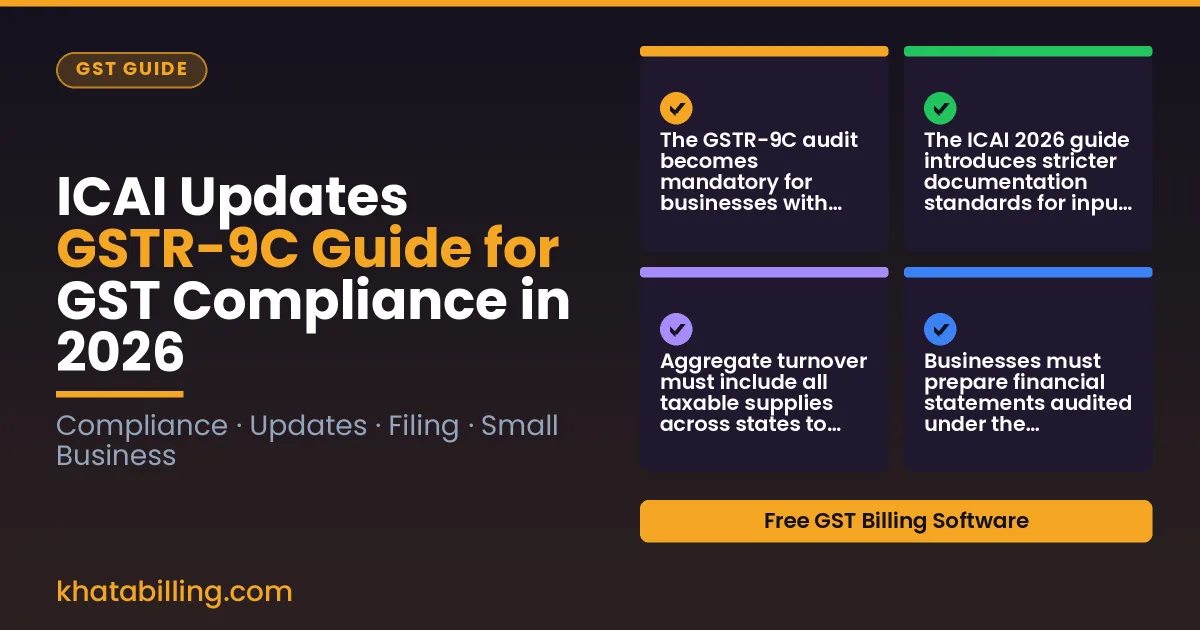
- The GSTR-9C audit becomes mandatory for businesses with turnover exceeding ₹10 crore from financial year 2025-26.
- The ICAI 2026 guide introduces stricter documentation standards for input tax credit verification and audit trail requirements.
- Aggregate turnover must include all taxable supplies across states to determine GSTR-9C eligibility under GST compliance.
- Businesses must prepare financial statements audited under the Companies Act before the GSTR-9C filing deadline.
- Automated GST compliance software reduces manual errors in reconciliation and supports real-time GSTR-1 filing preparation.
- Common mistakes include missing HSN code validation, incorrect ITC claims, and inadequate supporting document retention.
- Use the final checklist to verify audit readiness, ensure GSTR-9C compliance, and maintain continuous GST compliance beyond the audit cycle.
Understanding the GSTR-9C Audit Requirement for GST compliance in 2026
Understanding the GSTR-9C audit requirement for GST compliance in 2026 is essential for businesses that cross specific turnover thresholds under GST law. Any taxpayer whose total turnover in the preceding financial year exceeds ₹10 crore must undergo a GSTR-9C audit, a statutory requirement under Section 35 of the CGST Act. The audit verifies the accuracy of filed returns and ensures proper GST compliance. The compliance deadline for the GSTR-9C audit is the 31st day of the month following the filing of the GSTR-9 return, meaning businesses must complete the audit process by this date to avoid penalties. For small enterprises below the ₹10 crore threshold, GSTR-9C is not mandatory, but maintaining accurate records remains crucial for audit readiness. Khata Billing — free GST billing software supports efficient invoice generation and record-keeping within its free plan limits, covering 10 invoices a day, up to 100 in any 30-day period, helping small traders stay organized. By integrating Khata Billing, businesses can streamline data entry for audit preparation, though the audit itself is conducted by a Chartered Accountant. Staying compliant with GST filing deadlines and understanding the GSTR-9C requirement protects businesses from interest and penalty charges under the GST law.
See more about Khata Billing — free GST billing software.
Key Changes in ICAI GSTR-9C Guide 2026 and Their Impact on GST compliance
ICAI’s 2026 GSTR-9C guide introduces updated documentation standards and expands audit scope, directly affecting GST compliance for Indian small businesses. The revised guide requires auditors to verify physical stock records against system inventories, mandating that every GST invoice includes accurate HSN codes and clear seller details. For example, a retailer with a 30-day invoice volume of 80 must ensure each of the 10 daily invoices has a unique sequential number, and that the total GST liability matches the net tax collected across all 100 invoices in the period. This stricter approach eliminates ambiguity in input tax credit claims and ensures accurate reconciliation of CGST, SGST, and IGST components. The expanded audit scope now includes review of e-invoicing data from e-Waybill generation, and auditors must confirm that the invoice numbering sequence is continuous without gaps. Small businesses using manual billing may face additional record-keeping pressure, but Khata Billing’s automated invoice generation aligns with the new requirements by providing timestamped, sequential invoices with built-in barcode verification. The guide also clarifies that businesses with annual turnover under ₹1.5 crore can opt for simplified documentation, provided they maintain stock adjustment logs and retain all purchase invoices for 8 years. Accurate adherence to these standards ensures smooth GST compliance and avoids penalties during audit. For detailed implementation steps and templates, visit the Khata Billing blog.
Worked Example: Calculating Aggregate Turnover for GSTR-9C Eligibility under GST compliance
This GST compliance worked example shows how to calculate aggregate turnover for GSTR-9C audit eligibility across financial years.
- Gather all sales invoices from April 2023 to March 2024, including GST-registered turnover for each transaction as shown in the sales register.
- Sum the taxable value (excluding GST) of all invoices for the year. For instance, if total sales were ₹8,00,000 in FY 2023-24 and ₹6,00,000 in FY 2022-23.
- Calculate the combined turnover by adding the values from both financial years: ₹8,00,000 + ₹6,00,000 = ₹14,00,000.
- Compare this aggregate amount to the ₹10 crore threshold under GST law; since ₹14,00,000 is below the limit, GST compliance requires no GSTR-9C audit.
- Verify the calculation using Khata Billing's auto-generated sales summary report which consolidates party-wise turnover across years. The platform also maintains digital copies of all invoices for audit-ready verification.
- For businesses near the threshold, note that exceeding ₹10 crore in any financial year triggers the mandatory GSTR-9C audit regardless of prior years. Always use accurate GSTIN-linked records for compliance.All features
Step-by-Step Process to Prepare for GSTR-9C Audit under GST compliance
Start your GST compliance preparation for GSTR-9C audit with these essential steps: 1. Organise all financial records for the assessment year including sales, purchases, and expenses in chronological order. 2. Verify every invoice matches the GSTR-1 filing with correct GSTINs, HSN codes, and taxable values. 3. Reconcile stock movements with purchase and sales records to prevent valuation mismatches. 4. Prepare supporting documents like shipping bills, delivery challans, and payment receipts for scrutiny. 5. Ensure your GST software reflects the latest version and GSTIN details. Use Khata Billing's free plan to maintain daily invoice records within the 10-invoice-a-day limit, and upgrade to Premium for watermark-free invoices and unlimited record-keeping during the 30-day period to handle audit demands efficiently. A reliable POS billing system like the POS billing system streamlines real-time sales capture. Manual register versus digital billing shows that paper-based entries risk errors while digital systems auto-capture transactions, generate GST-compliant invoices with barcode scanning, and store data securely. This structure ensures you meet all GST compliance requirements without last-minute surprises.
Manual vs Automated GST Compliance Methods: A Practical Comparison
Manual record-keeping for GST compliance typically involves paper ledgers, physical file cabinets, and manual calculation of CGST, SGST, and IGST components. A shopkeeper in Delhi tracking sales in a notebook must reconcile every invoice against bank statements, a process that can take 8-10 hours weekly and often leads to mismatches during audit preparation. In contrast, digital GST-compliant systems like Khata Billing automate invoice generation, sync data across devices, and calculate tax liabilities in real-time, reducing audit preparation time by up to 60% as per industry observations. This accuracy prevents costly errors such as incorrect HSN code assignments or missed input tax credit claims, which can trigger penalties under GST law. While manual methods rely on human vigilance, digital platforms enforce consistency through predefined rules for invoice numbering and barcode scanning. For instance, a retailer in Mumbai using automated software avoids duplicate invoice entries that commonly occur in handwritten registers, ensuring compliance with GSTR-1 filing deadlines. The transition from manual to automated billing also streamlines stock valuation updates, as inventory adjustments automatically reflect in financial records, eliminating reconciliation gaps. With Khata Billing's Premium plan enabling unlimited invoicing and advanced GST reports like GSTR-1 and Profit & Loss, businesses achieve audit-ready records without additional effort. This shift not only saves time but also builds confidence during tax authority scrutiny, making GST compliance a strategic advantage rather than a burden.
Common Mistakes to Avoid During GSTR-9C Audit for GST compliance
Businesses frequently stumble during GSTR-9C audit preparation by overlooking critical invoice and HSN code details, which directly impact GST compliance. A common error is mismatching invoice totals with the declared taxable value, such as recording a ₹1,000 item at ₹900 after GST, creating reconciliation gaps. Another frequent issue involves incomplete HSN code entries—using '85' instead of the precise 6-digit code like '851762' for mobiles—leading to classification disputes. Khata Billing's free plan covers 10 invoices a day, up to 100 in any 30-day period, so businesses must ensure all transactions are captured accurately before audit; missing entries trigger mismatches. To prevent this, maintain a daily invoice log matching GST portal submissions, verify HSN codes against the official GST master list, and use barcode scanning for consistency. Additionally, avoid manual spreadsheet reconciliations that skip cash transactions, as this causes input tax credit mismatches. Proactive review of GSTR-1 filings against physical records prevents last-minute surprises during GSTR-9C verification, ensuring smooth GST compliance without unexpected penalties.
Final Checklist and Actions to Ensure Ongoing GST compliance Beyond GSTR-9C
This checklist ensures your GST compliance remains uninterrupted through 2026 and beyond, covering pre-audit preparation and post-audit actions required after GSTR-9C filing.
- Pre-Audit Steps: Verify all sales and purchase invoices in Khata Billing are numbered sequentially with valid GSTINs and accurate HSN codes; reconcile bank statements with recorded cash and UPI transactions; ensure inventory stock counts match physical counts using Khata Billing's stock adjustment feature; confirm input tax credit claims are supported by valid bills and purchase invoices; run the basic reports including party balances and stock overview to identify discrepancies before the auditor arrives.
- Post-Audit Actions: Review the GSTR-9C audit report for any notices or adjustments within 15 days and correct data in Khata Billing immediately; update any pending invoices or corrections in the software to reflect accurate filings; maintain all digital invoices and supporting documents for 7 years as per GST law; schedule quarterly reviews of GST reports like GSTR-1 and P&L using Premium features to catch errors early; keep bank and cash account records synchronized with Khata Billing's real-time data sync to avoid mismatches during future scrutiny.
Khata Billing simplifies GST compliance by automatically generating accurate GSTR-9C-ready documentation from real-time invoicing and stock data, eliminating manual reconciliation errors that businesses face during audit season.
Review your current GST compliance practices to ensure alignment with the 2026 ICAI updates, then Start free with Khata Billing to implement a GST-ready system that reduces audit risk and streamlines filing for every GST return type.
Source: ICAI Releases Updated GSTR-9C Filing Guide for FY 2025-26 — CAclubindia (25 Nov 2026)