- Understanding Recent GST Updates Affecting Shop Operations
- Step-by-Step GST Invoice Compliance for Daily Shop Transactions
- Worked Example: Calculating Invoice Limits and Tax Liability with Real Numbers
- Manual vs Digital Workflow Comparison for GST-Compliant Shop Billing
- Integrating GST Updates with Inventory Management for Shop Accuracy
- POS Integration Checklist for GST-Compliant Shop Billing
- Action Plan for Shop Owners to Adapt to GST Changes Before Deadline
- Frequently Asked Questions
GST updates mandate that Indian shop owners issue GST-compliant invoices for every transaction to remain legally valid, with Khata Billing's free plan covering 10 invoices a day and up to 100 in any 30-day period to support daily operations without additional cost. This compliance requirement directly impacts billing counters, inventory tracking, and GST filing timelines for small retailers across India. Understanding recent GST updates enables shop owners to avoid penalties while maintaining accurate financial records efficiently through digital tools. The free tier of Khata Billing handles basic invoicing with barcode generation and standard themes, while Premium offers unlimited invoicing and advanced GST reports like GSTR-1 for seamless tax submission without extra charges.
Recent GST updates require shops to issue invoices within 15 minutes of delivery, use correct HSN codes, and maintain digital records for 5 years, making Khata Billing's automated invoice generation and cloud sync essential for timely compliance and reducing manual errors at the billing counter during peak hours.
✅ Key Takeaways
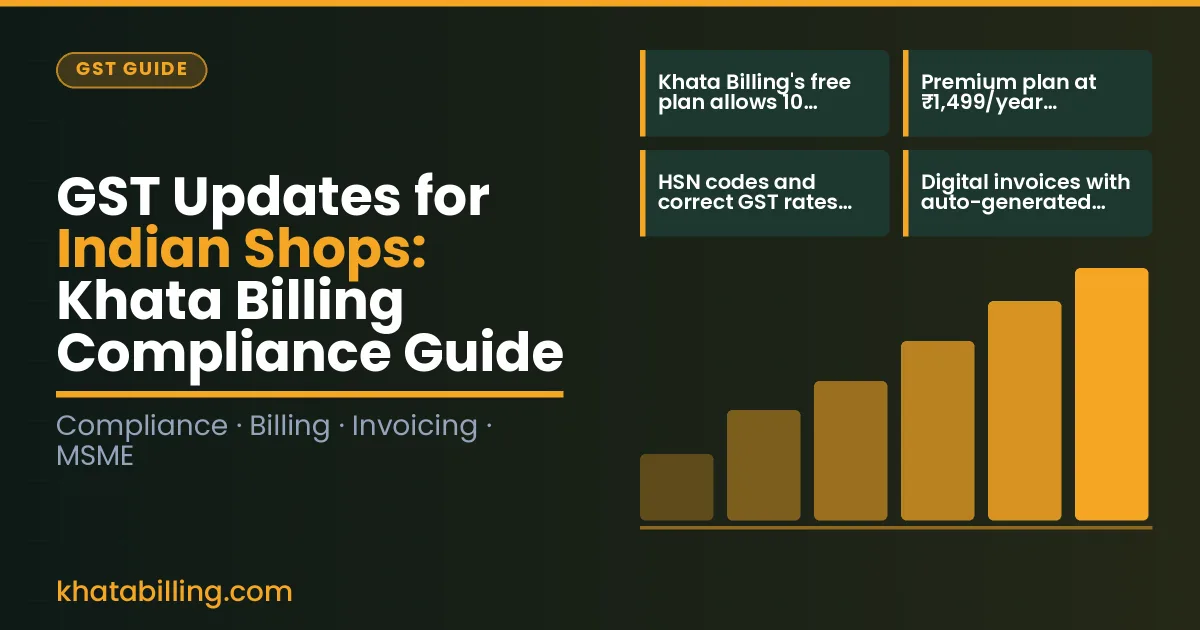
- Khata Billing's free plan allows 10 invoices per day and 100 per 30 days without cost
- Premium plan at ₹1,499/year provides unlimited invoicing and watermark-free GST-compliant invoices
- HSN codes and correct GST rates must appear on every invoice to meet recent GST update requirements
- Digital invoices with auto-generated barcodes reduce manual entry errors during busy shop transactions
- Stock adjustments recorded in Khata Billing sync with inventory management for accurate GST reporting
- GSTR-1 and Profit & Loss reports are Premium features requiring annual subscription for compliance
- Shop owners should adopt Khata Billing's POS integration checklist to ensure GST-compliant billing workflows
Understanding Recent GST Updates Affecting Shop Operations
GST updates effective July 2024 mandate specific invoice generation limits, e-invoice compliance, and revised HSN code rules for shop operations. The new daily invoice cap allows 10 invoices per day under the free plan, with a 100-invoice monthly ceiling, while Premium offers unlimited invoicing with no such restrictions. E-invoice generation must now include a unique IRN and QR code for every transaction, requiring integration with the government portal or approved tools. HSN code classification has been simplified for small retailers: businesses with turnover under ₹50 crore must use 2-digit HSN for B2C invoices, while 3-digit codes apply to B2B transactions, aligning with GST law clarity. Khata Billing — free GST billing software automatically enforces the 10-invoice daily limit and 100-invoice monthly cap in its free plan, preventing accidental overuse. For daily shop transactions, this means tracking invoices at the billing counter to avoid rejection. Staff can use the POS feature with up to 2 screens under free plan to manage these limits efficiently. The system supports barcode-based invoice creation, ensuring accurate item coding and automatic HSN assignment. Manual billing remains possible but requires strict adherence to the 10-invoice daily rule to stay compliant. Khata Billing's real-time sync ensures all devices reflect updated invoice counts instantly, reducing errors during peak hours.
See more about Khata Billing — free GST billing software.
Step-by-Step GST Invoice Compliance for Daily Shop Transactions
To comply with GST updates and stay within Khata Billing's free plan limits, follow these mandatory steps for daily GST invoice generation: first, ensure every invoice includes GSTIN of the supplier, recipient name and address, HSN code, item description, quantity, rate, taxable value, CGST, SGST/IGST, total amount, and a unique invoice number. Next, generate a barcode for each invoice using Khata Billing's automatic barcode feature, which embeds the GSTIN and invoice number for easy scanning. After creating the invoice, verify that the total daily invoice count does not exceed 10 and the 30-day period remains under 100; this prevents exceeding the free plan's 10 invoices per day and 100 in any 30-day period rule. Then, enable real-time synchronization by saving the invoice to the cloud, ensuring tax details update instantly for accurate GSTR-1 filing; this sync is automatic when using Khata Billing's mobile app. For example, a daily sale of 8 items with the following details: 8 units of 'Men's Cotton Shirt' (HSN 6109, 12% GST) priced at ₹500 each, total taxable value ₹4000, CGST ₹480, SGST ₹480, total ₹5360, creates one compliant invoice. Generate the barcode via Inventory & stock management integration, save it, and the system logs it within the 10-invoice daily ceiling.
Worked Example: Calculating Invoice Limits and Tax Liability with Real Numbers
A practical GST updates example for Indian shopkeepers: Let's calculate with 8 daily invoices of ₹2,500 each, totaling ₹20,000 per day. Khata Billing's free plan covers 10 invoices a day, up to 100 in any 30-day period. With 8 invoices daily (80 in 30 days), you have 20 daily capacity remaining and 20 invoice slots left for the month. Calculate CGST/SGST as 2.5% each on ₹20,000 (₹500 CGST + ₹500 SGST = ₹1,000 total tax per invoice). At 8 invoices daily, daily tax liability is ₹8,000. For 30 days, total invoices stay at 240 (well below the 100-invoice 30-day limit). Use Khata Billing's auto-invoice numbering to track this flow. The platform's real-time dashboard shows your remaining 20 daily slots and 20 monthly slots visually. Visit Khata Billing blog for more GST updates. Verify tax amounts using GST calculator tools before filing. Always consult a CA for final tax liability decisions.
See more about Khata Billing blog.
Manual vs Digital Workflow Comparison for GST-Compliant Shop Billing
Manual invoice creation and stock adjustments pose significant GST compliance risks for Indian shops, while Khata Billing's digital billing streamlines accuracy through automation. Consider a local kirana store manually writing paper invoices using a ledger; each entry requires careful HSN code selection, and daily limits in the free plan cap usage at 10 invoices before the 30-day total of 100 is reached, risking GST filing errors. In contrast, using the POS billing system within Khata Billing auto-populates HSN codes based on item selection, enforces sequential invoice numbering without gaps, and eliminates daily limits through Premium plan unlimited invoicing. Similarly, manual stock adjustments involve physically counting shelves and updating ledgers, often leading to discrepancies that cause CGST, SGST, and IGST miscalculations during GSTR-1 filing. Digital inventory sync in Khata Billing updates stock levels in real time across devices, preventing mismatches in party ledgers and ensuring accurate input tax credit claims. The following comparison illustrates how digital workflows resolve common manual pitfalls:
Integrating GST Updates with Inventory Management for Shop Accuracy
Real-time stock adjustments at the billing counter ensure GSTR-1 filings remain accurate by instantly reflecting every sale in inventory records. When a shopkeeper scans a product at the point of sale, Khata Billing automatically reduces stock quantity and updates the value based on the latest purchase rate, eliminating manual reconciliation errors that cause discrepancies in GST returns. The system uses automatic HSN code mapping for each item, so when "100 grams of turmeric powder" is sold, the correct 120190 HSN code is applied without user intervention, meeting GST law requirements for precise item classification. GST mandates stock valuation based on the last purchase cost (LIFO, FIFO or weighted average as chosen in settings), and Khata Billing enforces this by linking inventory entries to the most recent supplier invoice, ensuring the cost of goods sold matches the declared taxable value. For example, if turmeric was bought at ₹50 per unit and sold at ₹60, the system records a ₹10 profit per unit, automatically calculating CGST and SGST components for the GSTR-1 summary. This eliminates mismatches between declared turnover and actual stock movement, a common audit trigger. The platform supports multiple stock valuation methods required under GST, allowing shop owners to select FIFO for perishable goods or weighted average for steady inventory, with all calculations updated in real time at the billing counter, keeping GST compliance seamless and audit-ready.
POS Integration Checklist for GST-Compliant Shop Billing
To ensure GST updates are seamlessly handled in your shop, focus on these technical requirements for your POS system.
- Multi-screen billing capacity: POS systems must support at least 20 billing screens for busy retail environments, allowing multiple transactions during peak hours without delays. Manual billing cannot scale to this level.
- Automatic tax rate application: The system should automatically apply the correct CGST, SGST, or IGST rates based on the product's HSN code. This eliminates manual entry errors when GST rates change, such as during GST updates announced by the government.
- Synchronization with e-invoice portals: During peak business hours, POS systems must sync transaction data in real-time with the e-invoice portal to generate GST-compliant e-invoices. Khata Billing's real-time data sync ensures this happens automatically, avoiding manual uploads that slow down operations.
These features are essential for GST-compliant shop billing. Khata Billing's Premium plan includes multi-screen POS support up to 20 screens, automatic tax calculation, and real-time e-invoice synchronization, which are critical for shops handling high transaction volumes under GST law.
Action Plan for Shop Owners to Adapt to GST Changes Before Deadline
Start your 30-day GST update preparation now with this practical timeline to ensure shop compliance before the deadline. Day 1-5: Train all staff on Khata Billing's digital billing workflow. Teach staff to use barcode scanning for invoice creation, verify HSN codes against the official GST portal, and practice generating e-invoices in real-time. This prevents manual entry errors during GST filing.
Day 6-10: Verify all HSN codes in your product catalog. Cross-check your existing inventory with the latest HSN list from the GST portal. Update Khata Billing's item database with correct HSN codes for each product category. This step ensures accurate GST classification and avoids mismatched filings.
Day 11-15: Set up automated inventory alerts in Khata Billing. Enable stock adjustment notifications for low inventory items and configure threshold alerts for fast-moving goods. Link these alerts to your sales data to prevent stockouts that could disrupt GST-compliant billing cycles. Use the platform's real-time sync to monitor stock levels across desktop and mobile.
Day 16-20: Review your current invoice numbering sequence. Ensure it follows GST rules with sequential numbering and no gaps. Configure Khata Billing to auto-generate invoice numbers based on your shop's sequence. Test printing barcodes on A4 sheets for thermal printer compatibility before peak sales periods.
Day 21-25: Conduct mock GST return simulations using Khata Billing's export features. Generate GSTR-1 reports and Party Ledger data to verify accuracy. This prepares you for actual filing without stress. Ensure all stock valuation reports reflect real-time inventory counts.
Day 26-30: Finalize your compliance checklist. Confirm all staff can access Khata Billing's dashboard with up to 4 widgets for quick stock and sales checks. Validate that unlimited invoicing (Premium feature) is enabled for high-volume shops. Schedule a team review meeting to address any gaps before the official GST deadline.
GST updates for Indian shops are now effortlessly managed with Khata Billing, which handles GST-compliant invoicing, inventory tracking, and POS operations seamlessly within its platform. Small business owners can focus on growth while the software ensures accurate tax calculations and timely filings through its integrated GST features.
Practical compliance is simplified when you Start free with Khata Billing Start free with Khata Billing to experience real-time GST readiness in daily shop operations.
Source: From GST to e-invoicing: Closing the loop on Digital India — The Economic Times (03 Nov 2026)