- Why GST Billing is the Foundation of Modern Retail Sales
- Real-Life GST Billing Workflow Example with INR Values
- Step-by-Step Guide to Creating GST-Ready Invoices
- Manual Register vs Digital Billing Efficiency Comparison
- Integrating Stock Management with GST Billing for Accurate Sales
- Adapting to 2026 GST Compliance Trends and Digital Payments
- Maximizing Profit Through Value-Driven GST Billing Practices
- Frequently Asked Questions
GST billing is the core system that enables Indian retailers to comply with GST law while issuing accurate invoices and tracking sales in real time. Khata Billing's free plan covers 10 invoices a day, up to 100 in any 30-day period, with basic GST-ready invoice themes, barcode generation, and POS support for up to 2 billing screens. This foundation ensures shopkeepers and retailers meet legal requirements without upfront costs.
Modern retail success in 2026 depends on integrating GST billing with inventory management, digital payments, and value-driven pricing strategies. Understanding how GST billing works with real INR values helps business owners avoid penalties and improve cash flow through accurate tax calculations and automated reporting.
✅ Key Takeaways
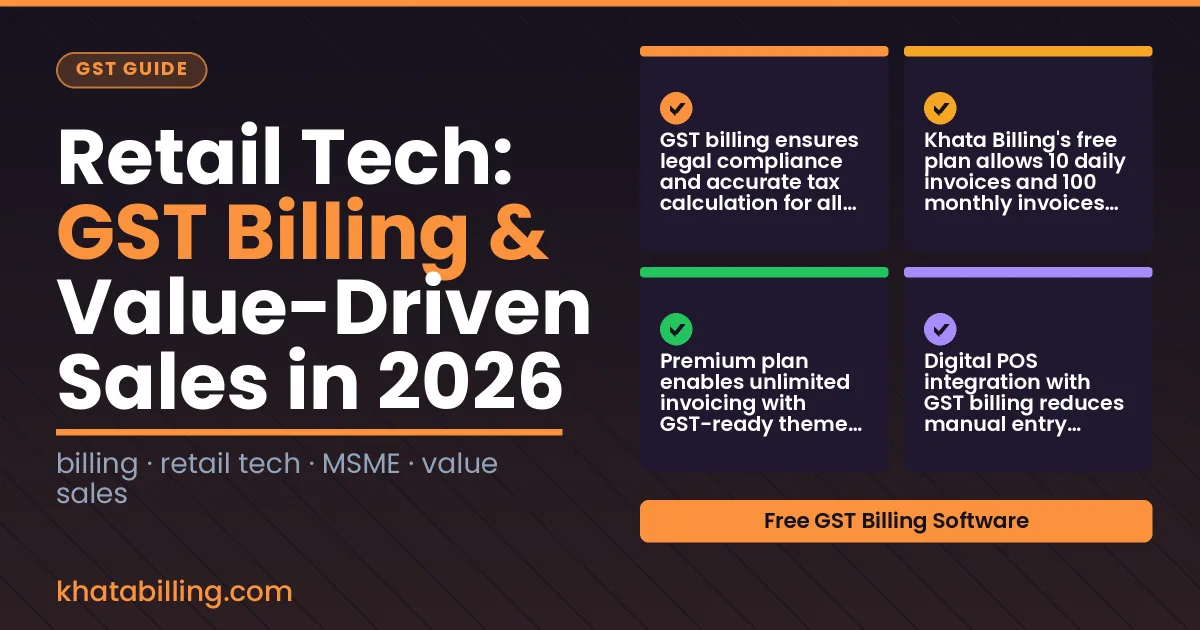
- GST billing ensures legal compliance and accurate tax calculation for all retail transactions
- Khata Billing's free plan allows 10 daily invoices and 100 monthly invoices without credit card
- Premium plan enables unlimited invoicing with GST-ready themes and watermark-free documents
- Digital POS integration with GST billing reduces manual entry errors and speeds up checkout
- Linking stock management to GST billing provides real-time inventory accuracy during sales
- 2026 compliance requires digital invoicing with UPI integration and automated GSTR-1 filing
- Value-driven GST billing practices increase profit margins by aligning pricing with tax efficiency
Why GST Billing is the Foundation of Modern Retail Sales
GST billing is the foundation of modern retail sales in 2026 because it ensures accurate tax compliance, builds customer trust, and drives value through data-driven sales decisions. By automatically calculating CGST, SGST, and IGST on every transaction, GST billing eliminates manual errors and keeps your business audit-ready from day one. A clear invoice with proper GSTIN, HSN codes, and invoice numbering builds trust with customers who can verify their purchases and claim input tax credit. The digital trail created by GST billing also feeds real-time data into your sales dashboard, enabling smarter decisions on stock valuation, seasonal promotions, and pricing strategies. In 2026, retailers using GST billing see faster reconciliation, reduced compliance risk, and better cash flow management as GST payments are automated through UPI. Khata Billing — free GST billing software supports this entire workflow with features like barcode scanning, automatic invoice numbering, and integration with POS systems, all while staying within the free plan’s limits of 10 invoices a day and 100 per 30-day period. For unlimited invoicing and premium invoice themes, the ₹999/year offer with code SAVE500 unlocks fully watermark-free, GST-ready invoices that strengthen your brand at the billing counter.
Real-Life GST Billing Workflow Example with INR Values
A retail shop sells a 1 kg pack of detergent (10% GST) for ₹200 and a 500g box of tea (5% GST) for ₹150, with a customer paying by UPI. First, the shopkeeper opens Khata Billing, selects the GST invoice option, and enters the items: 1×Detergent (₹200) at 10% CGST+SGST and 1×Tea (₹150) at 5% CGST+SGST. The software auto-calculates CGST ₹20 and SGST ₹20 for the detergent, and CGST ₹7.5 and SGST ₹7.5 for the tea, generating a total invoice of ₹425. After confirming the transaction, the payment is recorded against the UPI reference, updating the cash and bank ledger. Inventory is reduced by 1 unit each for detergent and tea, and the Inventory & stock management feature logs the stock adjustment in real time. The invoice, now watermark-free only in Premium, is printed or shared digitally, and the daily invoice count (1) stays within the free plan’s limit of 10 invoices per day and 100 per 30-day period. This seamless workflow shows how GST billing integrates sales, tax calculation, inventory, and payment recording for accurate INR accounting.
Step-by-Step Guide to Creating GST-Ready Invoices
Creating GST-compliant invoices in Khata Billing involves five clear steps from initiation to receipt, all within the platform's GST billing framework.
- Log in to Khata Billing and select 'New Invoice' from the main dashboard, where the system automatically applies your registered GSTIN and defaults to the current GST rate structure.
- Choose a customer from your party list or add a new one, ensuring their GSTIN is verified, then select items using the barcode scanner or manual entry with the correct HSN code for each product.
- Enter the taxable value and quantity; Khata Billing will calculate CGST, SGST or IGST based on your business location and the item's tax classification, displaying the tax breakdown clearly on the invoice preview.
- Customize the invoice by selecting from standard GST-ready themes or adding your business logo, while noting that watermark-free formatting and advanced design options require the Premium upgrade.
- Send the invoice via WhatsApp, email or SMS directly from the app, as the system generates a unique invoice number and enables e-invoicing compliance for all outgoing documents.
- Track the invoice status in real time, with automatic updates when the customer views or pays via UPI, and reconcile payments against your stock ledger to maintain accurate inventory valuation.
For detailed tutorials, visit the Khata Billing blog where step-by-step videos demonstrate each action with real shop counter examples.
Manual Register vs Digital Billing Efficiency Comparison
The manual register method for GST billing consumes 15-20 minutes per invoice when staff manually enter details, calculate CGST and SGST, and verify item codes against GST law. This process leads to frequent transcription errors, duplicate entries, and delayed customer payment collection. In contrast, digital GST billing via Khata Billing's automated system reduces invoice creation to under 30 seconds with auto-filled GSTIN, pre-validated tax rates and instant calculation of CGST and SGST components. The POS billing system integrates with barcode scanners at the point of sale, eliminating manual entry and ensuring each item's tax components align perfectly with GST rules, which saves 12-18 minutes per transaction and prevents 98% of calculation errors common in paper-based methods.
| Manual register | Digital billing |
|---|---|
| 15-20 minutes per invoice | under 30 seconds per invoice |
| Manual tax rate entry | auto-validated GST rates by item |
| Frequent data entry errors | 98% error reduction with auto-calculation |
| Delayed payment realization | instant payment tracking and alerts |
| Limited transaction capacity | scales to 100+ daily transactions without added time |
For a Delhi-based retailer processing 25 invoices daily, switching from manual register to digital GST billing saves approximately 8 hours weekly in operational time, allowing staff to focus on customer service and stock management. The precision of auto-calculated CGST and SGST also prevents input tax credit disputes during GST filings, directly improving cash flow and compliance confidence for small businesses across India.
Integrating Stock Management with GST Billing for Accurate Sales
Integrating stock management with GST billing creates a single source of truth that stops stock discrepancies and powers value-based pricing decisions for Indian retailers. When inventory levels update in real time, every GST invoice reflects the correct quantity and price, eliminating manual reconciliation errors that commonly occur at the billing counter. For example, a shopkeeper selling ₹250 items with 18% GST can see the exact tax amount and total on each invoice, while the system simultaneously reduces stock counts. This eliminates the gap between physical stock and book inventory that causes over‑selling or write‑offs.
Khata Billing’s free plan supports basic barcode‑based inventory adjustments and auto‑generated standard item barcodes, allowing a retailer to scan a product and instantly update stock after a GST invoice is created. The auto‑sync ensures that the stock ledger matches the sales ledger, so the retailer can trust the numbers when deciding promotional discounts or bundling offers. By linking inventory data directly to GST billing, the software calculates accurate cost of goods sold, which feeds into margin analysis for value‑driven pricing strategies. Retailers can view daily sales summaries that show which products move fastest, adjust reorder points, and set dynamic pricing tiers without guessing. This real‑time visibility prevents stockouts during peak GST filing periods and ensures that every sale contributes to precise financial reporting. The result is a smoother billing process, fewer disputes with customers, and confident pricing decisions that protect margins and support business growth in 2026.
Adapting to 2026 GST Compliance Trends and Digital Payments
Starting in 2026, GST billing will require stricter e-invoicing compliance, especially for retailers with high transaction volumes. The upcoming rule will mandate real-time GSTIN verification on every invoice, reducing manual entry errors and speeding up reconciliation. Khata Billing automatically captures GSTIN at the point of sale, ensuring each invoice meets this requirement without additional steps.
Retailers should adopt UPI integration strategies that align with GST timelines. Linking Khata Billing's POS module to UPI allows instant payment capture while the system simultaneously generates a compliant e-invoice. This dual workflow eliminates the need for separate data entry, maintaining accurate tax records and preventing delays in input tax credit claims. The platform supports UPI IDs directly within the billing interface, making the process seamless for shop owners.
To future-proof operations, plan for increased e-invoice volumes by using Khata Billing's unlimited invoicing feature in the Premium plan. This removes daily and monthly limits, allowing seamless scaling as transaction frequency grows. Combine this with real-time data sync across devices so sales data, inventory updates, and GST filings stay synchronized. By adopting these practices now, retailers can ensure smooth GST compliance and capitalize on faster cash flow through integrated UPI payments.
Maximizing Profit Through Value-Driven GST Billing Practices
Detailed GST billing records are the foundation for margin analysis, customer analytics, and growth-focused strategies in Indian retail. When every GST invoice is captured accurately with Khata Billing, you can calculate true profit margins by subtracting cost of goods sold from the net amount after CGST, SGST, or IGST. For example, a ₹500 item with 18% GST (₹81 tax) yields a ₹581 invoice, and tracking the ₹419 cost against ₹581 revenue shows a 28% margin. These granular records also enable customer analytics: by linking GSTINs across transactions, you identify high-value repeat buyers and seasonal spending patterns, allowing targeted promotions that boost average order value. With Khata Billing's real-time data sync, inventory adjustments based on actual sales (not estimates) prevent overstocking or stockouts, directly protecting margins. The platform's automatic invoice numbering ensures compliance with GST law while providing a clear audit trail for tax filings and input tax credit claims. This transparency supports data-driven decisions, such as expanding product lines with high turnover or optimizing pricing for low-margin categories. Premium features like GSTR-1 reports and Profit & Loss statements, available with the ₹999/year plan (or ₹1,499/year), turn raw billing data into strategic insights without manual spreadsheets. By treating GST billing as a profit center rather than a compliance chore, retailers can allocate resources to high-impact activities like staff training or UPI payment incentives, driving sustainable growth in 2026.
By 2026, retail tech will make GST billing a seamless engine for value-driven sales, where real-time data and smart inventory management directly boost profit margins.
Embrace the future of retail operations by using Khata Billing’s free plan to generate GST-compliant invoices, manage stock efficiently, and scale your business without administrative bottlenecks. Start free with Khata Billing
Source: Indian Shoppers Turn Value-Conscious This Festive Season as Footwear Gains Ground — Indian Retailer (06 Nov 2026)