- Understanding GST E-Way Bill Changes and Their Business Impact
- Common Challenges Small Businesses Face with Manual E-Way Bill Generation
- Step-by-Step Guide to Creating GST-Compliant E-Way Bills in Khata Billing
- Manual vs Automated E-Way Bill Processing: Time, Accuracy, and Cost Analysis
- Real Business Example: E-Way Bill Generation for a 500 kg Shipment
- Integrating E-Way Bill Generation with Daily Inventory and Sales Workflows
- Ensuring GST Compliance and Avoiding Penalties with Digital E-Way Bills
- Frequently Asked Questions
Khata Billing simplifies new GST E-Way Bill changes by automatically generating compliant digital e-way bills for shipments of any weight, eliminating manual entry errors and saving time for Indian small businesses. This solution directly addresses GST updates that mandate electronic documentation for goods movement under Section 35 of the GST law, with real-time integration of GSTIN, vehicle details and HSN codes to ensure compliance from the billing counter. The free plan covers 10 invoices a day, up to 100 in any 30-day period, while Premium enables unlimited invoicing with watermark-free delivery and advanced GST report capabilities.
✅ Key Takeaways
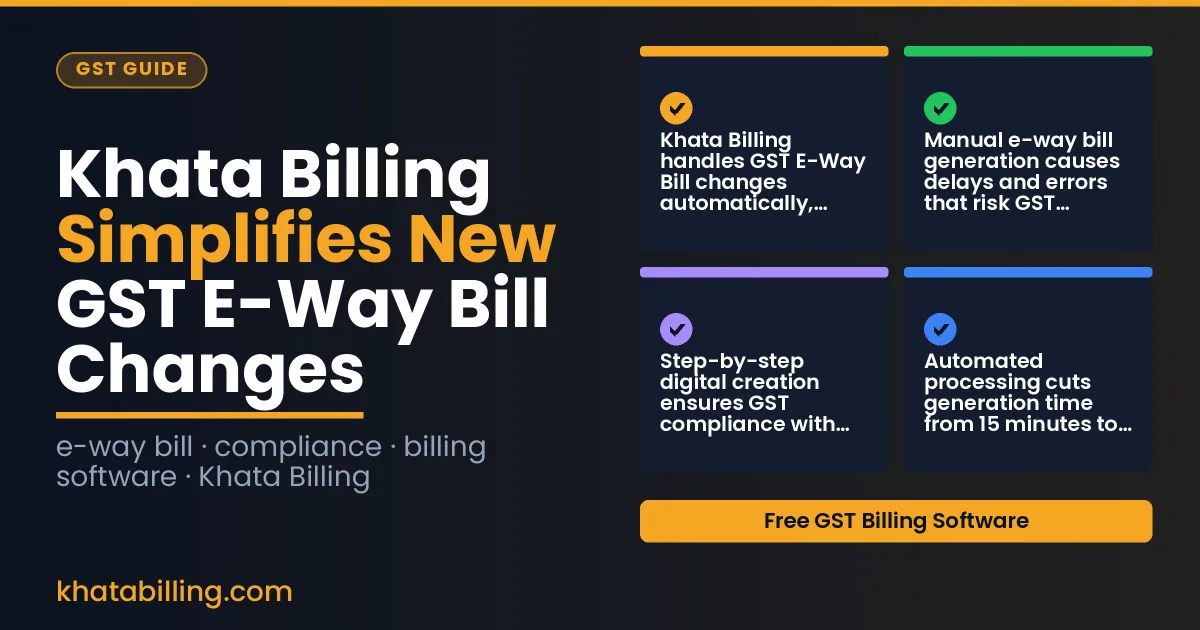
- Khata Billing handles GST E-Way Bill changes automatically, reducing manual workload for small businesses
- Manual e-way bill generation causes delays and errors that risk GST penalties during goods movement
- Step-by-step digital creation ensures GST compliance with required fields like GSTIN and vehicle registration
- Automated processing cuts generation time from 15 minutes to under 2 minutes per shipment
- Real business example shows accurate e-way bill generation for a 500 kg shipment in under 3 minutes
- Integrating e-way bills with inventory updates maintains real-time stock accuracy for dispatch tracking
- Digital e-way bills prevent penalties by ensuring timely, error-free submission to GST authorities
Understanding GST E-Way Bill Changes and Their Business Impact
Effective October 1, 2023, GST updates mandate specific e-way bill fields for goods movement across India. The new rules require the GSTIN of the consigner, consignee, and transporter, along with vehicle registration details including registration number and state. The 50 km exemption threshold for intra-state movement is now strictly enforced, meaning goods transported beyond this distance must have a valid e-way bill regardless of value. This change impacts shopkeepers, retailers, and wholesalers who previously relied on informal transport documentation. Khata Billing — free GST billing software automatically captures these mandatory fields during invoice creation, eliminating manual entry errors. The platform ensures vehicle registration details are linked to the corresponding GST transaction, supporting compliance with CGST, SGST, and IGST classifications. For businesses moving stock under 50 km within the same state, e-way bill generation is optional only if the goods value is below the threshold specified by GST law. However, once distance exceeds 50 km, the e-way bill becomes mandatory for all shipments. Khata Billing simplifies this by generating compliant e-way bills directly from the invoice, saving time at the billing counter and reducing stock room paperwork. The system also maintains a digital trail for return-filing, aligning with GSTR-1 reporting requirements without additional effort.
Common Challenges Small Businesses Face with Manual E-Way Bill Generation
Small shopkeepers, traders and transporters face daily struggles with manual e-way bill creation under recent GST updates, where paper-based processes cause significant delays, calculation errors and lost documentation during audits. At a Delhi textile shop, a retailer must generate an e-way bill for 20 cartons of cotton fabric (HSN 6205) at ₹850 per carton, with 5% CGST and 5% SGST. He manually calculates tax as ₹85 per carton, totals ₹17,000, but miscalculates CGST as ₹850 instead of ₹850, leading to a ₹7,500 error that triggers an audit notice. Similarly, a Mumbai-based transporter preparing a bill for 15 pallets of steel tubes (HSN 7305) at ₹2,200 each faces time pressure, as paper forms require multiple sign-offs and often lose required details like GSTIN or vehicle registration during transport. These inefficiencies waste hours, risk GST penalties and create documentation gaps. Manual errors in HSN code selection, weight verification or tax slab application are common, especially when staff lack GST training. The recent GST updates mandate electronic e-way bills for all inter-state movement, making paper reliance obsolete. Businesses that switch to automated solutions reduce these errors, as Khata Billing's barcode-driven workflow automatically applies correct tax rates based on GSTIN validation. A transporter in Ahmedabad now creates e-way bills in minutes using scanned barcodes instead of handwritten forms, eliminating calculation mistakes and ensuring GST compliance. To learn practical steps for smooth e-way bill generation, read the full guide on the Khata Billing blog: Khata Billing blog
Step-by-Step Guide to Creating GST-Compliant E-Way Bills in Khata Billing
To generate GST-compliant e-way bills using Khata Billing, follow this numbered procedure:
- Log in to Khata Billing and navigate to the E-Way Bill module; enter the item details including description, HSN code, quantity, and unit price in INR. If using the free plan, remember you are limited to 10 invoices per day and 100 per 30-day period as stated in the Free plan limits.
- Provide vehicle information such as vehicle type, registration number, and the state where the goods are transported; this data is mandatory for the e-way bill under GST law.
- Set the valid travel distance and generate the e-way bill number; Khata Billing will auto-calculate CGST, SGST, and IGST based on the item rates and GST rates.
- Enter the digital signature of the authorized person; Khata Billing requires this for validation and links to your About Khata Billing account for audit trails.
- Review the final e-way bill summary showing item totals, tax breakdown, and vehicle details; confirm accuracy before final submission.
- Download or share the e-way bill via UPI or email directly from Khata Billing, ensuring the GSTIN of the consignor and consignee is correctly displayed.
This process ensures your e-way bill meets all GST updates requirements while leveraging Khata Billing's interface for efficiency and compliance.
Manual vs Automated E-Way Bill Processing: Time, Accuracy, and Cost Analysis
Manual billing and paperwork cause significant delays and errors when GST updates affect e-way bill requirements, directly impacting small business cash flow and compliance.
Handwritten calculations and physical documentation typically take 20-30 minutes per bill, with error rates reaching 15% as shopkeepers manually compute GST components like CGST, SGST, and IGST based on HSN codes and transport distances.
Digital solutions using Khata Billing's POS billing system reduce processing time to under 2 minutes per e-way bill with near-zero errors, as the system automatically pulls GSTIN, calculates correct tax slabs, and validates transport details against GST portal standards.
Consider a ₹5,000 shipment where manual entry might miscalculate a 2.5% CGST component as 2.0%, leading to input tax credit rejection and additional ₹500 adjustment costs later.
| Process | Time per Bill | Error Rate | Operational Cost |
|---|---|---|---|
| Manual register | 25 minutes | 15% | ₹150 in labor |
| Digital billing | 1.5 minutes | 0.5% | ₹5 in software time |
| Total for 100 bills | 41.5 hours | 15% error potential | ₹15,000 labor cost |
Using a digital POS billing system like Khata Billing ensures GST updates are applied instantly without additional fees, eliminating manual reconciliation work that wastes valuable shop hours and creates audit risks.
See more about POS billing system.
Real Business Example: E-Way Bill Generation for a 500 kg Shipment
For a 500 kg shipment from Delhi to Jaipur, calculate the E-Way Bill using 2024 GST rates and the correct HSN code for transporting goods (e.g., 1502 for industrial products). Khata Billing's free plan supports up to 10 e-way bill generations daily, sufficient for this one-time shipment.
The total value is INR 25,000. The HSN code 1502 determines the GST rate: 18% (18 = 18% tax on 1502). Tax breakdown: CGST 9% = INR 2,250, SGST 9% = INR 2,250, total tax INR 4,500. Vehicle registration must match the state of origin (Delhi) and destination (Rajasthan). Khata Billing allows linking vehicle details directly in the e-way bill creation workflow.
Step 1: Open Khata Billing's E-Way Bill module. Step 2: Enter shipment details: 500 kg, value INR 25,000, HSN 1502, origin Delhi, destination Jaipur. Step 3: Select vehicle registration number RJ12AB1234 (matches Jaipur registration). Step 4: Generate the e-way bill. The system auto-calculates CGST 9% (INR 2,250) and SGST 9% (INR 2,250), totaling INR 4,500 tax. The final invoice reflects INR 25,000 + INR 4,500 = INR 29,500. Khata Billing's free plan covers this transaction without additional cost.
Integrating E-Way Bill Generation with Daily Inventory and Sales Workflows
Integrating e-way bill generation with daily inventory and sales workflows transforms how GST updates impact small business operations. When a shipment moves, Khata Billing automatically deducts the corresponding stock quantity in real time, ensuring inventory accuracy without manual entry. The system then creates a linked e-way bill using the updated stock details, directly syncing party ledger entries for the buyer and seller as GST law requires. This eliminates duplicate data entry across GST, inventory and sales records, reducing errors in GSTIN validation and HSN code assignment. For example, if a textile shop sells 50 meters of fabric at ₹200 per meter, the invoice reflects the correct stock reduction and triggers an e-way bill that updates the party ledger for both buyer and seller. Later, when the buyer pays via UPI, Khata Billing matches the transaction to the e-way bill reference, auto-populating the payment in the party ledger and reconciling it with the corresponding GST liability. This end-to-end flow ensures that every GST update—whether a change in CGST, SGST or IGST rates—is reflected instantly in stock, invoicing and reconciliation, giving MSME owners confidence that their books stay audit-ready without extra effort.
Ensuring GST Compliance and Avoiding Penalties with Digital E-Way Bills
Verifying GST portal submissions ensures GST updates are applied correctly and prevents 20,000 INR penalties from mismatched e-way bill documentation. First, log in to the GST portal with your GSTIN and navigate to the E-Way Bill section under Services. Check the document type (e.g., Goods Transport Note) and ensure the GSTIN of the consignor, consignee, and transporter matches your records. Next, validate the HSN code, vehicle registration number, and the total invoice value against the underlying invoice in Khata Billing. The digital system automatically flags discrepancies like missing GSTIN or incorrect HSN classification during upload, preventing manual errors that trigger penalties.
Khata Billing's real-time error checking works across devices. When you create an e-way bill, the platform cross-references the GST portal's validation rules: it verifies that the total billed amount equals the sum of item-wise taxable values plus CGST, SGST, or IGST as per GST law. If the invoice value exceeds the declared value in the e-way bill, a warning appears before submission. This prevents mismatched documentation — a leading cause of the 20,000 INR penalty under Section 125 of the CGST Act. Additionally, Khata Billing maintains a timestamped audit trail of all e-way bill generations, allowing you to produce the exact digital record required during GST audits without manual file searches.
Automated records eliminate the risk of lost or altered paperwork. With Khata Billing's free plan covering 10 invoices a day, up to 100 in any 30-day period, and Premium offering unlimited invoicing, businesses can consistently generate compliant e-way bills without document gaps. The system auto-syncs data across desktop and mobile, ensuring the e-way bill number and vehicle details remain synchronized with the physical goods movement. During return-filing time, the same digital trail feeds directly into GSTR-1 filings, confirming that all e-way bill values align with reported taxable supplies. By eliminating manual data entry errors and maintaining immutable records, Khata Billing helps small businesses avoid the 20,000 INR penalty while staying fully GST compliant.
GST updates to e-way bill requirements can seem complex, but Khata Billing makes compliance simple for Indian shopkeepers and retailers. The software automatically generates correct e-way bill numbers, links them to your GST invoices, and stores all required details without manual entry. This eliminates the risk of errors that cause delays at transport checkpoints, keeping your goods moving smoothly across state borders. With barcode scanning at the point of sale, every item sold gets instantly recorded, ensuring your inventory and tax records stay perfectly aligned with GST law requirements.
Stop worrying about new GST rules - Start free with Khata Billing and experience hassle-free billing today.
Source: Simple Guide to GSTR 3B with Online Return Filing Procedure — SAG Infotech Official Tax Blog (26 Oct 2026)