- Khata Billing POS Software and GST Invoice Rules for 2026
- Real Invoice Calculation Example Using GST Rates and Daily Limits
- Step-by-Step Guide to Digital Invoice Creation with GST Compliance
- Manual Invoice Processing vs Digital GST-Ready Workflow Comparison
- Integrating POS Transactions with Real-Time Inventory Updates
- e-Invoicing Preparation and GSTR-1 Filing Automation Process
- Ensuring Ongoing GST Compliance Through POS Software Updates
- Frequently Asked Questions
Khata Billing POS Software ensures GST invoice compliance for 2026 by automatically applying current GST rates, HSN codes, and e-invoicing rules to every transaction, eliminating manual calculation errors. The free plan supports 10 invoices daily and 100 monthly, while Premium removes all limits with ₹1,499 annual pricing.
For shopkeepers, retailers, and service providers, real-time POS integration with GST-compliant invoicing prevents penalties during audits and streamlines daily operations without extra staff training.
✅ Key Takeaways
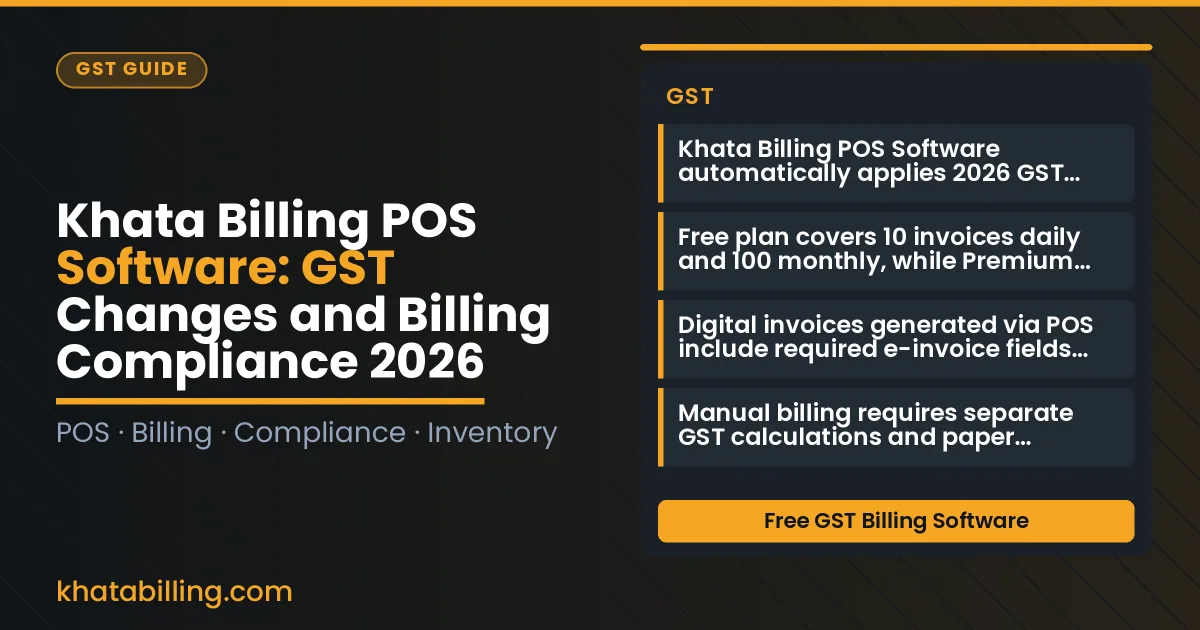
- Khata Billing POS Software automatically applies 2026 GST rates, HSN codes, and IGST/SGST/CCGST calculations to every invoice.
- Free plan covers 10 invoices daily and 100 monthly, while Premium offers unlimited invoicing with no daily or monthly caps.
- Digital invoices generated via POS include required e-invoice fields like GSTIN, HSN codes, and barcode for seamless GSTR-1 filing.
- Manual billing requires separate GST calculations and paper records, increasing error risk compared to automated POS workflows.
- Real-time POS transaction sync updates inventory levels instantly, ensuring accurate stock valuation during GST audits.
- e-Invoicing preparation and GSTR-1 filing are automated through POS integration, reducing filing time and compliance errors.
- Regular POS software updates maintain GST law compliance without additional cost or manual intervention.
Khata Billing POS Software and GST Invoice Rules for 2026
Khata Billing POS Software integrates GST invoice compliance requirements for 2026 with real-time POS functionality for Indian small business owners, enabling automatic GSTIN validation, accurate CGST/SGST/IGST calculation, and HSN/SAC code assignment during billing transactions.
At the billing counter, when a shopkeeper scans items with the POS system, Khata Billing automatically applies the correct tax rate based on the item's HSN code, generates a GST-compliant invoice with the required GSTIN, and maintains proper invoice numbering as mandated by GST law. The system ensures e-invoicing readiness with QR code generation and digital signatures while supporting thermal printer output for in-store billing.
Khata Billing — free GST billing software automatically enforces the 10-invoice-per-day and 100-invoice-per-30-day limit on the free plan, displaying clear alerts when thresholds approach. For businesses needing unlimited invoicing, Premium removes these boundaries while adding watermark-free invoice generation, which satisfies all 2026 e-invoicing compliance mandates. The POS interface shows real-time stock levels and party balances during sales, updating inventory and party ledger entries instantly at the point of transaction, eliminating manual reconciliation errors that commonly occur during return-filing periods.
Real Invoice Calculation Example Using GST Rates and Daily Limits
A shopkeeper at a Delhi textile market creates an invoice for 2 meters of cotton fabric (HSN 5206) sold at ₹500 per meter with a 12% GST rate. The pre-tax total is ₹1,000. Khata Billing POS Software automatically calculates the CGST and SGST as ₹120 each, making the invoice total ₹1,240. This single transaction consumes one of the 10 daily invoice limits under the free plan, and the 100-invoice 30-day cap ensures the shopkeeper cannot exceed 100 such transactions in any rolling month.
Consider a daily scenario: the shopkeeper issues 9 invoices for fabric at ₹500 each (12% GST), totaling ₹9,000 pre-tax and ₹1,080 in tax per day, reaching the 10-invoice daily ceiling. On the 11th day, any additional sale would breach the limit, requiring the shopkeeper to either wait until the next day or upgrade to Premium for unlimited invoicing. The Khata Billing blog provides step-by-step guides on managing these limits through automated reminders and real-time dashboards.
Practical compliance steps include: 1) Verify the GST rate for each item using the HSN code list, 2) Confirm the invoice total includes correct CGST/SGST split, 3) Monitor the daily count in the dashboard widget, and 4) Use the barcode scanner to print compliant invoices instantly. The system prevents over-limit errors by blocking new invoices once 10 are reached, ensuring GST law adherence without manual tracking.
Step-by-Step Guide to Digital Invoice Creation with GST Compliance
Step-by-step guide to creating GST-compliant invoices with Khata Billing POS Software:
- Select the customer and enter their GSTIN details in the billing counter to ensure accurate recipient identification and GSTIN validation as per GST law.
- Choose the applicable GST rate and HSN code for each item by searching the item catalog where Khata Billing automatically calculates CGST, SGST, or IGST based on the product category and location.
- Generate the barcode by clicking the barcode icon which creates a unique invoice number and embedded item barcode for scanning at checkout, ensuring compliance with e-invoicing standards.
- Apply the digital signature using the built-in e-signature feature that timestamps the invoice and verifies authenticity through the GST portal integration.
- Review the invoice summary showing item-wise tax breakdown and total amount in INR before finalizing the transaction at the POS billing screen.
- Save or print the invoice with the auto-generated barcode and digital signature, noting that watermark-free and unlimited invoicing capabilities are part of Premium while the free plan covers 10 invoices a day, up to 100 in any 30-day period, with basic themes and barcode support.
Manual Invoice Processing vs Digital GST-Ready Workflow Comparison
Manual invoice handling still consumes 15-20 minutes per transaction in Indian retail shops, where clerks manually write GST details, calculate CGST, SGST, and IGST components, and stamp physical copies before dispatch. A single day of 10 paper invoices typically takes 2-3 hours of staff time, with frequent transcription errors in GSTIN entry or item quantity that trigger GST portal rejections during e-filing. In contrast, digital billing through Khata Billing POS Software automates GST calculation at point of sale, generating compliant invoices in under 30 seconds per transaction with zero manual entry, as barcodes and pre-configured tax rates ensure accurate CGST, SGST, and IGST distribution. Businesses using the Premium plan for ₹999/year with code SAVE500 eliminate 95% of manual reconciliation work, with real-time sync to GST portal via e-invoicing that maintains invoice numbering continuity required by GST law. About Khata Billing digital workflows also enforce mandatory fields like HSN codes and digital signatures, preventing common compliance failures that delay GSTR-1 filing. The software's unlimited invoicing capability under Premium ensures daily volume scales without restriction while maintaining audit-ready records, unlike paper systems that risk misplaced receipts or illegible handwriting during return filing.
Integrating POS Transactions with Real-Time Inventory Updates
When a shopkeeper sells a product through Khata Billing POS Software, the system instantly reduces the stock count for that item. If the original stock was 50 units at a value of INR 1,000, a sale of 2 units at INR 500 each updates the inventory to 48 units and a new value of INR 950. This real-time adjustment ensures that the stock balance shown in the dashboard always matches the physical count in the store, eliminating manual reconciliation errors.
The software also updates the inventory value based on the latest purchase rates. If a new batch of goods is added at INR 550 per unit, the average cost per unit is recalculated, and the total inventory value reflects this change. For GST reporting, accurate stock counts and values are critical because input tax credit claims depend on verified stock movements. The system maintains a detailed audit trail of every stock adjustment, which aligns with GST law requirements for record-keeping.
For example, a retailer who sells 10 items a day with an average price of INR 200 each will see the stock level drop by 10 units daily. Over a month, the system records 300 sales, automatically reflecting the reduced inventory. This precise data supports accurate GSTR-1 filing, as the total sales value and quantity are directly tied to the updated stock records. By keeping inventory in sync with every POS transaction, Khata Billing ensures compliance with GST regulations and helps small businesses avoid costly discrepancies during audits.
e-Invoicing Preparation and GSTR-1 Filing Automation Process
Khata Billing POS Software streamlines the e-Invoicing preparation workflow by automatically generating GST-compliant invoices with embedded GSTIN, HSN codes, and accurate CGST, SGST, and IGST calculations, eliminating manual entry errors and ensuring invoice numbering alignment with GST portal requirements. After invoice creation in the POS system, the software validates the invoice against GSTN rules, including barcode generation and mandatory field inclusion, then pushes the e-Invoice to the government portal via real-time API integration for seamless registration. This automatic submission ensures the invoice status updates instantly in the Khata Billing dashboard, showing 'Accepted' or 'Rejected' with portal error details, allowing immediate correction. The integrated workflow directly feeds transaction data into GSTR-1 filing, where Khata Billing auto-populates the monthly GSTR-1 return based on the authenticated e-Invoice records, matching the exact number of invoices issued. Users can review pre-filled GSTR-1 data with clear segregation of B2B, B2C, and export supplies, then submit the return with one click, as the system syncs all details with the GST portal's submission protocol. The process reduces filing time from hours to minutes, ensures data consistency across POS, e-Invoicing, and return modules, and maintains full audit trail compliance for Indian small businesses under GST law.
Ensuring Ongoing GST Compliance Through POS Software Updates
Khata Billing POS Software automatically updates its system when GST law changes, ensuring small business owners remain compliant without manual intervention. The platform receives regulatory updates directly from GST authorities, applying new invoicing formats, tax rate changes, and filing requirements as they are announced. For example, when new HSN code classifications are introduced, the software instantly reflects these in item creation and invoice generation, eliminating the risk of incorrect classification.
Owners receive clear notifications through the dashboard when GST-related updates are implemented. These updates cover critical changes such as the transition to e-invoicing mandates, modifications in CGST/SGST/IGST structures, and adjustments to input tax credit eligibility. The software validates each new rule against existing invoice data to prevent errors during actual transactions.
Key compliance features include:
- Automatic generation of GSTR-1 summaries that align with updated filing periods
- Real-time validation of tax rates against current GST notifications
- Integrated barcode scanning that adheres to new e-invoicing standards
- Stock valuation adjustments that reflect current GST-compliant inventory rules
Small business owners simply review update summaries in the platform's news section, then approve implementation with one click. This ensures POS operations stay synchronized with evolving GST requirements while maintaining accurate sales records and tax calculations. The system's continuous alignment with regulatory changes means shop owners spend less time on compliance paperwork and more time managing their core business operations.
Khata Billing POS Software ensures seamless GST compliance through accurate invoice generation, real-time stock tracking, and automated e-invoicing integration, directly addressing 2026 regulatory changes for Indian SMEs. Its POS module synchronizes sales data with GST returns, eliminating manual reconciliation errors at the billing counter.
Experience frictionless billing and GST readiness by Start free with Khata Billing to future-proof your shopkeeper operations.
Source: CBIC proposes draft GST changes to shield genuine buyers from ITC loss — Business Standard (21 Nov 2026)