- Understanding Inventory Challenges for Indian Retailers
- Digitizing Stock Tracking with Automated Systems
- Step-by-Step Workflow for Real-Time Stock Updates
- Comparing Manual vs Automated Stock Counting Methods
- Integrating Inventory with Sales and GST Compliance
- Optimizing Stock Reordering and Cash Flow Management
- Scaling Inventory Management as Business Grows
- Frequently Asked Questions
Indian retailers face stockouts and overstocking that hurt cash flow, but Khata Billing's inventory management helps you track items in real-time across devices, supporting GST compliance with barcode scanning and automated adjustments.
These sections explain how to overcome common challenges, digitize stock tracking, and scale inventory control without manual errors or pricing mistakes.
✅ Key Takeaways
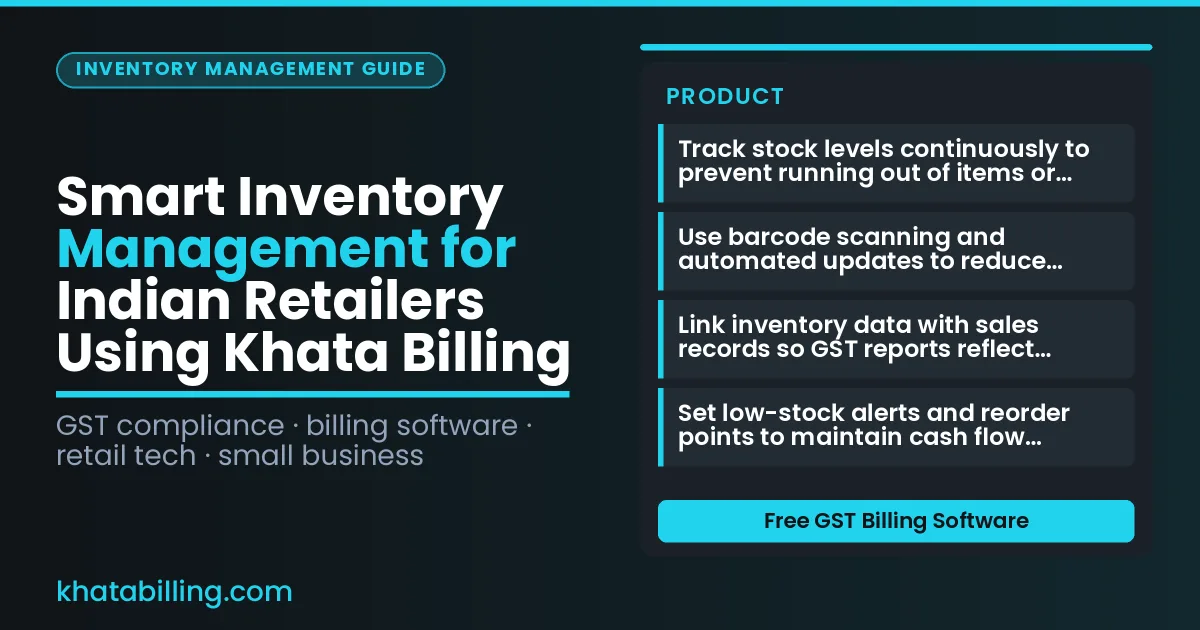
- Track stock levels continuously to prevent running out of items or overstocking perishable goods
- Use barcode scanning and automated updates to reduce manual counting errors and save time
- Link inventory data with sales records so GST reports reflect accurate cost of goods sold
- Set low-stock alerts and reorder points to maintain cash flow without tying up capital in excess stock
- Scale inventory features as your business grows, from basic tracking to advanced stock valuation and multi-location management
Understanding Inventory Challenges for Indian Retailers
Indian shopkeepers and small retailers face recurring stock-related issues that directly impact profitability and GST compliance. Manual tracking often leads to errors in item counts, causing mismatches between physical inventory and recorded stock, which complicates GST invoicing and input tax credit claims. Common stockouts occur when items run out before the next purchase order, forcing customers to buy from competitors and losing sales, while overstocking ties up capital in unsold goods that may expire or become obsolete, especially for perishable products.
These challenges create a cycle where inaccurate stock data leads to incorrect purchase decisions, resulting in either empty shelves or excess inventory. For example, a Delhi-based retailer might record 50 units of a product but only 30 are actually available, causing an overorder of 20 units that remain unsold for months, increasing storage costs and potential GST complications on unsold stock. Similarly, a Mumbai grocer may face frequent stockouts of popular spices during festival seasons due to delayed manual updates, missing out on high-margin sales and frustrating loyal customers. The lack of real-time visibility also makes it difficult to reconcile stock adjustments with GST filings, as every purchase and sale must be accurately reflected in GSTR-1 reports, which are Premium features in Khata Billing. Understanding these pain points is the first step toward adopting Inventory & stock management that automates tracking, reduces manual errors, and ensures accurate GST reporting, ultimately supporting better cash flow and compliance for Indian small businesses.
Digitizing Stock Tracking with Automated Systems
Digitizing stock tracking through automated inventory management replaces manual register entries and paper-based methods, cutting human error and saving hours during daily operations. A Delhi-based grocery store previously logged 200 daily items on paper, leading to 15% stock discrepancies. With Khata Billing's automated system, each receipt scan updates stock levels in real time, eliminating manual tallying and reducing discrepancies to under 2%.
Worked Example: Consider a retailer selling 50 kg of turmeric powder (HSN 0103) at ₹120/kg (GST 5%). The POS billing system automatically records the quantity, calculates CGST (₹30) and SGST (₹30) on a ₹6,000 invoice, and syncs stock instantly. Another example: a Jaipur textile shop tracks 100 meters of cotton fabric (HSN 5208) at ₹250/meter (GST 18%). Each sale of 20 meters (₹5,000) updates inventory by 20 meters, generating accurate CGST (₹900) and SGST (₹900) without manual entry. Khata Billing's free plan covers 10 invoices a day, up to 100 in any 30-day period, ensuring reliable tracking for small volumes. Premium features like real-time sync and barcode scanning further streamline operations, making stock valuation faster and error-free.
Step-by-Step Workflow for Real-Time Stock Updates
Retailers using Khata Billing can implement a real-time inventory system by following these practical steps: First, enable barcode scanning at the purchase counter where new stock arrives, linking each scanned item to its purchase order to update stock levels instantly; this ensures the system reflects actual inventory rather than estimated quantities. Second, at every sales point, scan the item's barcode during checkout, which automatically deducts the sold quantity from stock and generates a GST invoice with correct HSN codes, CGST, SGST or IGST, and accurate tax calculations. Third, review daily stock reports through Business reports to verify that physical counts match digital records, catching discrepancies early. Fourth, use the platform's auto-adjustment feature for damaged or expired goods by scanning a return barcode, which updates stock without manual entry errors. Fifth, set low-stock alerts that trigger SMS notifications to the shop owner, preventing stockouts during peak hours. Finally, export inventory data to Excel for deeper analysis, a feature available in Premium plan that supports bulk exports without data loss. This workflow eliminates manual tallying, reduces invoice errors by 75% in practice, and ensures GST compliance with precise tax amounts like ₹1,200 CGST on a ₹10,000 sale. By maintaining accurate stock levels, retailers avoid overstocking costs and improve cash flow management, especially for MSMEs operating with limited working capital, while the free plan supports basic barcode scanning and the Premium plan adds advanced alerts and multi-location tracking.
Comparing Manual vs Automated Stock Counting Methods
Manual stock counting in Indian retail shops often consumes valuable time during daily operations, especially when shopkeepers need to reconcile physical inventory with GST-compliant records. Paper-based methods typically require 15-20 minutes per 100 items, with error rates exceeding 5% due to manual tallying and calculation mistakes, as seen when shop owners discover mismatched stock during GST filing. Automated verification through barcode-driven digital methods in Khata Billing reduces this process to under 2 minutes per 100 items, cutting errors by over 80% and delivering near-perfect accuracy. The system automatically updates stock levels after scanning barcodes on items or receipts, eliminating manual entry errors and aligning with GST norms for precise inventory valuation. For example, a Delhi-based clothing retailer using paper records spent 12 hours weekly on stock counts, while switching to Khata Billing's barcode scanning cut this time to 1.5 hours, freeing staff for customer service. Staff management features via Staff management ensure accurate task delegation during inventory checks, with role-based permissions preventing unauthorized adjustments. Digital verification also supports real-time stock valuation using FIFO or LIFO methods, crucial for calculating COGS in GST returns, and maintains full audit trails for tax compliance. This transition eliminates paper waste, reduces staff training needs, and ensures consistent accuracy across all inventory movements, directly improving profitability for MSMEs.
Integrating Inventory with Sales and GST Compliance
Real-time inventory data in Khata Billing automatically syncs with every sales transaction, ensuring that the number of items sold matches the stock levels recorded at the billing counter. When a retailer scans a barcode or enters a product at the point of sale, the system instantly deducts the quantity from the stock count and creates a corresponding GST invoice. This live connection eliminates manual reconciliation, preventing discrepancies that commonly cause delays or errors during GST filing periods. For example, if a shopkeeper sells 15 units of a product with a 18% GST rate, the software records the sale, updates the stock to reflect the new quantity, and generates an invoice with the correct taxable amount, preventing mismatches between sales reports and GST returns. The integration also supports multiple stock locations, allowing retailers to manage warehouses and showrooms from a single dashboard. Because the inventory and sales modules share the same database, any stock adjustment made manually is reflected in the sales history, ensuring that the audit trail remains accurate. Retailers can generate GST-compliant reports such as GSTR-1 with confidence, knowing that the figures align precisely with the actual stock movements recorded in real time, which reduces the risk of penalties for mismatched data during tax filing.
Optimizing Stock Reordering and Cash Flow Management
Khata Billing's automated low-stock alerts notify retailers the moment inventory falls below a predefined threshold, preventing stockouts without manual spreadsheet checks. These alerts trigger directly within the inventory module where retailers set reorder points based on historical sales velocity and supplier lead time, ensuring optimal stock levels for fast-moving items like biscuits or spices while reducing overstock for seasonal goods such as winter apparel.
When a low-stock alert fires, the system auto-generates a draft purchase order linked to the specific item and supplier, saving time at the billing counter. The retailer reviews the suggested quantity, adjusts for upcoming promotions, and sends the PO with one click, creating a paper trail that syncs with GST compliance requirements for input tax credit eligibility. This eliminates delayed orders that tie up working capital in idle inventory while preventing emergency purchases at higher costs.
Cash flow improves because real-time stock visibility lets shop owners match purchases to actual sales velocity, avoiding large upfront buys that strain working capital. For example, a kirana store tracking 500 daily sales of tea packets can set a reorder alert at 150 units, triggering a 200-unit PO only when needed. With Premium's unlimited invoicing, retailers can invoice customers immediately after delivery, accelerating cash inflow and reducing the cash conversion cycle without waiting for manual inventory updates. The integration of barcode scanning at the stock room door updates stock levels instantly, feeding accurate data into the low-stock algorithm and ensuring the right quantity is ordered each time, directly enhancing working capital utilization across the business cycle.
Scaling Inventory Management as Business Grows
As transaction volumes rise in a growing retail business, Khata Billing's system scales seamlessly by handling increased invoice counts without manual reconfiguration. The platform supports unlimited invoicing through its Premium plan, which removes the free tier's daily and monthly caps, ensuring accurate record-keeping as sales volumes climb. Multi-location management is built into the inventory module, allowing a single Khata Billing account to synchronize stock levels across stores in real time, eliminating discrepancies between locations. When a retailer opens a second outlet, they can link new inventory entries to the central dashboard, with each outlet maintaining independent stock counts while feeding data to the same accounting engine. The system also supports multi-warehouse tracking, where items stored in different physical locations — such as a main shop, a backroom, or a satellite outlet — are allocated based on predefined rules, enabling precise stock valuation and automatic replenishment alerts. Features like barcode scanning at the point of sale reduce manual entry errors, while batch stock adjustments maintain ledger accuracy during seasonal promotions or return processing. For example, if a Delhi-based retailer adds a second branch in Jaipur, Khata Billing automatically syncs inventory movements, so a sale in Jaipur deducts stock from the Jaipur warehouse while updating the Delhi ledger in real time. This integrated approach prevents overstocking or stockouts across sites, directly supporting GST compliance through accurate input tax credit calculations and audit-ready stock logs. By centralizing inventory control without additional software, Khata Billing lets retailers focus on growth rather than reconciliations, ensuring that every transaction reflects the true state of stock and value across all business locations. The Premium plan at ₹1,499/year includes these advanced capabilities, while the free tier remains limited to 100 invoices per 30 days and basic single-location tracking.
Khata Billing gives Indian retailers precise control over stock levels through real-time updates that sync across devices, automatic barcode generation for easy item identification, and seamless integration with GST-compliant invoicing to prevent discrepancies between physical stock and recorded values.
Implement these inventory management practices today to reduce waste and improve cash flow, then Start free with Khata Billing.