- Why GST Updates Matter for Your Daily Billing
- GST Invoice Requirements: New Rules and How They Change Billing
- Real-World Example: Applying New GST Rules to a Retail Shop
- Step-by-Step Guide to Implement GST Compliance in Billing
- Manual vs Automated Billing: How Workflows Differ
- Integrating GST Updates with Inventory and POS Systems
- Final Checklist for GST-Ready Billing Operations
- Frequently Asked Questions
GST Updates require businesses to adjust their billing systems to meet new compliance rules under GST law. Khata Billing supports GST compliance with automatic invoice formatting, accurate GSTIN verification, and integration of CGST, SGST, and IGST calculations for every transaction, ensuring daily billing stays audit-ready without manual recalibration.
For small retailers, wholesalers, and service providers, these GST Updates directly impact how invoices are generated, how stock is tracked, and how daily sales limits are managed within Khata Billing's free plan. Staying compliant means understanding invoice numbering, barcode requirements, and the transition to digital filing through GSTR-1 submissions, all handled seamlessly within the platform.
✅ Key Takeaways
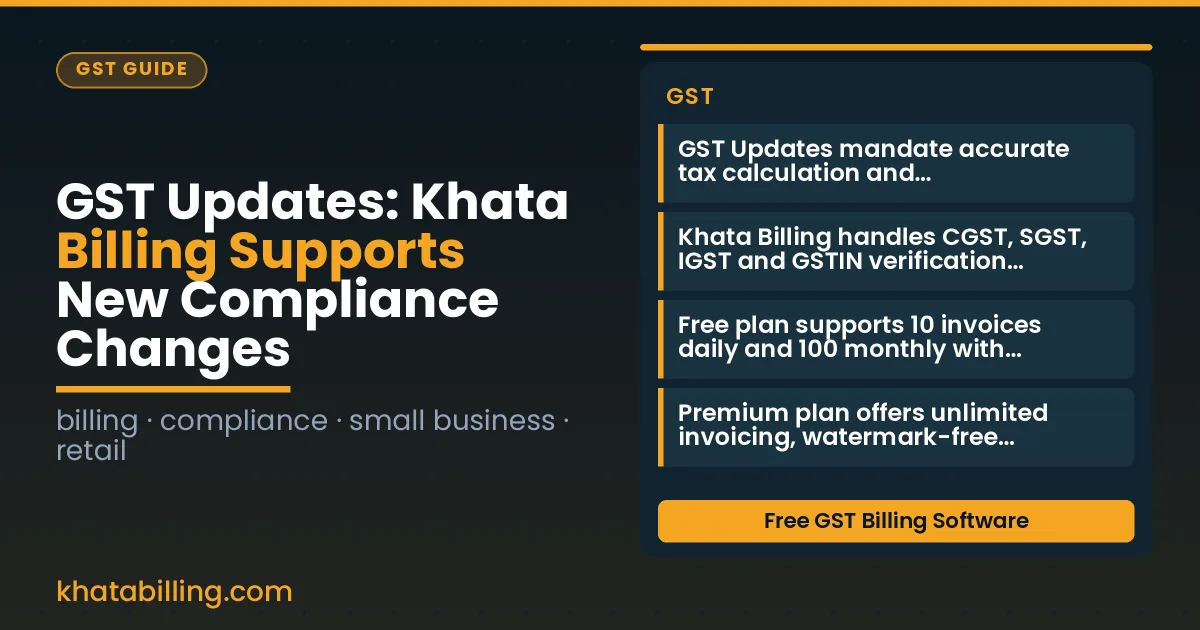
- GST Updates mandate accurate tax calculation and documentation for daily billing operations
- Khata Billing handles CGST, SGST, IGST and GSTIN verification automatically in every invoice
- Free plan supports 10 invoices daily and 100 monthly with standard themes and barcode generation
- Premium plan offers unlimited invoicing, watermark-free documents, and advanced GST reports like GSTR-1
- Manual billing risks errors in tax slabs while Khata Billing automates correct CGST-SGST-IGST splits
- Integrating GST updates with inventory ensures stock adjustments align with taxable sales
- Khata Billing maintains audit-ready records through real-time sync across desktop and mobile devices
Why GST Updates Matter for Your Daily Billing
Recent GST rule changes directly affect the daily billing routine of Indian shopkeepers, retailers and service providers, where manual entry of GSTIN, invoice numbering and tax calculations can easily trigger compliance errors that attract penalties. Small businesses that rely on paper registers or basic spreadsheets risk mismatched CGST, SGST and IGST amounts, incorrect HSN and SAC code selection, and missed GSTR-1 filing deadlines, which may lead to fines or interest charges under GST law. When a shopkeeper manually updates stock after each sale, the chance of forgetting to record an invoice or applying the wrong tax rate increases, creating discrepancies that tax officers scrutinise during audits. Service providers who generate bills without embedding the correct GSTIN or e-invoicing UUID may face rejection of their returns. The practical impact is clear: errors in manual billing can halt cash flow, invite legal notices, and erode customer trust. Automated solutions like Khata Billing — free GST billing software reduce these risks by enforcing GST-compliant invoice formats, auto-populating tax slabs based on HSN codes, and syncing data in real time, ensuring that every transaction adheres to the latest GST updates without extra effort.
See more about Khata Billing — free GST billing software.
GST Invoice Requirements: New Rules and How They Change Billing
GST Updates mandate new invoice rules effective July 1, 2024, requiring additional fields, barcode scanning, and strict e-invoicing timelines that disrupt traditional billing methods. Manual ledgers miss mandatory details like the buyer's GSTIN, SAC code, and dynamic QR code, risking audit non-compliance. Khata Billing automatically captures all required fields, including GSTIN, legal name, and address, while generating scannable barcodes linked to each line item. For example, a local grocery store issuing a GST invoice for 10 kg of onions (HSN 0711) at ₹60/kg, 5 kg of green chilies (HSN 0909) at ₹80/kg, with 5% CGST and 2.5% SGST, can now produce a compliant invoice in seconds: item names, quantities, unit rates, and tax calculations align perfectly with GST law. The POS billing system feature lets shopkeepers scan barcodes at the counter, instantly updating stock and creating invoices without re‑entering data. Traditional paper rolls cannot handle real-time e‑invoicing uploads; Khata Billing syncs within 15 minutes of generation, meeting the 24‑hour e‑invoice portal deadline. This ensures timely GST filing and avoids penalties for late submission. Businesses using manual methods must add GSTIN fields, verify HSN codes, and manually compute tax, increasing error risk. With Khata Billing, the same transaction generates a fully compliant e‑invoice ready for upload, streamlining GST returns and supporting MSME growth under the new regime.
Real-World Example: Applying New GST Rules to a Retail Shop
Here's how Raj, a clothing shop owner in Jaipur, adjusts his GST invoicing for the new 18% GST rate on synthetic fabrics: Khata Billing blog shows step-by-step implementation. First, he verifies his GSTIN and confirms the HSN code 6205 applies to his cotton shirts. Then, he enters the updated rate in Khata Billing's item master, setting 18% as the CGST rate while SGST remains 9% each, matching the new tax structure. Next, he creates a sample invoice with 5 shirts at ₹500 each, calculating ₹250 CGST (5 × ₹500 × 5%), ₹250 SGST, and a total of ₹550 per item. He checks that the invoice displays separate CGST and SGST columns as required by the updated norms. Finally, he confirms the invoice meets the 10-invoice daily limit under the free plan before sending it to the customer. This practical method ensures compliance without extra cost.
Step-by-Step Guide to Implement GST Compliance in Billing
Implementing GST Updates in your billing requires a clear sequence: first, assign precise item codes using HSN or SAC classifications for each product or service; next, configure accurate tax rates (CGST, SGST or IGST) in your billing software to reflect the correct jurisdiction; finally, generate compliant invoices that include GSTIN, invoice number, date, item description, quantity, rate, tax amount and total in INR. This structured approach ensures every transaction meets GST law requirements while simplifying audits and filings.
Here is a practical workflow for small shopkeepers and retailers: 1) Open Khata Billing and navigate to the item master to create new entries with correct HSN codes; 2) Set the applicable tax rate for each item based on GST law; 3) Use the software to auto-generate invoices that embed GST details, avoiding manual calculation errors; 4) Review each invoice for mandatory fields before sending to the customer. Following these steps reduces compliance risk and speeds up daily operations.
Inventory & stock management becomes smoother when item codes are standardized, as accurate stock levels feed directly into correct pricing and tax calculations during billing.
| Manual register | Digital billing |
|---|---|
| Handwritten item codes | Predefined HSN/SAC codes in software |
| Manual tax rate entry | Auto-applied tax rates based on item configuration |
| Paper invoice generation | Electronic invoice with GSTIN and digital signature |
| Error-prone totals | Instant calculation of CGST, SGST and grand total |
Using Khata Billing's free plan covers 10 invoices a day, up to 100 in any 30-day period, while the Premium upgrade at ₹1,499/year removes limits and adds watermark-free, fully customizable invoices that meet all new GST Updates requirements.
Manual vs Automated Billing: How Workflows Differ
Manual billing in Indian small businesses still relies on printed paper forms, handwritten entries, and physical ledger books at the billing counter. A shopkeeper must calculate tax manually, print an invoice, sign it, and then file it manually during GST return periods, consuming hours each week. In contrast, digital billing using Khata Billing automates invoice generation, applies GSTIN and tax rates automatically, and stores records securely, cutting preparation time by up to 70%. This shift eliminates manual calculations, reduces transcription errors, and ensures consistent invoice numbering, directly supporting GST compliance.
Key advantages of automated workflows:
- Time savings: Digital invoices are created in seconds versus minutes for paper, freeing staff for sales or stock management.
- Error reduction: Auto‑calculated CGST, SGST, IGST prevents mismatched tax amounts, avoiding penalties during GSTR‑1 filing.
- Accuracy improvements: Real‑time stock updates and barcode scanning ensure correct item descriptions, preventing returns and audit discrepancies.
For a retailer handling 200 daily transactions, switching from paper to digital reduces the time spent on invoice preparation from 3 hours to under 30 minutes, while eliminating common mistakes such as wrong HSN codes or incorrect tax percentages. The streamlined process also enables instant e‑invoicing submission, ensuring GST law requirements are met without delay. By adopting Khata Billing, businesses move from labor‑intensive manual billing to reliable, automated workflows that improve cash flow, compliance, and overall operational efficiency.
Integrating GST Updates with Inventory and POS Systems
Real-time stock tracking in Khata Billing updates instantly when POS transactions occur, so inventory valuation reflects actual goods sold and prevents manual counting errors that could affect GST calculations for CGST, SGST, and IGST components.
- When a shopkeeper sells 5 units of a product at ₹200 each, the system records the sale immediately, updating stock levels and generating the correct input tax credit claim without waiting for end-of-day reports.
- Barcode scanning at the point of sale eliminates manual entry mistakes, ensuring every transaction is captured for accurate inventory valuation and seamless GST report generation including GSTR-1 filings.
- Integrated POS and inventory data automatically populate the Profit & Loss and GST reports that are Premium features, so business owners see real-time compliance readiness without separate exports.
For example, if a retailer in Delhi records a sale of ₹5,000 with 18% GST, the system instantly reflects the ₹900 tax amount in both the inventory ledger and the GST liability, enabling precise input tax credit claims and avoiding mismatches during audit.
Final Checklist for GST-Ready Billing Operations
To achieve full GST compliance, small businesses must complete five essential actions: staff training on updated regulations, system validation for accurate GSTIN and invoice generation, review of new compliance requirements, ongoing monitoring of regulatory changes, and periodic system audits to ensure data integrity and correct tax calculation across CGST, SGST, and IGST components.
- Staff Training: Train all billing personnel on new GST updates, including correct HSN and SAC code application, accurate CGST, SGST, and IGST calculation, and proper use of barcode-based invoice creation to avoid manual entry errors that lead to filing rejections.
- System Validation: Verify that Khata Billing's GSTIN is correctly entered, confirm that the software automatically applies current tax rates and updates invoice numbering without gaps, and validate that barcode printing aligns with GST-compliant formats for thermal and A4 printers.
- Regulatory Review: Schedule monthly reviews of official GST notifications to ensure awareness of changes affecting e-invoicing, input tax credit eligibility, and new filing frequencies for GSTR-1 and GSTR-3B returns.
- Ongoing Compliance Monitoring: Use Khata Billing's custom dashboard widgets to track real-time sales data against GST thresholds, ensuring daily invoicing stays within the 10-invoice limit for free plan users and adhering to the 100-invoice monthly cap to avoid penalties.
- Periodic System Audits: Conduct quarterly audits of inventory records and party ledger data in Khata Billing to reconcile stock valuation adjustments with actual sales, confirming accurate input tax credit claims and preventing discrepancies during tax audits.
Regularly updating Khata Billing with the latest GST rules through its automatic sync feature ensures that small businesses maintain accurate invoice numbering, correct tax slabs, and proper e-invoicing formats required under current GST law, while the Premium plan's unlimited invoicing and advanced reporting capabilities support seamless compliance during business growth.
Khata Billing keeps your business GST-ready with automatic invoice numbering, barcode printing, and real-time data sync across desktop and mobile. The software handles stock adjustments, party balances, and basic reports so you can focus on serving customers instead of chasing paperwork. With the Free plan covering daily invoicing limits and Premium unlocking GST reports and bulk tools, you choose the level that matches your growth.
GST Updates made simple — let Khata Billing handle the compliance so your shop stays moving forward. Start free with Khata Billing