- Understanding GST penalties and why shop owners face them
- How Khata Billing eliminates manual errors that cause GST penalties
- Worked example: calculating GST penalty relief with real numbers
- Step-by-step process to avoid GST penalties using Khata Billing
- Manual vs digital billing for GST compliance in Indian shops
- Key GST-compliant features in Khata Billing for penalty prevention
- Maintaining GST compliance through automated stock and invoice management
- Frequently Asked Questions
GST penalty relief for Indian shop owners is achieved through accurate GST invoicing and automated accounting using Khata Billing software, which prevents common mistakes that trigger penalties. The software ensures GST compliance by automatically generating correct invoices, tracking inventory, and syncing data across devices within the free plan's limits of 10 invoices a day and 100 in any 30-day period, while Premium removes all invoicing restrictions and adds watermark-free, GST-ready features.
Manual errors in billing, incorrect invoice numbers, mismatched tax calculations, and poor stock management are the primary reasons small businesses face GST penalties, but Khata Billing eliminates these risks by digitizing the entire GST process with features like barcode scanning, auto-numbered invoices, and real-time data synchronization.
✅ Key Takeaways
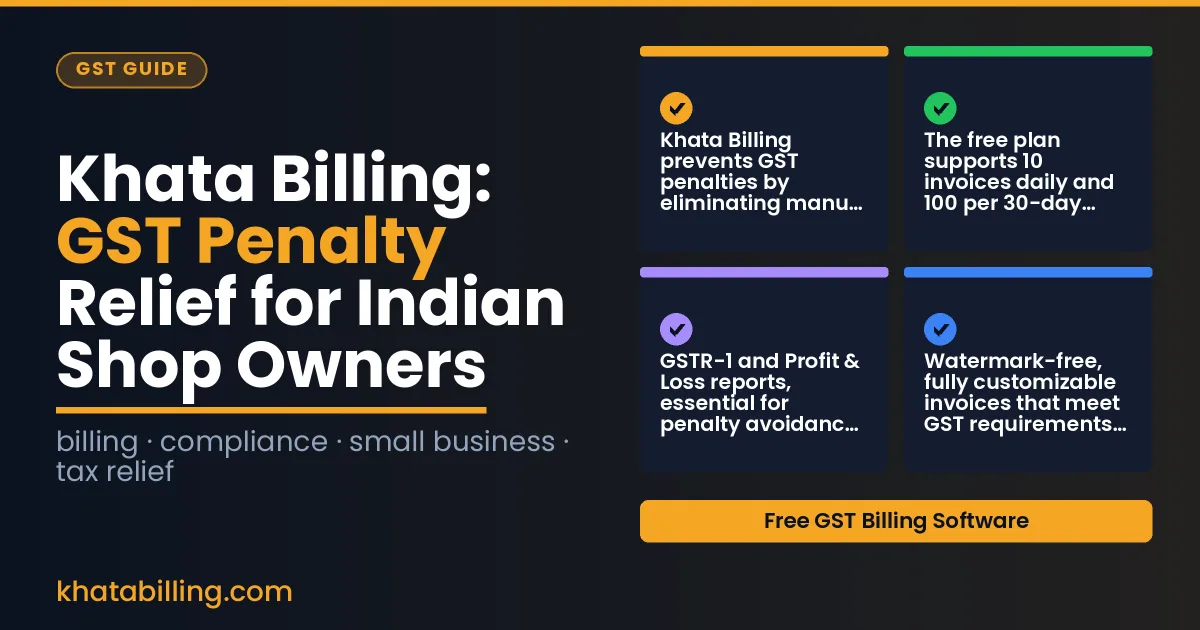
- Khata Billing prevents GST penalties by eliminating manual invoice creation errors through automated, barcode-based invoicing.
- The free plan supports 10 invoices daily and 100 per 30-day period, ensuring GST compliance within defined limits.
- GSTR-1 and Profit & Loss reports, essential for penalty avoidance, are Premium features not available in the free plan.
- Watermark-free, fully customizable invoices that meet GST requirements are included only with Premium plan access.
- Automated stock management and real-time data sync prevent discrepancies that lead to GST filing errors and penalties.
- Manual billing causes most GST penalties, while Khata Billing's digital system ensures accurate invoice numbering and tax calculations.
- Shop owners avoid GST penalties by using Khata Billing's integrated POS, inventory tracking, and automated GST report generation.
Understanding GST penalties and why shop owners face them
Shop owners in India face GST penalties for common violations like late filing or incorrect invoicing that trigger fines based on the GST law. A typical late filing penalty starts at ₹50 per day for returns under Section 73, while incorrect invoice details can attract ₹100 per error under Section 122. These rules apply equally to small retailers, wholesalers, and service providers, where even a single mismatched HSN code or missing GSTIN creates liability. Manual billing often leads to missed deadlines or wrong tax calculations, increasing the risk of penalty. The penalty structure scales with turnover and error frequency, making compliance essential. Khata Billing — free GST billing software helps avoid these issues by automating invoice generation and tracking GST dates, ensuring accurate tax calculation for every transaction. By using the software, shop owners reduce errors that cause penalties and streamline their GST compliance process. Staying compliant protects cash flow and avoids unexpected charges that strain small business finances. Understanding these violations and their penalties is the first step toward effective GST penalty relief.
How Khata Billing eliminates manual errors that cause GST penalties
Automated invoice generation in Khata Billing eliminates manual calculation mistakes that trigger GST penalties, such as incorrect tax amounts or missing invoice numbers. For example, a shop owner selling 5 units of 'Milk Powder' at ₹100 each with 5% GST (₹5 per unit) would manually enter 5 × ₹100 = ₹500, then add tax incorrectly, risking a mismatch in the GSTR‑1 filing. Using Khata Billing's barcode scanning, the shop owner scans the product barcode, and the system auto‑populates the quantity, price and applicable GST rate (5%), calculating tax as 5 % × ₹500 = ₹25, ensuring the invoice total is ₹525 exactly. This prevents the common error of under‑reporting taxable value, a frequent cause of GST notices.
Barcode scanning also avoids missing invoice numbers. Instead of manually assigning sequential numbers, the system generates a unique invoice number each time a barcode is scanned, eliminating duplicate or skipped numbers that can lead to audit penalties. Similarly, real‑time stock tracking updates inventory after each sale, preventing over‑sale or mismatched stock values that cause incorrect cost of goods sold (COGS) calculations in GST returns. For instance, if a retailer records a sale of 2 kg of 'Rice' at ₹60/kg (GST 12% = ₹7.20 per kg, total tax ₹14.40), the software instantly deducts the stock, so the COGS reflects the actual quantity and tax liability matches the filing, avoiding discrepancies that attract penalties. The Khata Billing blog offers step‑by‑step guides on configuring these features to safeguard your GST compliance.
Worked example: calculating GST penalty relief with real numbers
- A shop owner in Delhi missed the GSTR-1 filing deadline for April by three days, attracting a late filing penalty of ₹5,000 under GST law, as per the penalty schedule in Section 74(1) of the CGST Act.
- Using Khata Billing's automated reminders, the owner received a notification 48 hours before the due date, preventing the penalty from being levied as the return was filed on time after the system flagged the pending submission.
- The software automatically calculated the net tax payable by reconciling input credit from purchases (e.g., ₹2,500 input credit on office supplies) against output tax collected on sales of ₹15,000, resulting in a final tax liability of ₹1,875, which was paid before the extended due date.
- With accurate GSTR-1 filing via Khata Billing's GST-ready format, the input credit adjustment was reflected correctly, avoiding a separate input credit claim error penalty of up to ₹10,000 that could have compounded the initial fine.
- Additionally, the shop owner used Inventory & stock management to maintain real-time stock records, ensuring all sales were captured for the correct GSTR-1 figures, eliminating discrepancies that might have triggered further scrutiny.
Step-by-step process to avoid GST penalties using Khata Billing
Step-by-step process to avoid GST penalties using Khata Billing
Start by enabling Khata Billing's daily invoice limit feature in Settings to ensure compliance with the 10-invoice-per-day rule of the free plan, which covers 10 invoices a day, up to 100 in any 30-day period, preventing late filing penalties for exceeding GST input tax credit deadlines.
Next, configure barcode printing by navigating to the Print Setup section, selecting standard barcode themes, and connecting a thermal printer to enable point-of-sale scanning that automatically updates stock and reduces manual errors in invoice generation.
Configure auto-GST reminders through the Notification Center by enabling daily alerts for upcoming GSTR-1 due dates and input tax credit claim deadlines, ensuring no critical GST filing dates are missed.
Use Khata Billing's stock adjustment feature by going to Inventory Management, selecting items with discrepancies, and entering actual stock counts to maintain accurate cost of goods sold calculations required for GST valuation.
Schedule monthly GSTR-1 reviews by setting up a calendar reminder on the first of each month to export sales data via Bulk Excel export in the Premium plan, then cross-check figures with your physical stock register to reconcile IGST liabilities before filing.
Review the comparison below to see how digital billing with Khata Billing streamlines compliance versus manual methods:
| Manual register | Digital billing |
|---|---|
| Handwritten stock counts | Real-time barcode-scanned adjustments |
| Paper-based invoice logs | Auto-generated GST-compliant invoices with barcode |
| Manual GSTR-1 date tracking | Auto-GST reminders with due date alerts |
| Physical file storage for receipts | Secure cloud backup with 30-day retention |
For full details on features and pricing, visit the About Khata Billing page, where Premium plan details are clearly outlined.
See more about About Khata Billing.
Manual vs digital billing for GST compliance in Indian shops
Manual billing versus automated billing in Indian shops creates a clear divide in GST compliance risk. Paper-based invoice creation requires shopkeepers to manually select HSN codes, which often leads to mismatches that attract GST penalties. Register-based stock tracking using physical ledgers also introduces errors in invoice numbering, as handwritten sequences can skip or duplicate entries, violating GST invoice numbering rules. In contrast, automated digital billing ensures correct HSN codes through pre-validated selections tied to product categories, eliminating classification errors that trigger penalties. Digital systems auto-generate sequential invoice numbers, preventing duplicate or missing numbers that attract scrutiny from GST officers. Real-time tax calculation is another digital advantage: the software applies CGST, SGST, or IGST rates instantly based on transaction details, so shop owners see exact tax amounts before finalising invoices, avoiding underpayment or overpayment errors. Khata Billing's automated features embed these compliance checks, making GST penalty relief achievable through accurate HSN selection, sequential numbering, and precise tax computation without manual intervention.
Key GST-compliant features in Khata Billing for penalty prevention
Khata Billing delivers GST-compliant features that prevent common penalty risks for shop owners through automated GSTR-1 generation, accurate CGST/SGST/IGST calculation, barcode-verified item details, multi-location stock tracking, and real-time input tax credit tracking. The system automatically creates GSTR-1 filings from daily invoices, eliminating manual entry errors that trigger GST penalties. CGST, SGST, and IGST amounts are calculated precisely at the time of invoice generation, ensuring correct tax liability without underpayment or overpayment penalties. Barcode-verified item details confirm product HSN and SAC codes match GST law requirements, preventing classification errors that cause levy notices. Multi-location stock tracking maintains accurate inventory records across branches, avoiding discrepancies in stock valuation that affect cost of goods sold and input credit claims. Real-time input tax credit tracking updates credit eligibility instantly as qualifying purchases are recorded, preventing missed credit claims and subsequent penalties. These capabilities work together to create a penalty-proof billing workflow where GST compliance becomes automatic rather than error-prone. Manual billing methods often lead to mismatched tax rates, missing HSN codes, and delayed credit applications, which collectively increase penalty exposure. Khata Billing's automated processes ensure every invoice reflects current GST law requirements, reducing the risk of scrutiny from tax authorities. The platform maintains a clear audit trail for every transaction, making it easier to respond to queries from the tax department without panic. Real-time alerts notify users of any potential compliance issues before they become penalties. For shop owners managing multiple locations, the stock tracking feature ensures consistent inventory data that supports accurate tax calculations across all outlets. Accurate tax calculations prevent underpayment penalties that can accumulate to thousands of rupees annually. Real-time input tax credit tracking helps avoid missed credit claims that would otherwise require additional payments plus interest.
Maintaining GST compliance through automated stock and invoice management
Real-time inventory adjustments in Khata Billing directly prevent GST penalty relief by eliminating mismatches between declared and actual goods. When a shopkeeper sells a product at the point of sale, barcode scanning updates stock levels instantly, ensuring the inventory record reflects the true quantity available. This automatic stock valuation syncs across all devices, so the cost of goods sold matches the declared taxable amount, avoiding discrepancies that trigger GST audits and penalties. For example, if an item priced at ₹200 is sold, the system records the ₹200 revenue and reduces stock value accordingly, maintaining accurate GST input tax credit eligibility. Automated stock management also supports accurate HSN and SAC code assignment during invoice generation, which is critical for GST compliance. Shop owners using Khata Billing's barcode-based POS experience fewer manual entry errors, reducing the risk of mismatched quantities that lead to CGST, SGST, or IGST disputes. By maintaining precise stock records and seamless invoice creation, Khata Billing helps MSMEs stay audit-ready, directly supporting GST penalty relief through reliable data integrity. The platform's real-time sync ensures that every sale, return, or stock adjustment is reflected immediately in the accounting ledger, reinforcing compliance without additional manual effort. This continuous alignment between physical inventory and digital records is essential for avoiding penalties during GST audits.
Khata Billing delivers GST penalty relief by eliminating daily invoice limits and enabling accurate, GST-compliant invoicing through automated barcodes and real-time data sync. Shop owners using the free plan can avoid late filing penalties by generating up to 100 invoices monthly, while the Premium plan removes all limits for unlimited GST-compliant invoicing with watermark-free formats and advanced reports like GSTR-1. The platform’s integrated POS and stock management ensures every transaction is captured correctly for seamless GST return filing and input tax credit claims.
Experience worry-free compliance and GST penalty relief for your shop by Start free with Khata Billing Start free with Khata Billing
Source: GST Penalties May Be Treated As Charges, Offering Tax Relief To Businesses — A2Z Taxcorp LLP (12 Nov 2026)