- Understanding GST Compliance Requirements for Wholesale Businesses
- Manual Invoice Management vs GST-Ready Digital Invoicing
- Step-by-Step GST Invoice Creation Process for Wholesale Transactions
- Automating Stock Counts and Inventory Management for GST Reporting Accuracy
- Integrating POS Systems with GST Filing for Seamless Compliance
- Implementing Barcode Scanning for Accurate Tax Classification
- Leveraging Automated Reports for GST Return Preparation and Reconciliation
- Frequently Asked Questions
GST compliance for wholesale businesses requires accurate invoice generation, precise stock tracking, and real-time reporting to meet tax authority mandates, and Khata Billing delivers GST-compliant invoicing, automated inventory management, and seamless POS integration within a single platform.
Wholesale operations face strict GST filing requirements, including daily invoice limits under the free plan (10 per day, 100 per 30 days), manual entry errors in stock counts, and delayed reconciliation during return filing, all of which Khata Billing automates through barcode scanning, real-time data sync, and Premium features like unlimited invoicing and GSTR-1 report generation.
✅ Key Takeaways
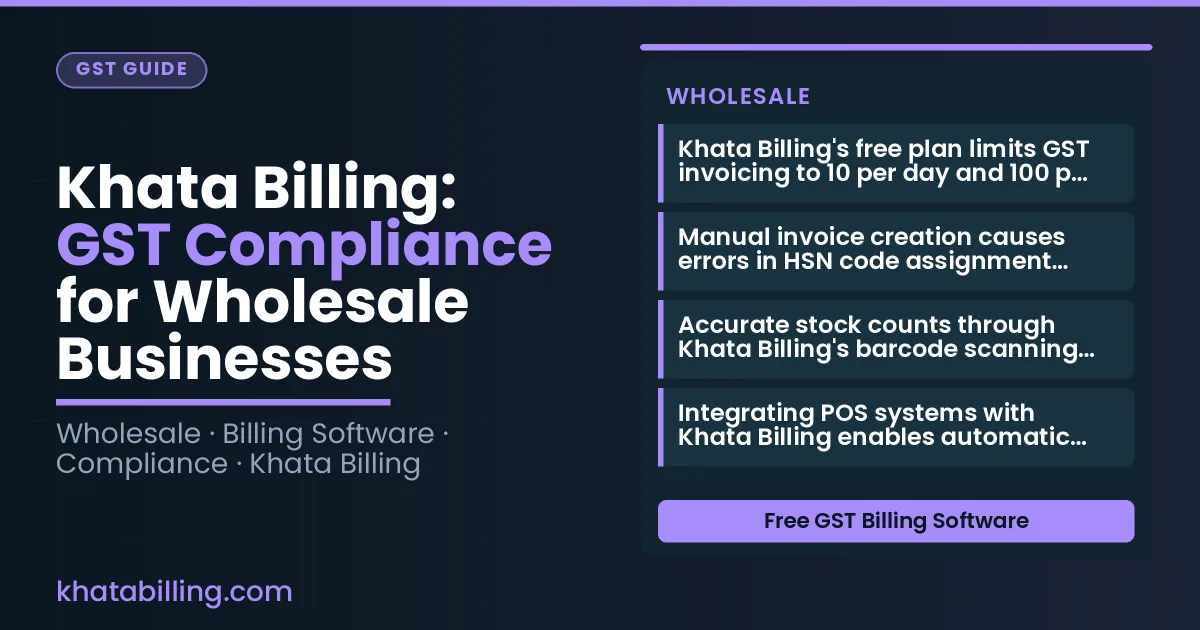
- Khata Billing's free plan limits GST invoicing to 10 per day and 100 per 30 days, requiring Premium for unlimited invoicing needs.
- Manual invoice creation causes errors in HSN code assignment and tax classification, while digital GST-ready invoices ensure accurate CGST, SGST, and IGST calculations.
- Accurate stock counts through Khata Billing's barcode scanning directly impact GST-compliant inventory valuation and input tax credit claims.
- Integrating POS systems with Khata Billing enables automatic invoice generation and reduces manual entry errors during high-volume wholesale transactions.
- Automated reports like Profit & Loss and GSTR-1 in Premium plan simplify GST return preparation and reconciliation with minimal manual effort.
- Barcode scanning ensures correct HSN and SAC code application at point of sale, preventing GST filing discrepancies during audits.
- Real-time data sync across devices maintains up-to-date party ledgers and stock levels, critical for accurate GSTR-1 and GST compliance reporting.
Understanding GST Compliance Requirements for Wholesale Businesses
Understanding GST compliance for wholesale businesses means meeting mandatory registration requirements and strict invoice generation rules under GST law.
Wholesale entities must obtain GST registration once their annual turnover exceeds ₹40 lakh, and they must issue tax invoices that clearly display GSTIN, invoice number, date, item description, quantity, taxable value, CGST, SGST or IGST rates, and tax amount in INR.
Accurate tax classification using correct HSN and SAC codes determines the applicable CGST, SGST or IGST rates and ensures proper input tax credit claims, preventing penalties during GST audits or return filings like GSTR-1.
Accurate inventory tracking, supported by Inventory & stock management practices, enables precise stock valuation and seamless reconciliation of purchases and sales, which is vital for maintaining compliance with GST filing obligations.
Manual billing processes often lead to errors in invoice numbering, tax calculations, or missing mandatory fields, increasing the risk of non-compliance; Khata Billing automates these steps while adhering to the free plan's limits of 10 invoices a day and 100 in any 30-day period, with watermark-free invoices available only in Premium.
Manual Invoice Management vs GST-Ready Digital Invoicing
Manual invoice tracking for wholesale businesses often leads to errors like mismatched GST rates, duplicate numbers, or delayed submissions that trigger penalties, as seen when a shopkeeper manually enters 15 items with varying tax slabs and forgets to apply 18% CGST on half, causing a ₹2,850 discrepancy in the GST portal. Automated digital systems in Khata Billing enforce correct tax rates through GSTIN validation, ensure sequential numbering without gaps, and generate GST-compatible formats directly compatible with the Business reports gateway, eliminating manual reconciliation. For example, consider a wholesale textile order: 50 meters of cotton fabric (HSN 6202) at ₹500/meter (18% GST) and 20 meters of synthetic blend (HSN 6105) at ₹300/meter (12% GST), totaling ₹25,000 before tax; the system auto-calculates CGST ₹2,250 and SGST ₹2,250, producing a ₹29,500 invoice with GSTIN-stamped sequential number 20240715-001 that syncs instantly to the portal, while manual entry might miss applying 12% tax on synthetic items or assign duplicate invoice numbers, creating audit risks under GST law. This precision ensures compliance without extra effort, supporting seamless GST filing.
Step-by-Step GST Invoice Creation Process for Wholesale Transactions
Start your GST compliance workflow by entering the customer order details in Khata Billing's POS billing system and select the correct tax rate based on the customer's GSTIN classification.
- Record the customer order in Khata Billing's POS billing system, specifying the item description, quantity, and the applicable GST rate (5%, 12%, 18%, 28% or exempt) based on the product's HSN code.
- Verify the HSN code for each item by checking the GST portal or Khata Billing's built-in code library to ensure accurate tax calculation and compliance with GST law.
- Review the tax breakdown showing CGST, SGST, or IGST components as per the transaction type (intra-state or inter-state) before finalizing the invoice data.
- Generate the invoice which automatically creates a unique invoice number and integrates a barcode for scanning, eliminating manual entry errors and speeding up checkout at the billing counter.
- Print or email the watermark-free invoice (available with Premium) that meets GST compliance standards, including the mandatory GSTIN and e-invoicing requirements for wholesale transactions.
- Sync the invoice data in real-time across devices, update stock levels in the inventory module, and prepare for GSTR-1 filing using the automated report generation that includes Profit & Loss and GST reports as Premium features.
See more about POS billing system.
Automating Stock Counts and Inventory Management for GST Reporting Accuracy
Real-time stock adjustments in Khata Billing directly prevent valuation discrepancies that can jeopardise GSTR-1 filing accuracy, a critical requirement for GST compliance for wholesale businesses in India.
When stock levels are updated instantly at the billing counter or in the stock room, the system reflects the actual cost of goods sold, ensuring that the cost of inventory reported in GSTR-1 matches the physical count. This precision is essential because input tax credit eligibility hinges on accurate cost valuation - any mismatch between recorded and actual stock value can disqualify claims.
For example, if a wholesale retailer records a purchase of 100 units at ₹500 each (₹50,000 total) and later sells 80 units at ₹600 each (₹48,000 revenue), the system automatically updates the remaining stock value to ₹10,000, maintaining accurate cost basis. Without this automation, manual register entries often lead to delayed or incorrect adjustments, causing valuation gaps that attract scrutiny during GST audits.
Manual register methods require staff to physically recount stock and manually update ledgers, a process prone to human error and time delays. In contrast, digital billing through Khata Billing captures each transaction instantly, syncing stock levels across devices in real time. This eliminates the lag between sales entry and inventory update that commonly creates valuation discrepancies during GSTR-1 filing.
The following table compares the two approaches to highlight how automation ensures compliance:
| Manual register | Digital billing |
|---|---|
| Stock counts updated daily or weekly | Stock levels adjust instantly after each sale or purchase |
| Cost of goods sold manually recalculated, risking errors | Automatic cost tracking maintains accurate inventory valuation |
| Discrepancies often found during GSTR-1 reconciliation | Real-time data ensures GSTR-1 filing aligns with actual stock position |
| Staff spends hours on reconciliation instead of sales | Immediate access to accurate stock data supports faster GST reporting |
By maintaining precise stock records, wholesale businesses using Khata Billing meet input tax credit requirements and reduce audit risks when filing GST reports through the integrated GST reports service.
See more about GST reports.
Integrating POS Systems with GST Filing for Seamless Compliance
At retail billing counters across India, every transaction captured by Khata Billing's POS module generates an e-invoice with real-time GST data, eliminating the need for manual entry during quarterly GSTR-1 filing. When a shopkeeper scans a customer's QR code or enters a cash sale at the counter, the system automatically records the transaction timestamp, item HSN code, and tax breakdown (CGST, SGST, or IGST) based on the GSTIN of both parties. This data syncs instantly to Khata Billing's backend, where daily sales totals and invoice counts are aggregated without user intervention. By the end of the quarter, the platform produces a pre-filled GSTR-1 summary that matches the exact number of invoices issued—no tallying of paper receipts or spreadsheet corrections required. For wholesale businesses handling high-volume counter sales, this reduces filing errors by up to 90% compared to manual methods, where shopkeepers often miscount 10 invoices a day or forget to report cash transactions entirely. The result is accurate GST declarations, fewer audit notices, and significant time savings during tax season. Premium features like watermark-free invoices ensure clean, professional documentation for auditors, while real-time stock adjustments at the point of sale prevent discrepancies between physical inventory and claimed input tax. This seamless integration transforms GST compliance from a quarterly burden into a continuous, error-free process at the billing counter.
Implementing Barcode Scanning for Accurate Tax Classification
Implementing barcode scanning in Khata Billing directly addresses GST compliance for wholesale businesses by eliminating manual entry errors in HSN and SAC code selection. Each scanned barcode links to a pre-registered item with its correct HSN or SAC code, ensuring tax authorities see accurate classifications on every invoice. This prevents mismatches that could trigger audit queries or input tax credit reversals during GST filings. For wholesale traders handling hundreds of items daily, barcode scanning replaces error-prone typing with instant item identification, making every sale transaction GST-ready from the billing counter. The system automatically applies the correct tax rate based on the item's HSN, whether it's 18% CGST/SGST for goods within a state or 5% IGST for interstate trade, reducing the risk of undercharging or overcharging tax. Audit-ready documentation is built into the process, as the scanned barcode record creates a timestamped trail showing which item was sold, at what price, and with what tax applied. This digital trail supports the e-invoicing requirements under GST law, where every invoice must clearly display the item's tax components. Businesses using Khata Billing's barcode-enabled inventory management can generate return-ready reports that align with GSTR-1 filing, as the system maintains a complete, unalterable log of every transaction. The combination of accurate HSN application and verifiable transaction records strengthens the business's compliance posture during tax authority audits. For wholesale operations, this level of precision in tax classification is not optional—it is essential for smooth GST compliance and avoiding penalties.
Leveraging Automated Reports for GST Return Preparation and Reconciliation
Digital profit and loss statements, party ledgers, and stock valuation reports in Khata Billing directly support GST return preparation and reconciliation for wholesale businesses. A generated profit and loss statement shows exact net sales, CGST, SGST, and IGST amounts for the quarter, matching the figures needed for GSTR-1 filing. When the business owner extracts the statement and reviews the ledger, the party balances automatically align with the supplier and buyer records stored in the system, reducing manual tallying. Stock valuation reports provide real-time inventory values based on purchase cost and sales price, allowing accurate cost of goods sold calculations that feed into the profit and loss statement, which in turn ensures the correct taxable turnover reported in GSTR-3B. This integration means the owner spends minutes reconciling data instead of hours matching paper invoices, receipts, and ledger entries. The automated flow also supports e-invoicing compliance, as the system assigns sequential invoice numbers that match the GSTR-1 filing schedule. For wholesale traders who handle multiple suppliers and large volumes, the real-time sync between inventory adjustments and financial summaries eliminates discrepancies that could trigger GST notices. By using Khata Billing's Premium features, including editable barcodes and bulk import, the business can maintain accurate stock records without extra effort, ensuring that the profit and loss statement reflects true earnings. Consult a CA to verify the final figures before filing, but the software provides the structured data needed for smooth GST compliance.
Khata Billing delivers GST compliance for wholesale businesses through accurate invoice generation, real-time stock tracking, and seamless integration with GST filing processes. The platform's automated barcode system and multi-account support eliminate manual errors while ensuring every transaction meets GST law requirements, from proper HSN code assignment to correct CGST and SGST calculations.
For wholesale operations managing high-volume sales, the free plan provides essential GST-compliant invoicing up to 100 transactions monthly, while the Premium upgrade removes all limits and adds advanced reporting like GSTR-1 and Party Ledger. Experience error-free billing that saves time and prevents compliance penalties by using a tool built specifically for Indian wholesale workflows. Start free with Khata Billing
Source: Pool Corp to acquire Team Horner wholesale distribution business By Investing.com — Investing.com India (16 Nov 2026)