- GST October 2026 Compliance Update for Small Business Billing
- October 2026 GST Invoice Numbering Rules Explained
- Step-by-Step Guide to Create GST-Ready Invoices in October 2026
- Manual Invoice Process vs Digital GST-Ready Workflow
- October 2026 GSTR-1 Filing Checklist for Small Businesses
- Integrating October 2026 GST Rules with Inventory Management
- Action Plan for October 2026 GST Compliance Readiness
- Frequently Asked Questions
GST October 2026 compliance requires small business owners to follow new invoice numbering rules and prepare for mandatory GSTR-1 filing using GST-ready billing software. Khata Billing provides free GST invoicing with 10 daily and 100 monthly invoice limits to meet current requirements. The updated rules change how businesses generate and file invoices to ensure GST law adherence.
This October 2026 GST compliance update guides shopkeepers, retailers, and service providers through revised invoice numbering standards, digital workflow adoption, and the transition from manual to automated billing processes that support accurate tax reporting and inventory tracking under GST law.
✅ Key Takeaways
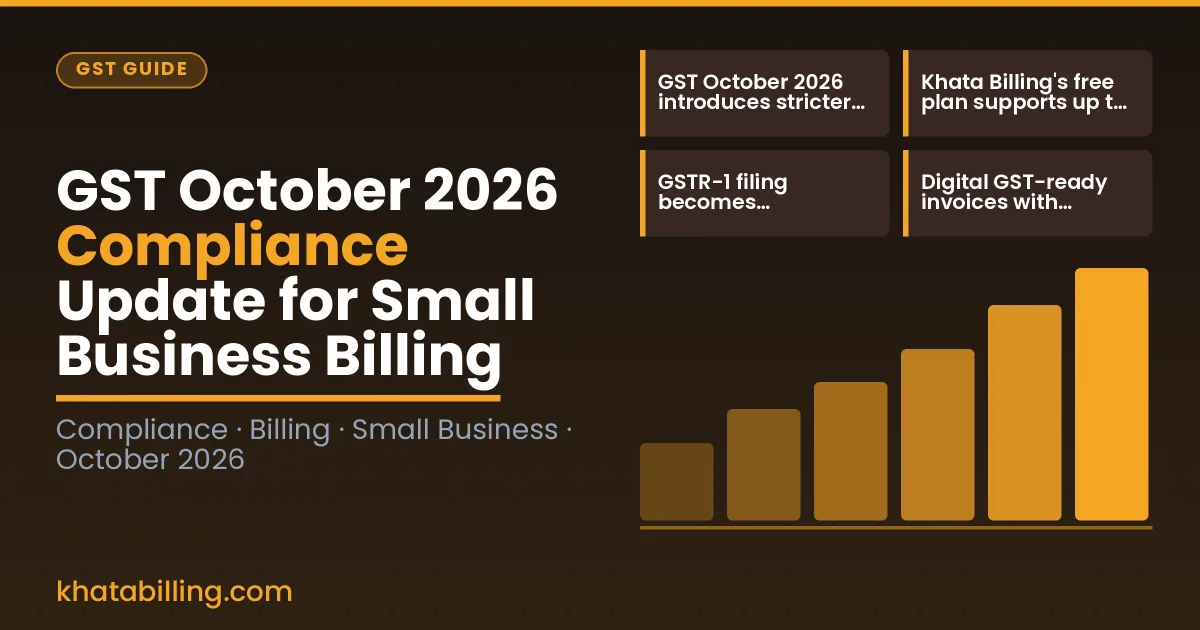
- GST October 2026 introduces stricter invoice numbering rules requiring sequential, date-based numbering for all registered businesses.
- Khata Billing's free plan supports up to 10 invoices per day and 100 per 30-day period with standard numbering formats.
- GSTR-1 filing becomes mandatory for all GST-registered businesses starting October 2026 with detailed sales and tax data submission.
- Digital GST-ready invoices with embedded barcodes and accurate GSTIN reduce manual entry errors and ensure audit readiness.
- Integrating inventory management with GST-compliant billing ensures stock adjustments reflect correctly in GSTR-1 filings.
- Small businesses should upgrade to Premium plan for unlimited invoicing, watermark-free documents, and advanced GSTR-1 reporting features.
- Create a monthly compliance calendar to track invoice limits, filing deadlines, and system updates for October 2026 readiness.
GST October 2026 Compliance Update for Small Business Billing
The GST October 2026 compliance deadline marks a critical update for Indian small business billing operations, requiring accurate GST invoicing aligned with current law. Khata Billing automatically applies all regulatory changes without manual intervention, ensuring your daily billing workflows stay compliant. This deadline affects how you generate GST invoices, manage stock records, and reconcile CGST, SGST, and IGST components on every transaction. The free plan of Khata Billing covers 10 invoices a day, up to 100 in any 30-day period, with basic invoice themes and barcode generation supporting GST compliance. Real-world billing counters see staff use thermal printers to produce GST-compliant invoices with correct HSN codes, while stock rooms adjust inventory values based on real-time data sync. Khata Billing's automatic updates eliminate the need to manually revise invoice formats before the deadline, as the system pre-loads GST-ready themes and e-invoicing parameters. Businesses using Khata Billing avoid last-minute GST filing stress since party ledger updates and GSTR-1 preparation become seamless parts of daily operations. The software's integration with UPI and MSME registration details ensures your billing reflects current tax liabilities. For businesses needing advanced features like bulk import or unlimited invoicing, the Premium plan at ₹1,499/year provides watermark-free invoices and full GST report access including Profit & Loss statements. Khata Billing — free GST billing software continues to handle these updates automatically, keeping your billing counter efficient and your GST filings accurate.
October 2026 GST Invoice Numbering Rules Explained
Under GST October 2026 compliance rules, every small business must use a mandatory invoice numbering sequence that includes a unique prefix, the transaction date, and continuous series tracking to avoid GSTN portal rejection during filing. The new format requires the prefix 'GST' followed by the year '2026', then the date in DDMMYYYY format, and finally a sequential number like 'GST20260101-0001'. This structure ensures traceability and prevents duplicate invoice numbers that trigger filing errors. For example, an invoice dated 15 October 2026 with sequence 0001 becomes 'GST20261510-0001'. The sequence must increment strictly daily, resetting only when the date changes, and businesses cannot skip numbers or reuse formats. Khata Billing's free plan supports this sequence within its 10-invoice daily limit, while the Premium plan offers unlimited series continuity without daily caps, enabling seamless stock and inventory management across Inventory & stock management operations. Using this standardized sequence protects businesses from penalties and ensures accurate GST portal submissions. The strict rules mean manual billing systems often fail due to irregular numbering, making automated solutions essential for compliance and operational efficiency. Entrepreneurs must align their billing software settings with this format to maintain uninterrupted GST filing, especially when generating reports like GSTR-1 where invoice integrity is verified by the tax authority. Preparing now avoids last-minute corrections before the October 2026 deadline.
Step-by-Step Guide to Create GST-Ready Invoices in October 2026
Here is a practical sequence for generating GST-compliant invoices in October 2026 using Khata Billing, ensuring accuracy from item selection to final submission.
- Select the appropriate product from your inventory list or create a new item, ensuring the HSN code matches the product category as defined under GST law, which Khata Billing supports through its auto-suggest feature during item creation.
- Verify the HSN code is correctly assigned; Khata Billing cross-references the HSN with GSTIN validation during invoice generation, preventing mismatches that could trigger e-invoicing errors.
- Choose the correct tax rate (CGST, SGST, or IGST) based on the buyer’s location and transaction type, as Khata Billing automatically calculates the tax amount and updates the invoice total including CGST, SGST, and IGST components.
- Review the automatically generated invoice to confirm the GSTIN appears on both buyer and seller sides, the invoice number follows the sequential format, and the total reflects accurate tax calculations, which Khata Billing handles through its real-time GSTIN verification.
- Save or print the invoice, noting that watermark-free and customizable options are available in Premium plans, while the free plan maintains compliance within its 10-invoice-per-day and 100-invoice-per-30-day limits.
- Upload the invoice to the IRN portal via Khata Billing’s integrated e-invoicing feature, which ensures the final invoice matches the details registered with the GST portal, including the unique IRN number.
For detailed tutorials and screenshots, visit the Khata Billing blog where step-by-step guides demonstrate each stage of compliant invoice creation.
Manual Invoice Process vs Digital GST-Ready Workflow
Manual invoice creation often relies on paper registers or basic spreadsheets, which fail to maintain continuous numbering required under GST October 2026 compliance rules. Shopkeepers manually numbering invoices from 101 face gaps when lost or torn documents break the sequence, risking GSTN verification failures. Automated digital billing systems solve this by assigning sequential invoice numbers automatically, ensuring every transaction from October 2026 onward meets legal requirements without manual intervention.
Paper-based methods also struggle with accurate tax calculations. GST October 2026 mandates precise CGST, SGST, and IGST splits based on location and product categories, but handwritten totals often misapply tax rates, leading to filing rejections. Khata Billing's digital GST-ready workflow captures item details, HSN codes, and tax slabs at entry, instantly calculating correct amounts. The POS billing system feature even handles UPI payments and auto-applies tax adjustments during billing. In contrast, digital platforms enforce consistent invoice numbering and tax rules, preventing the ₹2,500 penalty for mismatched sequences or incorrect tax percentages common in paper-based systems.
October 2026 GSTR-1 Filing Checklist for Small Businesses
For GST October 2026 GSTR-1 filing, small businesses must verify invoice matching, tax liability reconciliation, and prevent errors through systematic checks before submission. Start by confirming that every sales invoice in your accounting system matches the corresponding GSTR-1 entry, including GSTIN, HSN code, and invoice number. Verify that the total taxable value and CGST, SGST, or IGST amounts align with the invoice-level records. Use Khata Billing’s auto-generated barcode system to scan each invoice and cross-check against the digital ledger. Ensure the cumulative daily invoice count does not exceed the free plan’s limit of 10 invoices per day or 100 in any 30-day period. Reconcile the total tax liability by comparing the sum of CGST, SGST, and IGST collected against the input tax credit available from purchase invoices. Match the GSTR-1 taxable value with the Profit & Loss report generated in Khata Billing’s Premium plan, as GSTR-1 and Profit & Loss reports are Premium features. Check that the invoice numbering sequence is continuous and that no duplicate or missing numbers exist. Review the party-wise sales summary to confirm all customer GSTINs are correctly mapped. Finally, validate that the stock valuation reflects actual inventory adjustments made in Khata Billing’s inventory module, as stock errors can distort taxable sales. Perform these steps manually or through Khata Billing’s automated dashboard to avoid common mistakes like mismatched tax rates or incorrect HSN codes. Submit only after all verification steps are complete.
Integrating October 2026 GST Rules with Inventory Management
Khata Billing synchronizes stock levels in real time whenever an item is sold, returned, or transferred between locations, ensuring that the inventory record matches the physical goods and the taxable transactions recorded for GST October 2026 compliance.
When a retailer records a sale of a ₹200 item with 5% GST, the system instantly reduces the stock quantity by one unit and generates a tax invoice that includes the correct CGST and SGST breakdown, which feeds directly into the input tax credit calculation for the buyer.
This automatic linkage prevents manual mismatches that commonly cause audit discrepancies, such as claiming input tax credit on a purchase invoice while the sales invoice shows a different quantity or price due to delayed stock updates.
Because the item master updates are tied to each transaction, the system maintains an audit‑ready trail that aligns with the GST law requirement that input tax credit be claimed only on invoices that match the actual goods received.
For businesses using Khata Billing’s real‑time data sync across desktop and mobile devices, the inventory adjustment happens at the point of billing, so the stock count and the GST‑eligible sales value remain consistent throughout the month, eliminating the need for reconciliatory entries during the October 2026 audit cycle.
Action Plan for October 2026 GST Compliance Readiness
Small business owners should act immediately to prepare for GST October 2026 compliance by taking three practical steps. First, conduct staff training on updated GST rules effective October 1, 2026, focusing on e-invoice generation, tax rate selection, and error correction procedures. Train cashiers and sales staff to use POS systems for accurate invoice creation, ensuring they understand HSN code selection and CGST/SGST/IGST application. Second, perform system configuration checks in Khata Billing: verify invoice numbering sequence, confirm GSTIN accuracy across all customer records, and enable automatic tax calculation for all applicable rates. Check that barcode scanning works with thermal printers and that stock adjustments sync correctly with inventory management. Third, implement document backup protocols by scheduling weekly exports of sales, purchase, and inventory data to secure cloud storage. Store backup files in INR 10,000 value folders as required by GST law, and test restore procedures quarterly to ensure data integrity. These steps ensure your business remains audit-ready without disrupting daily operations. Khata Billing's free plan covers 10 invoices a day, up to 100 in any 30-day period, supporting initial compliance training without additional cost. Premium features like unlimited invoicing and GSTR-1 report generation become essential as transaction volume grows. Staff should practice creating error-free invoices using auto-generated barcodes to avoid manual entry mistakes. Regular backup verification prevents data loss during critical filing periods. Training sessions should include mock return filing exercises to build confidence in GST portal submission.
Khata Billing supports your GST October 2026 compliance by automating invoice generation, maintaining accurate stock records, and synchronizing data across devices to prevent manual errors. The software ensures every transaction aligns with GST law requirements through real-time updates and secure backups.
Stay audit-ready with automatic GSTR-ready reports and error-free filing; Start free with Khata Billing Start free with Khata Billing
Source: Income Tax and GST Compliance Calendar of October 2026 — SAG Infotech Official Tax Blog (26 Oct 2026)