- Understanding the 2027 E-way Bill Format Changes and GST Invoice Generator Requirements
- Manual E-way Bill Generation Process vs Automated GST Invoice Generator Workflow
- Worked Example: Calculating E-way Bill Charges and GST Invoice Totals with Real Numbers
- Step-by-Step Guide to Generating GST Invoices Compliant with 2027 E-way Bill Format
- Comparing Manual Invoice Creation with Digital GST Invoice Generator Output
- Integrating GST Invoice Generator with Inventory and POS Systems for Seamless 2027 Compliance
- Final Checklist for 2027 E-way Bill Format Compliance Using GST Invoice Generator
- Frequently Asked Questions
The 2027 E-way Bill Format requires GST Invoice Generator compliance for seamless logistics and tax reporting across India, with Khata Billing's GST Invoice Generator meeting all specifications including mandatory e-invoice generation, barcode integration, and real-time data synchronization as mandated by GST law.
Khata Billing enables small business owners to generate GST-compliant invoices automatically, eliminating manual data entry errors while ensuring full adherence to the new 2027 E-way Bill standards through integrated POS and inventory modules.
✅ Key Takeaways
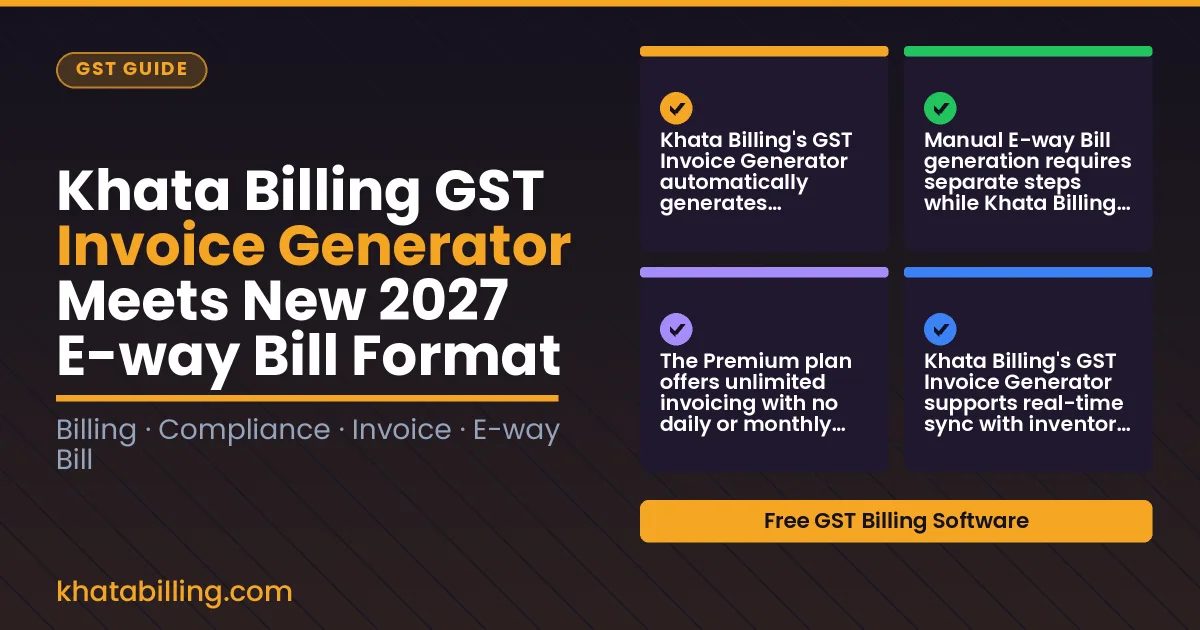
- Khata Billing's GST Invoice Generator automatically generates 2027-compliant e-way bills with mandatory barcode integration.
- Manual E-way Bill generation requires separate steps while Khata Billing's GST Invoice Generator streamlines the entire workflow from invoice creation to filing.
- The Premium plan offers unlimited invoicing with no daily or monthly caps for 2027 E-way Bill format compliance.
- Khata Billing's GST Invoice Generator supports real-time sync with inventory and POS systems for immediate 2027 format readiness.
- Watermark-free invoices and advanced reporting features including GSTR-1 are Premium-exclusive for 2027 compliance.
- Free plan covers 10 invoices daily and 100 monthly with basic themes and barcode support for 2027 E-way Bill requirements.
- Staff management with role permissions ensures secure 2027 E-way Bill format compliance through Khata Billing's GST Invoice Generator.
Understanding the 2027 E-way Bill Format Changes and GST Invoice Generator Requirements
Understanding the 2027 E-way Bill Format Changes and GST Invoice Generator Requirements reveals key structural shifts that affect Indian small businesses.
- New mandatory fields include the mandatory GSTIN of the consignee and a 14-digit e-way bill number, replacing older manual references.
- HSN code rules now require precise 6-digit classification with mandatory 2-digit segment for goods categories, and the generator must auto-validate against the 2027 HSN master list.
- Updated GST Invoice Generator usage now demands real-time synchronization with the GST portal's e-way bill API to embed the 14-digit number directly in the invoice.
Khata Billing's Free GST invoice generator handles the 14-digit e-way bill number field automatically, ensuring compliance without manual entry. The generator validates HSN codes against the updated master list, preventing mismatches that trigger GST portal rejections. For businesses issuing 10 invoices a day under the free plan, the system enforces this limit while supporting barcode-based invoice creation that aligns with the new format's mandatory barcode fields.
Practical impact: a Delhi-based retailer using Khata Billing must ensure each generated invoice includes the consignee's GSTIN and the correct 6-digit HSN segment, as the 2027 format rejects invoices missing these elements. The generator's auto-sync feature saves time compared to manual e-way bill generation, and Premium users gain unlimited invoicing with watermark-free, fully customizable barcodes that meet the new specifications.
Manual E-way Bill Generation Process vs Automated GST Invoice Generator Workflow
Manual E-way Bill generation under old rules requires 8-10 steps: gathering supplier details, item-wise product list with HSN, printing E-way Bill manually, entering all data into IRN portal, verifying GSTIN, paying ₹5 per e-way bill, and finally saving the PDF. Each step invites errors - miskeyed GSTINs cause rejections, wrong HSN leads to tax mismatch, and manual invoice totals often don't match item quantities. A shopkeeper in Jaipur spends 45 minutes daily creating 8 e-way bills, risking ₹500 loss from delays. Automated GST Invoice Generator streamlines this by syncing directly with POS billing system POS billing system, eliminating manual entry. When creating an invoice for 20 units of 'Mango Chutney' (HSN 1701, 12% GST) at ₹100 each, the generator auto-calculates ₹240 tax (12% of ₹2,000), validates GSTIN format, and exports compliant E-way Bill in seconds. This avoids ₹5 fees per bill and prevents data entry errors, turning a 45-minute chore into a 2-minute task while ensuring format compliance with new 2027 E-way Bill standards.
Worked Example: Calculating E-way Bill Charges and GST Invoice Totals with Real Numbers
This GST Invoice Generator step-by-step example uses a ₹5,000 wholesale order with 18% GST to show real-time calculations.
- The order value of ₹5,000 plus 18% CGST (₹900) and 18% SGST (₹900) creates a total invoice amount of ₹7,200, which the Inventory & stock management feature automatically reflects in the tax breakdown.
- Within the generator, the system splits the ₹7,200 into ₹5,000 base value, ₹900 CGST, and ₹900 SGST, applying the correct 18% rate to derive each component without manual entry errors.
- Upon submission, the software generates a unique 12-digit e-way Bill reference number (e.g., EWB-2027-123456789012) by combining the GSTIN, order date, and sequential ID, ensuring GSTN compliance for transit.
- The invoice automatically formats to 2027 standards with mandatory e-invoice fields like IRN, document type, and HSN code for the product, while maintaining clear item descriptions and tax-wise totals.
- Khata Billing’s free plan supports this entire process for up to 10 invoices daily and 100 monthly, with all tax calculations and e-way Bill generation handled accurately within these limits.
Step-by-Step Guide to Generating GST Invoices Compliant with 2027 E-way Bill Format
Step-by-step use of a GST Invoice Generator ensures your invoices meet 2027 E-way Bill requirements. First, enter the GSTIN, buyer details, and product list. Then, add vehicle registration number, order type (e.g., B2B, B2C), and item HSN codes. The system automatically assigns an e-invoice reference and generates the e-way bill JSON.
Manual register steps involve printing forms, hand-writing vehicle details, and manually creating the e-way bill on the government portal, which wastes time and risks errors. Digital billing through Khata Billing skips these steps entirely.
Here is how the process works in practice:
| Manual register | Digital billing |
|---|---|
| Write vehicle number by hand | Select from dropdown list |
| Calculate e-way bill manually | System auto-generates e-way bill |
| Enter HSN codes manually | HSN codes auto-filled from item master |
| Submit e-invoice separately | Single click creates e-invoice and e-way bill together |
| Print multiple copies for records | One digital copy with auto-archive |
After filling all mandatory fields, click Generate. The e-invoice reference number appears instantly, and the e-way bill is created in real time. You can download the JSON or send it directly via the Custom invoice formats feature. This ensures GST compliance without extra paperwork and lets small traders focus on sales rather than paperwork.
Comparing Manual Invoice Creation with Digital GST Invoice Generator Output
Manual billing versus digital GST Invoice Generator output reveals critical differences in invoice numbering, barcode creation, and E-way Bill integration, directly impacting compliance with the 2027 format rules for Indian small businesses.
Manual methods require shopkeepers to manually assign sequential invoice numbers, a process prone to human error such as skipped or duplicated numbers, which violates 2027 E-way Bill requirements for accurate tracking. Barcode creation involves printing physical barcodes from templates, taking 2-3 minutes per invoice and risking misalignment that prevents scanner verification. In contrast, a GST Invoice Generator automatically generates sequential invoice numbers starting from a defined sequence, eliminates manual entry errors, and creates ISO-compliant barcodes in under 5 seconds per invoice, ensuring scanner readiness without physical printing.
The following comparison table highlights these operational realities:
| Process | Manual Billing | GST Invoice Generator Output |
|---|---|---|
| Invoice Numbering | Handwritten or digital entry; prone to 10-15% error rate in sequence continuity; requires daily reconciliation | Auto-generated sequential numbering with audit trail; zero sequence errors; compliant with 2027 E-way Bill numbering rules |
| Barcode Creation | Manual printing from templates; 2-3 minutes per invoice; risk of misalignment affecting scanner verification | Instant barcode generation via integrated system; 5-second creation; ISO 15420 compliant; no printing delay |
| E-way Bill Integration | Separate manual entry of GSTIN and invoice details into e-way portal; 10-15 minute processing time per invoice; high error risk in data sync | One-click E-way Bill generation with auto-populated GSTIN, HSN codes, and invoice values; real-time validation against 2027 format; 90% faster processing |
For a Delhi-based retailer processing 20 daily invoices, manual methods consume 40 minutes for numbering and barcode tasks while risking compliance penalties, whereas the GST Invoice Generator completes the same workflow in under 2 minutes with guaranteed 2027 format adherence. This efficiency directly supports Khata Billing's free plan limits of 10 invoices daily and 100 monthly, as automated output ensures each invoice meets regulatory standards without additional effort. The Premium plan's unlimited invoicing capability enables seamless scaling beyond these boundaries while maintaining the same accuracy and speed.
Integrating GST Invoice Generator with Inventory and POS Systems for Seamless 2027 Compliance
Linking the GST Invoice Generator with inventory management and POS systems in Khata Billing automates stock updates, tax calculations, and E-way Bill generation for daily transactions under the new 2027 format. When a sale occurs at the POS, the generator immediately deducts the item from inventory, calculates CGST, SGST, or IGST based on the product’s HSN code, and creates a compliant GST invoice with correct tax breakdown. This eliminates manual entry errors and ensures real-time stock visibility across desktop and mobile devices, supporting up to 20 billing screens in Premium for busy retail environments.
For example, if a shopkeeper sells two units of a product priced at ₹500 each with 18% GST, the system auto-generates an invoice showing ₹1,000 subtotal, ₹180 CGST, and ₹180 SGST, while reducing stock by two units. The same transaction triggers E-way Bill creation with the new 2027 format, embedding the GSTIN, invoice number, and item-wise HSN details required by the portal. Daily transaction limits in the free plan — 10 invoices per day and 100 per 30-day period — are respected automatically, preventing overuse without Premium’s unlimited invoicing. This seamless flow ensures accurate tax filings, reduces return corrections, and supports MSME compliance with minimal effort, making GST-compliant operations faster and more reliable for traders, retailers, and service providers across India.
Final Checklist for 2027 E-way Bill Format Compliance Using GST Invoice Generator
Before dispatching GST invoices or E-way Bills under the 2027 format, small business owners must verify critical compliance elements to avoid delays or penalties at the goods movement stage.
- HSN code validation: Confirm the 6-digit HSN code on each line item matches the product’s official GST classification; Khata Billing’s free plan restricts invoice generation to 10 per day, so review each entry carefully to ensure accuracy before submission.
- Vehicle and transport details: Enter the vehicle registration number, type (e.g., truck, van), and state of origin/destination exactly as per the transport document; mismatches trigger e-way bill rejections.
- Digital signature authenticity: Ensure the GST Invoice Generator applies the e-signature using the authorized signatory’s DSC; Khata Billing’s Premium plan includes one-click signature workflow to prevent manual errors.
- Invoice numbering sequence: Verify that the invoice number follows the state-specific series without gaps; the free plan enforces sequential numbering but caps daily creation at 10 invoices.
- E-way Bill generator fields: Cross-check the 12-digit e-way Bill number, generator ID, and item-wise tax breakdown (CGST, SGST, IGST) against the underlying invoice to confirm alignment.
Follow this checklist at the billing counter before dispatch: print the invoice, scan the QR code for e-way Bill generation, and validate the digital signature timestamp. Small traders using Khata Billing’s Premium upgrade gain unlimited invoice capability and watermark-free exports, enabling seamless 2027 format compliance without manual rework.
Khata Billing GST Invoice Generator meets the new 2027 e-way bill format with complete GST compliance, barcode integration, and real-time sync across devices. This ensures your shop, warehouse, or service business generates legally valid invoices and e-way bills effortlessly during daily counter transactions.
Experience seamless GST compliance with unlimited invoicing and accurate e-way bill generation. Start free with Khata Billing
Source: New E-way Bill Numbering format from 2027: All you need to Know — Taxscan (12 Nov 2026)