- Understanding the 2026 GST Invoice Format Changes and Their Impact on Daily Billing
- Step-by-Step GST Invoice Generation Process for 2026 Compliance
- Worked Example: Calculating GST Liability with New 2026 Invoice Rules Using Real Numbers
- Comparative Analysis: Manual Billing Methods vs Automated GST-Ready Invoicing Systems
- Implementing Real-Time Stock Updates and Automated Inventory Adjustments in Line with GST Requirements
- Best Practices for Barcode Scanning and Digital Invoice Storage to Ensure 2026 Compliance
- Action Plan: Updating Your Shop's Billing System for GST 2026 Readiness
- Frequently Asked Questions
GST updates for 2026 mandate a revised invoice format with mandatory fields for GST compliance, impacting daily shop billing. The new rules require updated invoice layouts, accurate HSN codes, and integration with real-time stock and GST return systems for shop owners.
Khata Billing provides GST-compliant invoicing with features like barcode scanning, inventory tracking, and automated GSTR-1 filing, enabling shop owners to meet 2026 requirements without manual errors.
✅ Key Takeaways
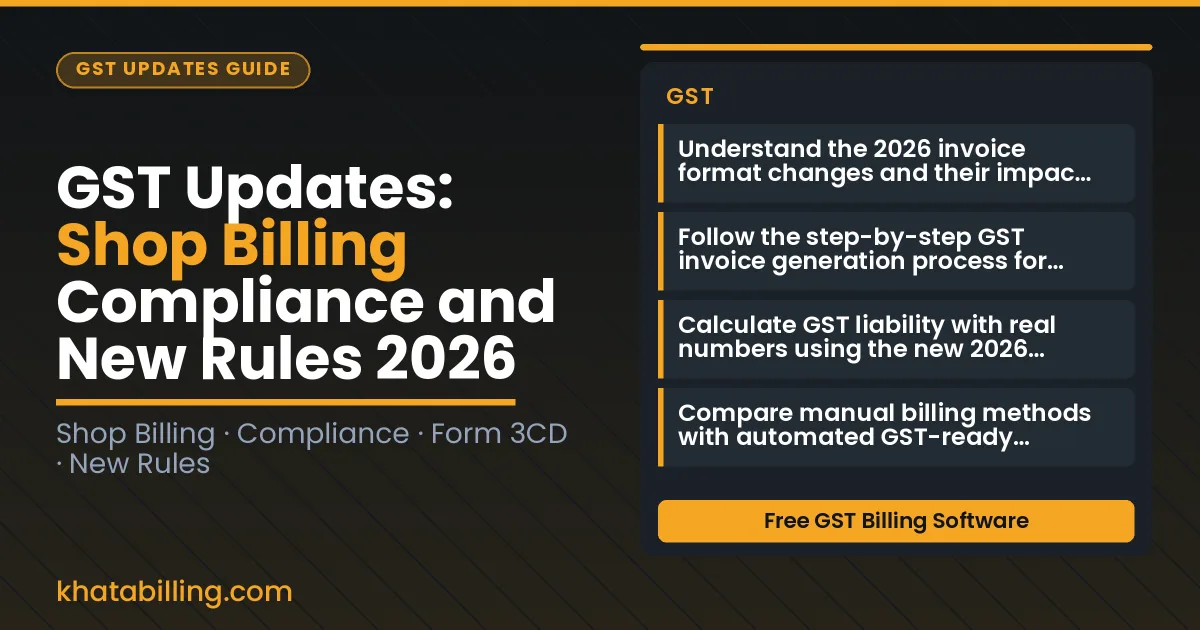
- Understand the 2026 invoice format changes and their impact on daily billing
- Follow the step-by-step GST invoice generation process for 2026 compliance
- Calculate GST liability with real numbers using the new 2026 invoice rules
- Compare manual billing methods with automated GST-ready invoicing systems
- Implement real-time stock updates and automated inventory adjustments for GST compliance
- Use barcode scanning and digital invoice storage to ensure 2026 compliance
- Create an action plan to update your shop's billing system for GST 2026 readiness
Understanding the 2026 GST Invoice Format Changes and Their Impact on Daily Billing
The 2026 GST updates mandate a standardized invoice layout with key fields like the legal name, GSTIN of the supplier and recipient, invoice date, unique sequential number, and a scannable barcode positioned clearly on the document. The new barcode must encode the GSTIN and be generated automatically by the software during invoice creation. This requirement impacts both physical and digital billing for shop owners: printed invoices must display the barcode visibly, while digital copies sent via email or WhatsApp must retain the same format for compliance. Khata Billing — free GST billing software automatically generates the required barcode and ensures the mandatory fields appear on every invoice, eliminating manual entry errors. With unlimited invoicing available in Premium, shop owners can print or email compliant invoices without worrying about daily or monthly limits. The platform also supports thermal printer integration, allowing quick physical printing that meets the new layout standards. Manual billing processes that skip the barcode or omit the sequential number will lead to rejection during GST audits, so adopting a digital solution that enforces these rules is essential for daily operations. Review the Khata Billing — free GST billing software to see how the system implements the 2026 layout requirements automatically.
Step-by-Step GST Invoice Generation Process for 2026 Compliance
GST updates for 2026 require shop owners to follow a strict invoice generation process starting with selecting the correct GST-compliant theme in Khata Billing to ensure proper HSN and SAC code application, then entering item details with accurate quantities and GST rates like 18% for packaged goods or 28% for services, which automatically calculates CGST and SGST components.
Worked Example: For a ₹500 stationery item at 18% GST (HSN 4907), the system adds ₹90 CGST and ₹90 SGST, making the total ₹680; entering 10 such items generates a ₹6,800 invoice with auto-numbering that follows GST rule 46(4) for sequential numbering without gaps.
After verifying the theme's GST readiness, the POS billing system enables barcode scanning for item codes, allowing staff at the billing counter to scan products and instantly populate the invoice while Khata Billing's free plan supports up to 10 invoices daily with auto-numbered sequences.
The final step involves printing the barcode-enabled invoice on A4 paper using thermal printers, where the system validates GSTIN and applies correct tax rates before finalizing the document that meets all e-invoicing compliance requirements for 2026.
Worked Example: Calculating GST Liability with New 2026 Invoice Rules Using Real Numbers
Here is a step-by-step worked example to calculate GST liability using updated 2026 invoice rules in Khata Billing. Assume a shop sells 5 units of item ABC (HSN 8517) at ₹500 each with 18% GST and 2 units of item XYZ (HSN 8471) at ₹300 each with 12% GST, totaling ₹2,900 before tax. The free plan allows 10 invoices daily and 100 monthly, so this invoice stays within limits. First, generate the invoice via Inventory & stock management in Khata Billing. The system auto-calculates CGST (9%) and SGST (9%) for 18% GST, showing ₹261 each, and IGST (12%) for 12% GST, showing ₹36, with a total tax of ₹558. Input tax credit is applied if the business has eligible previous purchases; for this example, assume ₹150 credit is claimed, reducing the payable GST to ₹408. The final invoice shows a total of ₹3,458 (₹2,900 + ₹558). After credit, the shop owner pays ₹408 in cash or via UPI. This calculation reflects Premium features like accurate tax breakdown and editable invoice details, while the free plan supports up to 100 invoices in any 30-day period.
Comparative Analysis: Manual Billing Methods vs Automated GST-Ready Invoicing Systems
Manual billing in a shop relies on paper registers, handwritten entries, and physical invoice books, consuming valuable time during customer checkout and creating frequent errors in GST calculations. A shopkeeper must manually compute CGST, SGST, and IGST, match HSN codes, and later reconcile stock, often leading to mismatches that trigger GST department audits. In contrast, automated GST-ready invoicing systems process transactions instantly, automatically calculate tax components, and generate compliant e-invoices with correct GSTIN and e-waybill integration, eliminating most reconciliation work. The shift from paper to digital reduces billing time by up to 70% based on industry observations, as shop staff spend less time writing and more time serving customers. Error rates drop significantly because digital systems validate GSTIN formats, apply correct tax rates based on product categories, and prevent duplicate invoice numbers. Compliance becomes seamless since the system auto-files GSTR-1 summaries and maintains audit trails for input tax credit claims. For a small retailer handling 50 daily invoices, manual entry might consume 2 hours, while digital billing completes the task in under 30 minutes, freeing time for customer engagement. Khata Billing blog offers practical guides on implementing these workflows. The transition also supports real-time stock updates, as digital billing syncs with inventory modules, ensuring accurate stock valuation and reducing shrinkage losses. With GST updates emphasizing e-invoicing mandates, adopting digital methods aligns directly with regulatory requirements, making compliance a natural outcome of efficient operations.
Implementing Real-Time Stock Updates and Automated Inventory Adjustments in Line with GST Requirements
Integrated stock management in Khata Billing directly supports accurate cost of goods sold (COGS) calculations by updating inventory levels in real time as sales occur, aligning with GST rules on inventory valuation and reporting. When a shopkeeper sells a product, the system automatically reduces stock quantity and adjusts the closing stock value, ensuring the cost basis for future sales reflects current inventory. This precision prevents mismatches during GST audits, where inconsistent stock records can trigger scrutiny under CGST and SGST provisions.
For example, if a retailer sells 5 units of a product priced at ₹500 each with 18% GST, the COGS reflects the actual purchase cost per unit, while GST liability is calculated on the sale value. Khata Billing’s automatic stock adjustment eliminates manual entry errors that could distort COGS and lead to incorrect input tax credit claims under GSTR-2. The platform’s real-time sync between POS, inventory, and accounting modules ensures that every transaction updates both the physical stock count and the financial records simultaneously, maintaining compliance with GST’s requirement for accurate stock valuation at the time of supply. Small businesses managing multiple categories benefit from continuous updates, avoiding the need for end-of-day reconciliations that consume time and risk inaccuracies.
Khata Billing’s free plan supports basic stock adjustments for up to 10 invoices per day and 100 in any 30-day period, sufficient for small retailers, while Premium users gain unlimited inventory tracking with bulk import and real-time sync across devices. Automated adjustments ensure that HSN codes, batch numbers, and valuation methods remain consistent with GST-compliant reporting, reducing the risk of non-compliance during e-invoicing or audit processes. By eliminating manual stock reconciliations, businesses save time and maintain reliable records for GSTR-1 filings and input tax credit eligibility.
Best Practices for Barcode Scanning and Digital Invoice Storage to Ensure 2026 Compliance
To comply with GST updates and ensure 2026 compliance, shop owners must adopt practical barcode scanning and digital invoice storage practices. Use a reliable barcode scanner connected to Khata Billing to instantly create invoices by scanning product barcodes, which eliminates manual entry errors and speeds up the billing counter process; the free plan covers 10 invoices a day, up to 100 in any 30-day period, while Premium offers unlimited invoicing and watermark-free generation.
Step 1: Enable barcode scanning in Khata Billing settings, then print A4 sheets with standard barcodes for each product. When a customer pays, scan the item barcode at the point of sale; the system auto-generates a digital invoice with correct GSTIN, HSN code, and tax breakdown (CGST, SGST, or IGST as applicable), ensuring accurate input tax credit claims.
Step 2: After generating the digital invoice, download the PDF or save it directly in Khata Billing’s cloud storage. The platform automatically retains records for the mandatory 7-year period required by GST law, with secure backup and real-time sync across devices. Avoid storing invoices on local devices only, as this risks data loss.
Step 3: Organize digital records by business year and GSTIN. Use Khata Billing’s custom dashboard widgets to monitor inventory levels and stock adjustments, ensuring accurate stock valuation during audits. Export bulk data to Excel for annual review, but keep the original digital copies secured in the platform’s encrypted storage. Consult a CA for filing decisions, as they can verify that your barcode scanning and storage methods meet GST department requirements for the full 7-year retention period.
Action Plan: Updating Your Shop's Billing System for GST 2026 Readiness
To prepare your shop for GST 2026 updates, follow this action plan to update your billing system and ensure compliance.
- Verify your GSTIN and confirm it is active in the GST portal; update any address changes immediately.
- Check your current invoice numbering sequence; if it exceeds 10 invoices per day, adjust the system to stay within the 100-invoice monthly limit of the free plan, or upgrade to Premium for unlimited invoicing.
- Enable barcode scanning for faster invoice creation; ensure your system prints barcode labels on A4 sheets as required.
- Configure staff roles in Khata Billing, assigning cashiers to the cash account and managers to bank account entries to maintain audit trails.
- Train all staff on new GST fields, such as HSN code entry and CGST/SGST/IGST split, using real billing counter scenarios.
- Run a test import of 5 items using the bulk import feature, ensuring data syncs correctly across desktop and mobile devices.
- Review and enable watermark-free invoice printing if you upgrade to Premium, as watermark removal is a Premium feature.
- Schedule a quarterly review of GSTR-1 filing dates and input tax credit reconciliation to avoid penalties.
GST updates for shop billing compliance in 2026 focus on accurate invoice generation, timely GSTR-1 filings, and proper HSN code usage to avoid penalties. Shop owners must ensure every transaction reflects the correct CGST, SGST, or IGST components and maintains a clear audit trail through digital records.
Implement these practices today to stay compliant and streamline operations; Start free with Khata Billing to manage invoices, inventory, and GST reports efficiently.
Source: Form 3CD Tax Audit Due Date Extension AY 2026-27: Critical Compliance Guide — CAclubindia (24 Oct 2026)