- Why GST Reforms Demand Faster Retail Sales Management
- Maximizing Daily Invoice Limits Within GST Compliance
- Step-by-Step Workflow for Issuing GST-Compliant Invoices
- Comparing Manual Sales Tracking vs Automated GST Reporting
- Integrating Point of Sale Data with Inventory for Stock Accuracy
- Leveraging Free Plan Features for Early-Stage Retail Growth
- Upgrading to Premium for Unlimited Sales Scaling
- Frequently Asked Questions
Khata Billing supports retail sales growth amid new GST reforms by ensuring compliance with daily invoice limits of 10 per day and 100 per 30-day period while providing GST-compliant tools for accurate sales tracking and inventory integration.
Retailers must adapt to the updated GST framework's stricter invoice requirements and electronic reporting needs without compromising sales velocity, and Khata Billing delivers a structured workflow that aligns with GST law while maximizing usable features within the free plan's defined boundaries and Premium plan's unlimited invoicing capabilities.
✅ Key Takeaways
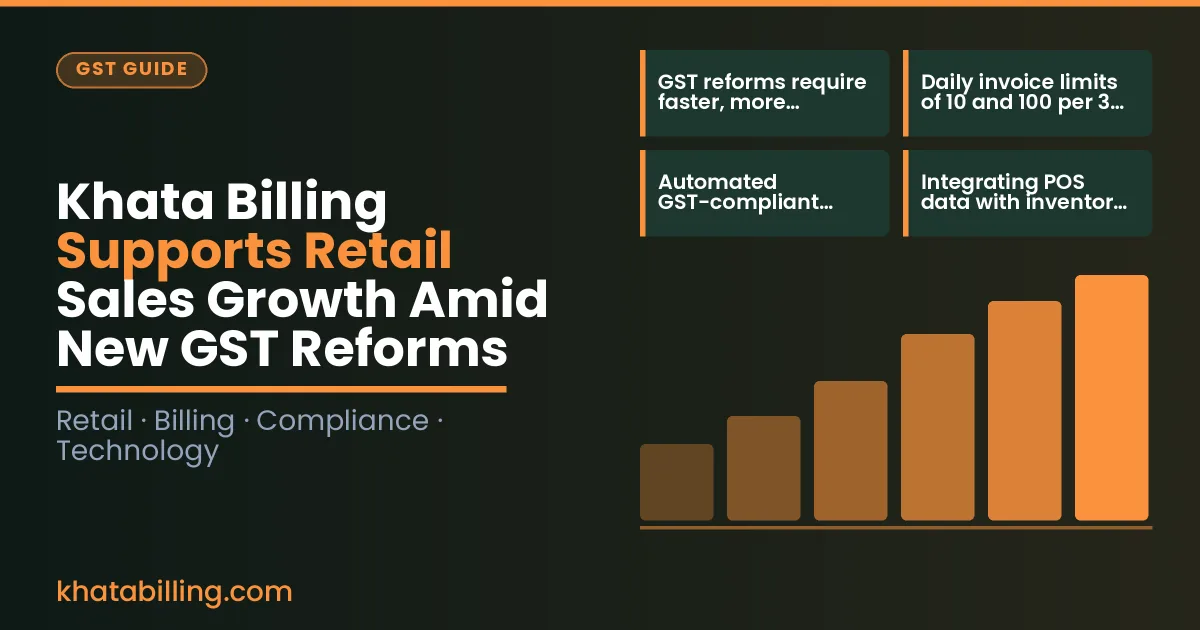
- GST reforms require faster, more accurate sales management to maintain compliance and cash flow
- Daily invoice limits of 10 and 100 per 30 days in the free plan demand efficient tracking to avoid compliance issues
- Automated GST-compliant invoicing with barcode scanning eliminates manual entry errors and speeds up checkout
- Integrating POS data with inventory updates ensures real-time stock accuracy across sales channels
- The free plan's basic reports and custom fields support early-stage retail operations without upfront cost
- Premium plan enables unlimited invoicing and advanced GST reports like GSTR-1 for scalable sales growth
- Upgrading to Premium at ₹999/year with SAVE500 code removes limits and unlocks staff management and bulk data tools
Why GST Reforms Demand Faster Retail Sales Management
Recent GST rule changes have tightened invoice requirements, forcing shopkeepers to issue receipts within 24 hours and match e-invoices with sales and purchase registers, which directly impacts daily sales volumes and cash flow timing. With a 10-invoice daily limit under Khata Billing's free plan, a retailer selling 15 items per day must split transactions or upgrade to avoid delays, as GST compliance mandates every sale be recorded with a valid invoice. The 100-invoice monthly cap also pressures businesses with high turnover, especially during festivals or harvest seasons when sales surge to 120 or more invoices in a single month. Cash flow becomes unpredictable when payments are delayed due to mismatched GST filings, and retailers often wait 7-10 days for buyer payments, straining daily operations. Manual billing creates errors in HSN code selection and tax calculation, leading to penalties or rejected returns. Inventory & stock management becomes critical when GST filings require precise stock records for input tax credit claims. Upgrading to Premium removes invoice limits, enables real-time stock sync across devices, and supports unlimited POS screens, helping retailers scale sales without GST-related bottlenecks.
Maximizing Daily Invoice Limits Within GST Compliance
Khata Billing's free plan covers 10 invoices a day, up to 100 in any 30-day period, and exceeding this daily ceiling risks GST compliance violations including penalties for incorrect return filings and possible scrutiny from tax authorities. The 10-invoice daily limit applies per user session, meaning if you generate 5 invoices in the morning and 5 in the afternoon, you have reached the limit and cannot create another invoice until the 24-hour cycle resets. For example, a small kirana store selling 200 grams of turmeric at 10% GST and 500 grams of rice at 5% GST on a single day would generate two invoices: turmeric total ₹150 (₹100 + ₹50 GST) and rice total ₹500 (₹475 + ₹25 GST), both using the Free GST invoice generator feature. Once the 10th invoice is created, the system blocks further entries for that day, displaying a clear notification to prevent accidental overages. Khata Billing helps track this volume through its dashboard widget that shows a real-time count of today’s invoices, allowing shopkeepers to plan additional sales or split large orders across multiple days to stay compliant. By reviewing the sales summary report each evening, merchants can see if they are approaching the 10-invoice threshold and adjust their workflow accordingly. This proactive monitoring ensures GST compliance while supporting daily sales growth.
See more about Free GST invoice generator.
Step-by-Step Workflow for Issuing GST-Compliant Invoices
Step-by-step, Khata Billing guides Indian retailers through GST-compliant invoicing from order to delivery. First, verify the customer's GSTIN at checkout; Khata Billing auto-checks its database for validity before proceeding, preventing invalid tax claims. Next, record the order details including items, quantities, and prices — a shopkeeper in Delhi entering a ₹500 mobile phone sale will see the system auto-calculate CGST, SGST, and IGST based on current rates. The platform then auto-populates the full tax breakdown with correct rates and amounts, eliminating manual math errors common in traditional billing. For speed, use barcode scanning: when the customer's items are scanned, Khata Billing pulls pre-loaded item details and barcodes, instantly generating a GST-compliant invoice with auto-numbered sequence. Then, review the invoice preview showing accurate totals including GST; a Mumbai retailer can confirm the ₹550 final amount with ₹25 CGST and ₹25 SGST before sending. Finally, issue the invoice via email or print with a scannable barcode — the shopkeeper in Jaipur sees customers scan it at exit, instantly updating stock and enabling UPI payments. Khata Billing — free GST billing software handles all steps seamlessly, removing the paperwork burden while ensuring GST law compliance.
Comparing Manual Sales Tracking vs Automated GST Reporting
Manual sales tracking in Indian retail often begins with handwritten registers, where each transaction must be recorded by hand, leading to significant delays and frequent errors in stock counts and invoice numbering. A shopkeeper may take several minutes per item to write down quantities, calculate totals, and apply GST rates, causing customers to wait and sales to stall. In contrast, Khata Billing automates stock counts by updating inventory in real time as items are scanned or sold, eliminates manual invoice numbering with sequential auto-generation, and prepares GSTR-1 data instantly for seamless compliance. This automation reduces errors and frees staff to focus on customer service, directly supporting sales growth under new GST reforms. The software's barcode scanning and digital receipt generation ensure accuracy while maintaining GST compliance without extra effort. All features are accessible through the platform's interface, and users can explore the full range of tools at All features to see how digital billing transforms daily operations and ensures smooth GST filing.
| Manual register | Digital billing |
|---|---|
| Hours spent reconciling stock at day end | Real-time stock updates with barcode scanning |
| Handwritten invoice numbers cause duplicates or gaps | Auto-generated sequential invoice numbers ensure accuracy |
| GSTR-1 preparation requires manual data entry and is error-prone | GSTR-1 data is auto-populated from digital invoices for quick filing |
| Stock discrepancies lead to overstocking or stockouts | Instant stock count adjustments prevent shortages and waste |
Integrating Point of Sale Data with Inventory for Stock Accuracy
Linking Point of Sale screens directly to stock management in Khata Billing stops overselling and ensures accurate inventory records during retail sales. When a cashier creates a billing entry on a POS screen, the system immediately deducts the sold quantity from stock, so shelves never show available items that have already been sold. This real-time deduction prevents situations where a customer buys the last piece of stock only to find it marked available on the counter. It also supports accurate GST valuation of inventory by capturing every sale with the correct quantity and rate at the time of transaction, ensuring the cost of goods sold matches actual movement rather than estimated or delayed counts. For example, if a shopkeeper sells five units of a product priced at ₹200 each with 12% GST, Khata Billing records the sale instantly, applies the correct CGST and SGST, and updates stock to reflect the reduced quantity. This prevents mismatches during GSTR-1 filing and avoids penalties for input tax credit claims that arise from inconsistent stock data. With Khata Billing, retailers maintain a single source of truth for both sales and inventory, eliminating manual reconciliation between billing software and stock ledgers. The result is smoother operations, fewer stockouts, and reliable GST compliance.
Leveraging Free Plan Features for Early-Stage Retail Growth
Khata Billing's free plan supports early-stage retail growth by providing essential GST compliance tools without upfront investment. The free tier covers 10 invoices a day, up to 100 in any 30-day period, which aligns with typical shop volumes during initial GST transition. Shop owners can generate GST-compliant invoices with standard layouts and barcode automation, eliminating manual calculation errors at the billing counter. Basic reporting features including sales summary, expense tracking, and stock overview help monitor daily collections in INR without complex accounting knowledge. For instance, a local grocery store processing 80 invoices monthly stays within limits while tracking party balances and inventory adjustments. The free plan also includes thermal printer support and basic inventory management with stock adjustment, enabling seamless receipt printing and real-time stock updates during peak hours. With 1 bank account and 1 cash account integration, small retailers maintain clear financial records for audits. This foundation allows shopkeepers to focus on customer service and sales growth during the critical first months of GST implementation, using Khata Billing's free features to build operational efficiency before considering Premium upgrades.
Upgrading to Premium for Unlimited Sales Scaling
Khata Billing's Premium plan removes the daily and monthly invoice caps that restrict small retailers during peak sales periods, allowing unlimited billing without the stress of hitting the 10-invoice-a-day ceiling on the free tier. With up to 20 billing screens in the POS module, shopkeepers can process multiple customer transactions simultaneously at busy counters, reducing queue times and increasing throughput during festival seasons or market rushes. The system automatically generates accurate CGST, SGST and IGST breakdowns on each invoice, ensuring compliance with the new e-invoicing mandate while input tax credit claims are streamlined through the integrated GSTR-1 filing feature that becomes available only in Premium. Advanced reports such as the Party Ledger and Day Book provide real-time visibility into customer payment patterns, helping retailers adjust credit terms and inventory restocking schedules for sustainable growth. These tools collectively enable businesses to scale sales volume confidently as GST regulations evolve, turning what once required manual ledger reconciliation into an automated, error‑free workflow.
Khata Billing empowers retail businesses to adapt to new GST reforms through automated GST invoicing, accurate stock tracking, and seamless POS integration, ensuring compliance without manual effort.
Experience the full benefits of GST-ready billing for your shop or store by Start free with Khata Billing Start free with Khata Billing
Source: Retail Sales Grow 8% In September 2026 Ahead Of Festive Season: RAI Business Survey West India Leads Regional Growth At 10%, While QSR, Food & Grocery And Apparel Emerge As The Strongest-Performing Categories. — TRIPURA STAR NEWS (22 Oct 2026)